

Europe is fighting over who pays for Ukraine. German Chancellor Friedrich Merz wants every EU country to chip in for new aid, and he's tying it to the EU's next long-term budget. Four countries have said no: Slovakia, the Czech Republic, Hungary and Bulgaria.
Here's what the fight is about, and what it means for American taxpayers.
What Merz wants
In a letter to European Council President António Costa, Merz called a commitment to fresh aid for Ukraine an "essential prerequisite" for approving the EU's next long-term budget, according to Euronews. "Supporting Ukraine is a matter of our indivisible European security, and so must be the burden sharing for that support," he wrote.
That's a big lever. Both the budget and new Ukraine aid need the agreement of all 27 EU countries. By linking the two, Merz is saying Germany, the EU's biggest economy and biggest contributor, won't sign off on one without the other.
The numbers behind it, according to Euronews:
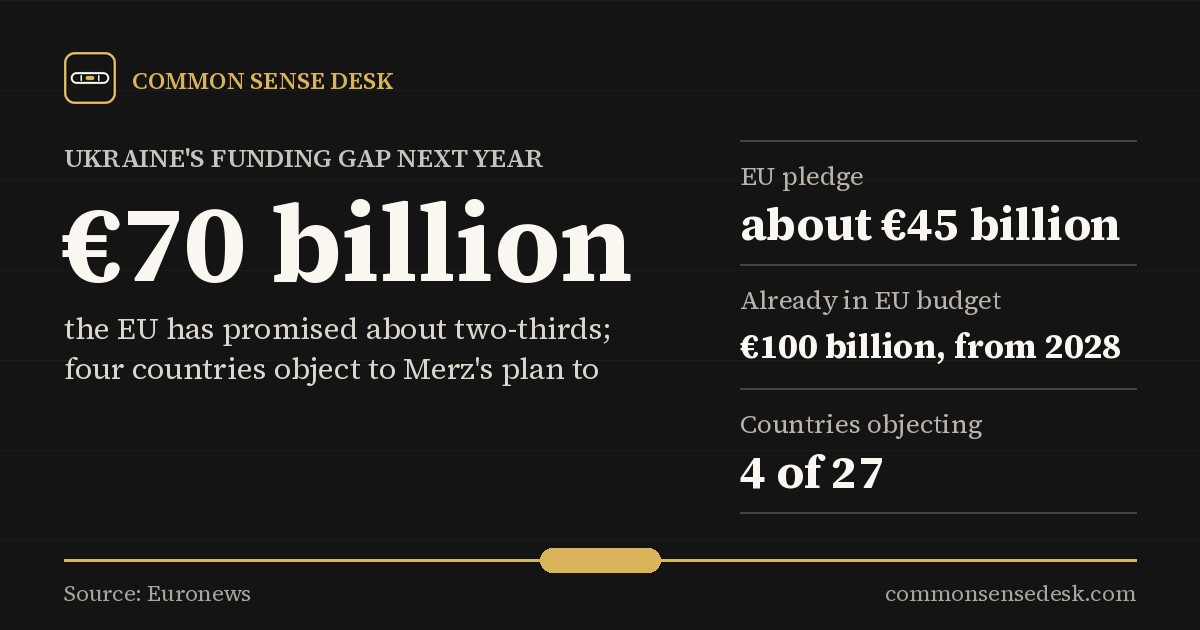
- Ukraine faces a funding gap of about €70 billion next year.
- The EU has promised to cover about two-thirds of that, roughly €45 billion, through a tool that hasn't been decided yet. New joint EU borrowing is the leading option.
- The proposed long-term EU budget already sets aside €100 billion for Ukraine, but that money isn't available until 2028.
- All of this comes on top of an existing €90 billion EU support loan. Slovakia, the Czech Republic and Hungary got exemptions from that one.
What the four countries say
- Slovakia: Prime Minister Robert Fico called it a "textbook case of blackmail" and threatened a veto. "We have the same veto power as the German federal chancellor," he said.
- Czech Republic: Prime Minister Andrej Babiš said Merz "probably doesn't realise" the proposed budget already earmarks €100 billion for Ukraine.
- Hungary: Prime Minister Péter Magyar said he doesn't see it as blackmail, but that taking on new EU-level debt is "obviously unacceptable for us for domestic political reasons," because of Hungary's own deficit. "We will find a solution for the EU budget. I am sure of it," he added.
- Bulgaria: Prime Minister Rumen Radev pointed to Bulgaria's high deficit and asked to be left out of future Ukraine credit lines. "Bulgaria is in no way blocking the decisions at the Council level," he said. He said Bulgaria will keep helping in other ways, such as energy.
Merz admitted that "at least four countries think differently," but said it's important to keep talking.
What happens next
Costa wrote back to Merz that he'll make time for "a broad discussion on Ukraine" at this week's informal summit of EU leaders in Dublin. The real decisions are set for a special summit in Brussels at the end of the month, after the European Commission puts forward its plan to fill Ukraine's funding gap, according to Euronews.
What it means for American taxpayers
The short version: right now, Europe is paying most of the new bills, and this fight is about how Europe splits them.
Under the Biden administration, Congress made about $195 billion available for Ukraine-related spending, according to an analysis by EU Perspectives. That changed under President Trump. Today, most American weapons reach Ukraine through a NATO program called PURL. European allies pay for American-made weapons, and NATO sends them on to Ukraine. By June 2026, allies had announced $6.3 billion in PURL packages, and $4.8 billion of that had already gone to the U.S. Treasury, according to the same analysis. NATO says everything allies have paid for is being delivered.
So when Europe argues over Ukraine money, it's partly arguing over orders for American factories. If the EU agrees on new funding, some of it is likely to buy U.S. weapons, paid for by European taxpayers, not American ones. If Europe deadlocks, pressure could grow on Washington to step back in. That's the scenario American taxpayers should watch.
President Trump has made his view clear. In September, he said Europe should repay "hundreds of billions of dollars" in U.S. aid that he said was given "free of charge."
The common-sense view
Merz has a point that it's unfair when a few countries carry the load for something every member says is about shared security. The four countries have a point too: they're dealing with their own deficits, and the EU budget already includes €100 billion for Ukraine. For Americans, the bigger story is the shift itself. Europe is now paying for more of its own neighborhood's defense, which is what Washington has asked for years.
Sources
- Euronews: EU budget battle erupts as four countries defy Merz over Ukraine aid euronews.com
- Euronews: Costa seeks to reassure Merz after EU budget ultimatum euronews.com
- RT: Four EU states defy Merz's Ukraine funding ultimatum rt-english.com
- EU Perspectives: Europe calm in face of Trump threats to halt arms sales for Ukraine euperspectives.eu
- Commonspace.eu: NATO says US weapons purchases for Ukraine under PURL are continuing commonspace.eu