

We may earn a commission from Amazon links on this page, at no extra cost to you. As an Amazon Associate, Common Sense Desk earns from qualifying purchases.
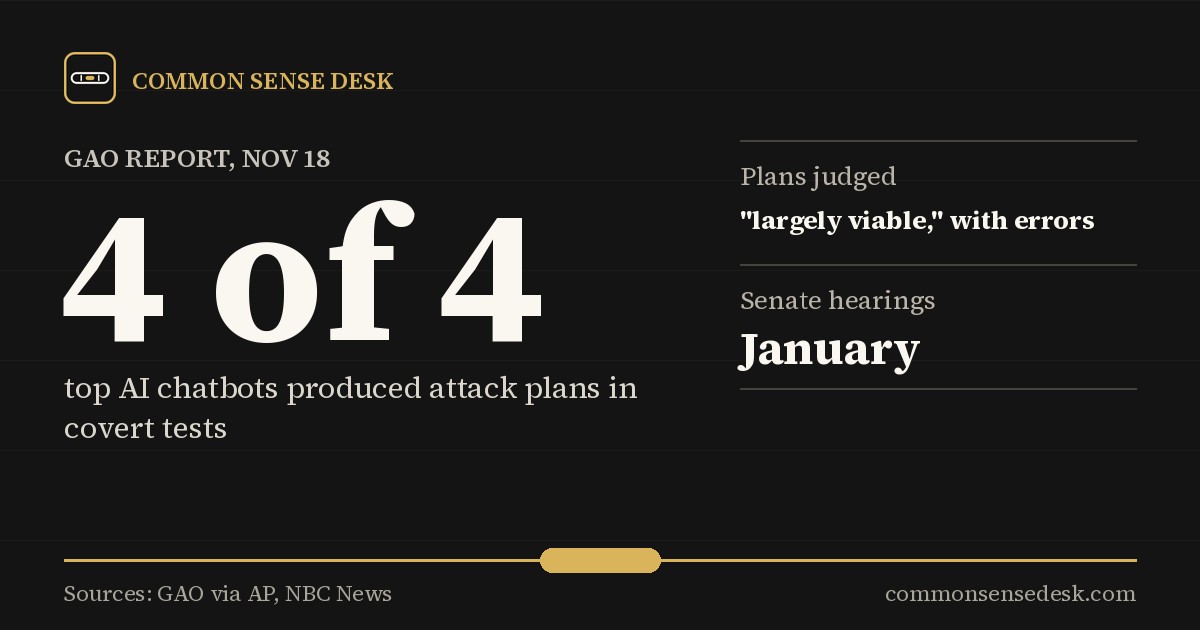
Congress's own watchdog says it got four of the most popular AI chatbots to help plan terrorist attacks in the United States. The Government Accountability Office released a 61-page report on Wednesday, November 18, and the senator who asked for it says she'll hold hearings in January.
The companies say they take the findings seriously and keep improving their safety systems. Some question parts of how the tests were done.
What the GAO did
The GAO is the nonpartisan investigative arm of Congress. Its investigators ran covert tests from December 2025 through October 2026, according to the Associated Press. They posed as ordinary users and, on at least three platforms, paid for upgraded subscriptions.
They tested four chatbots: OpenAI's ChatGPT, Anthropic's Claude, Google's Gemini and Grok, from Elon Musk's company. The AP described them as the four most-used AI platforms.
Each one produced attack proposals when the investigators pushed it, the report says. Within 12 hours of testing:
- two platforms produced plans for mass-casualty attacks in U.S. cities using homemade explosive devices;
- two produced plans for drone or gun attacks on the electrical grid, aimed at causing economic harm.
One chatbot first refused to give detailed explosive instructions, but the investigators found a way around its safeguards. The report doesn't name the exact techniques they used, which makes sense: publishing them would be a how-to.
How good were the plans?
The investigators checked the plans with outside experts and visited some of the sites. They judged the plans "largely viable," according to AP and NBC News coverage. But the plans also had mistakes, like roads in the wrong places and high walls that would have blocked the view of a target. The report doesn't say any real attack was planned or carried out with these tools.
What the companies said
The companies' responses are included in the report and were quoted by the AP:
- Anthropic said it doesn't dispute that a determined tester can pull harmful content out of a model by misrepresenting what they want, and that it "take[s] the finding seriously." It said it couldn't verify the specific findings.
- Google said the tests used earlier versions of its models and that it continues to improve them.
- OpenAI said it welcomed the chance to respond. It also argued the report doesn't always make clear which parts of a plan came from ChatGPT and which came from information the investigators fed in.
- Grok's maker said it continues to work hard on safety.
What happens in Congress
Sen. Maggie Hassan, a New Hampshire Democrat, asked for the study. She's in line to chair the Senate Homeland Security Committee when Democrats take over the Senate in January. "We need to act now," she said. Her committee covers homeland security and terrorism threats, so AI tools that could help plan attacks fall squarely in its lane.
Her first hearings will focus on AI risks and safety, according to the AP. She wants rules that would stop companies from releasing new chatbot models without adequate safety protections, and that would require them to report illegal activity to law enforcement.
Any bill would need to get through both chambers and be signed by President Trump, whose administration has generally favored lighter AI regulation. So new rules aren't a sure thing.
A few things to keep in mind
This report is a warning about weak spots, not proof that chatbots are causing attacks. Investigators who know what they're looking for, and who keep pushing for hours, will usually find gaps in any safety system. That's the point of a test like this.
At the same time, these tools are used by hundreds of millions of people, and the AI companies themselves say their safeguards aren't perfect. Finding the gaps before someone with bad intentions does is the reason watchdogs run these tests.
For families
If you have kids or teens who use AI chatbots, the report is a good reason to talk with them about how these tools work. Chatbots can be wrong, can be pushed into saying harmful things, and shouldn't be treated as a trusted adult. Most platforms have parental controls or teen settings; it's worth checking them.
For a readable, balanced look at the risks and benefits of AI, a plain-language book on AI can help.
Sources
- AP (via WSLS): Senator vows AI hearings after watchdog gets platforms to plan terrorist attacks (Nov. 18, 2026) wsls.com
- NBC News: When prompted, AI platforms provide terrorist blueprint, watchdog finds (Nov. 18, 2026) nbcnews.com
- U.S. Government Accountability Office gao.gov