

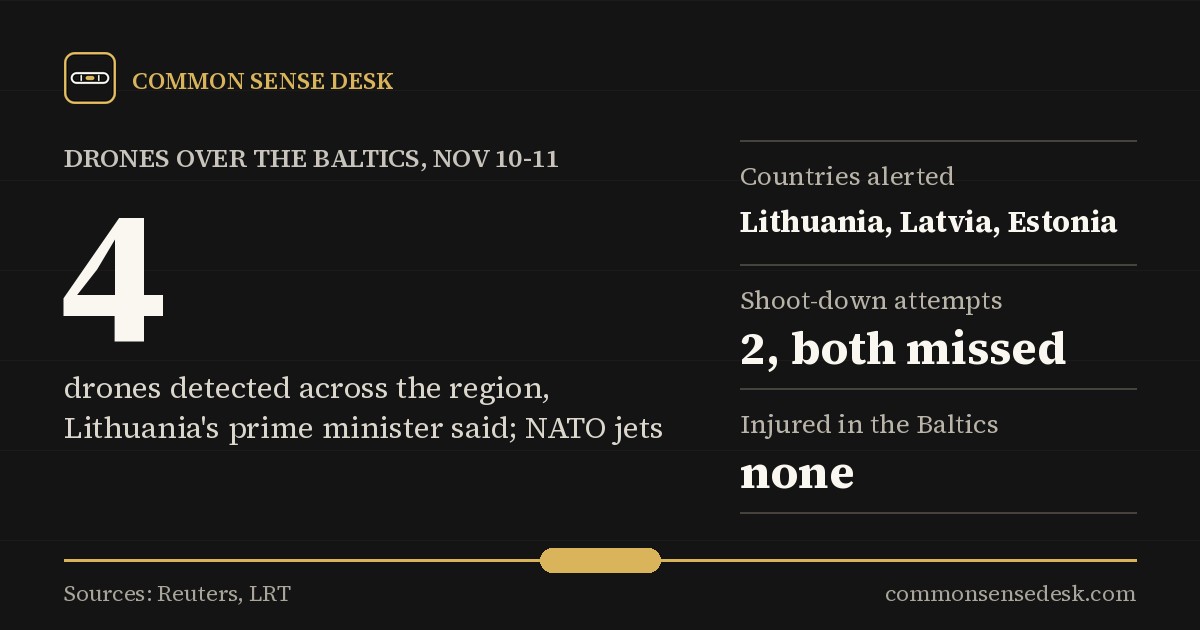
NATO fighter jets took off overnight after at least four drones strayed into the airspace of the Baltic states, according to Reuters. It happened during the night of November 10 to 11, while drones were attacking Russia's northwest. People in Lithuania, Latvia and Estonia got alerts on their phones telling them to take shelter. Nobody in the Baltic states was hurt.
Here's what happened, what's confirmed, and what each side says.
What happened, country by country
- Lithuania got the worst of it. A yellow alert went out around 11 p.m. local time for the Vilnius and Utena regions. A second alert later spread across much of central and northern Lithuania and was raised to red, meaning take shelter, according to the Lithuanian public broadcaster LRT. One warning covered Kaunas, the country's second-largest city. Prime Minister Mindaugas Sinkevičius said four drones were detected across the region and called it "a difficult night," according to Reuters.
- Latvia issued an airspace threat warning after 3 a.m. for the Cēsis, Smiltene and Gulbene areas, according to LRT. Latvia's military said its drone interceptors, air defenses and NATO air-policing jets were all activated.
- Estonia also sent out a shelter alert, which was later lifted, according to Reuters.
- Finland briefly closed parts of its airspace and sea lanes in the eastern Gulf of Finland as "a precautionary measure," then lifted the restrictions.
Three flights at Vilnius airport were affected, involving more than 400 passengers, according to LRT.
The NATO response
NATO jets were scrambled twice over Lithuania. Officials there said two attempts to shoot down a drone failed. One missile self-destructed, and its debris was later recovered in the Biržai district in the north. A second jet had a technical problem but landed safely. Officials said they chose not to fire over Kaunas to avoid putting residents at risk, according to LRT. The drone then crossed into Latvia.
As of Wednesday, we found no formal statement from NATO headquarters on the incident in the reports from Reuters and LRT. The responses came from the national governments.
Whose drones were they?
That isn't confirmed, and officials in Lithuania didn't fully agree.
- Lithuania's crisis management chief, Vilmantas Vitkauskas, said the drones were first detected in Belarus, according to LRT. Lithuania's defense minister, Robertas Kaunas, said Belarus had warned Lithuania about unidentified objects at 10:47 p.m.
- The defense minister said the drones were "most likely Ukrainian," and had drifted off course on their way to Russia's Ust-Luga port. But the chief of defense staff, Giedrius Premeneckas, said there was "no confirmed information" on their nationality.
- Lithuania's armed forces chief said the drones "were diverted by electronic warfare measures," according to Reuters.
The two warring sides blame each other. Moscow accuses Kyiv of using NATO airspace as cover for its attacks. Kyiv says Russian signal jamming sometimes knocks its drones off course. The NATO countries in the region hold Russia responsible for the war that's causing these incidents, according to Reuters.
The people hurt that night
The same night, drones set fire to the Ust-Luga port area in Russia's northwest and injured three people, and drone debris killed two people in Russia's Smolensk region, according to the local governor as cited by Russian news agencies. Reuters also reported that Russian strikes overnight cut power in Kryvyi Rih and injured one person in Kharkiv and six in Zaporizhzhia. Reuters said it couldn't immediately confirm the reports from either side. On both sides, it's ordinary people who pay.
What it means for Americans
The Baltic states are NATO members, and the U.S. is bound to help defend them. Each stray drone over NATO territory is a test of that system. Last night, it worked the way it's supposed to: alerts went out, jets went up, nobody was hurt. But two missed shots and an unknown number of drones show how hard small, cheap drones are to stop, and how easily a mistake could pull NATO closer to the war. That's a risk Americans have a stake in, even from far away.
What to watch next
- Lithuania's investigation: how many drones, whose, and whether any carried explosives.
- Any formal NATO statement or a request by the Baltic states for NATO consultations.
- Whether more drones stray across borders as strikes on Russia's northwest continue.
Sources
- Reuters via The Globe and Mail: Baltic nations issue drone alerts and NATO scrambles jets as Russia, Ukraine trade strikes theglobeandmail.com
- Reuters via Cyprus Mail: NATO jets scrambled as drone alerts sweep Baltic states cyprus-mail.com
- LRT (Lithuanian public broadcaster): Drone incursions trigger air alerts across Lithuania, NATO jets scrambled lrt.lt