

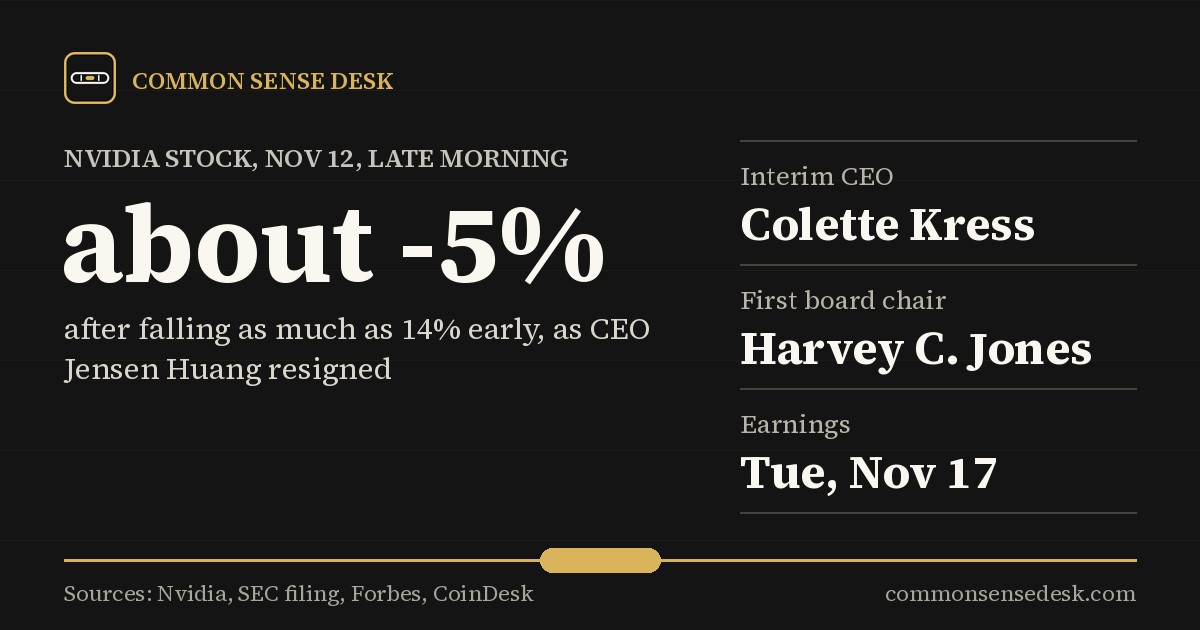
Jensen Huang, the man who built Nvidia into the most important chip company in the world, resigned on Thursday, November 12, effective immediately. Nvidia's board named its chief financial officer, Colette Kress, as interim CEO, according to the company's own announcement and its filing with the Securities and Exchange Commission.
Most Americans don't own Nvidia directly. But if you have a 401(k), an IRA or an index fund, there's a good chance you own a piece of it. So here's what happened, and what it means for your money.
What Nvidia announced
According to the company's statement:
- Huang resigned as president, chief executive and a member of the board, effective immediately. The SEC filing says the board accepted his resignation on November 11.
- Colette Kress, who joined Nvidia in 2013 and has been its finance chief, is interim CEO and keeps her CFO job until a permanent CEO is named. Before Nvidia, she spent nearly 25 years in finance roles at Cisco and Microsoft.
- Harvey C. Jones, a longtime tech executive and investor and a former CEO of the chip-design software company Synopsys, becomes the board's first-ever chair.
- The board will look at candidates from inside and outside the company.
"The Board has full confidence in Colette and the leadership team," Jones said. He said the board expects "operations, customer commitments and product roadmap to continue without interruption." Kress said: "Our focus remains on serving our customers, partners, developers and shareholders."
Nvidia gave no reason for the resignation. News reports, including from CBS News, NBC News and CNBC, have tied it to reports about Huang's personal relationships. Huang hasn't commented publicly, and a company spokesperson said he won't work with Nvidia in any capacity going forward. We'll leave the personal side there.
How the stock reacted
Investors didn't panic for long. Nvidia shares fell as much as 14 percent early Thursday, according to CoinDesk, and briefly dropped the company's market value below Microsoft's, according to Forbes. By late morning, the drop had narrowed to about 5 percent, leaving Nvidia worth about $4 trillion, Forbes reported. CNBC noted the stock was already down more than 20 percent over the past month before this news.
The wider market held up. The Dow, the S&P 500 and the Nasdaq turned higher during the day, according to Yahoo Finance, while some rival chipmakers, such as AMD and Broadcom, gained.
Why one company matters so much
Nvidia makes the chips that power most of the world's big data centers, and for the past few years it has been one of the most valuable companies on Earth. Huang led it for 33 years, from a small graphics-chip startup to where it is today.
Because index funds like S&P 500 funds hold companies according to their size, Nvidia is one of the biggest holdings in many of them. That means when Nvidia moves, a lot of ordinary retirement accounts move with it, even for people who've never bought a single share on purpose.
What it means for your wallet
For most people, the honest answer is: not much, if you stay calm.
- If you own an index fund, Nvidia is one company among hundreds. A 5 percent drop in one stock, even a big one, is a small dent in a diversified fund. The broader market turned higher during the day on Thursday.
- If you own a lot of Nvidia directly, this is a reminder of a basic rule: don't put too much of your savings in one company, no matter how strong it looks. Even the best-run companies can be shaken by one person's exit.
- Don't trade on headlines. Selling in a panic on a day like this usually locks in a loss. If you're investing for retirement years away, one bad day for one company shouldn't change your plan.
The common-sense takeaway: diversification is boring, but days like today are exactly why it works.
What to watch next
- Tuesday, November 17: Nvidia reports its quarterly results as previously scheduled, with results around 1:20 p.m. Pacific and a call at 2 p.m. Pacific. Investors will want to hear that the business, not just the leadership, is steady.
- Who the board picks as permanent CEO, and how long it takes.
- Whether customers and partners say anything about their plans with Nvidia.
This article is general information, not personal financial advice.
Sources
- Nvidia: NVIDIA Announces CEO Transition nvidianews.nvidia.com
- SEC: Nvidia Form 8-K, November 2026 sec.gov
- CNBC: Nvidia stock pares morning losses after CEO Jensen Huang announces resignation cnbc.com
- Forbes: Nvidia shares sink as rival chipmakers rise after Jensen Huang resigns forbes.com
- CoinDesk: Nvidia shares plunge as much as 14% as Jensen Huang resigns coindesk.com
- Yahoo Finance: Stock market today, Nov. 12 sg.finance.yahoo.com