

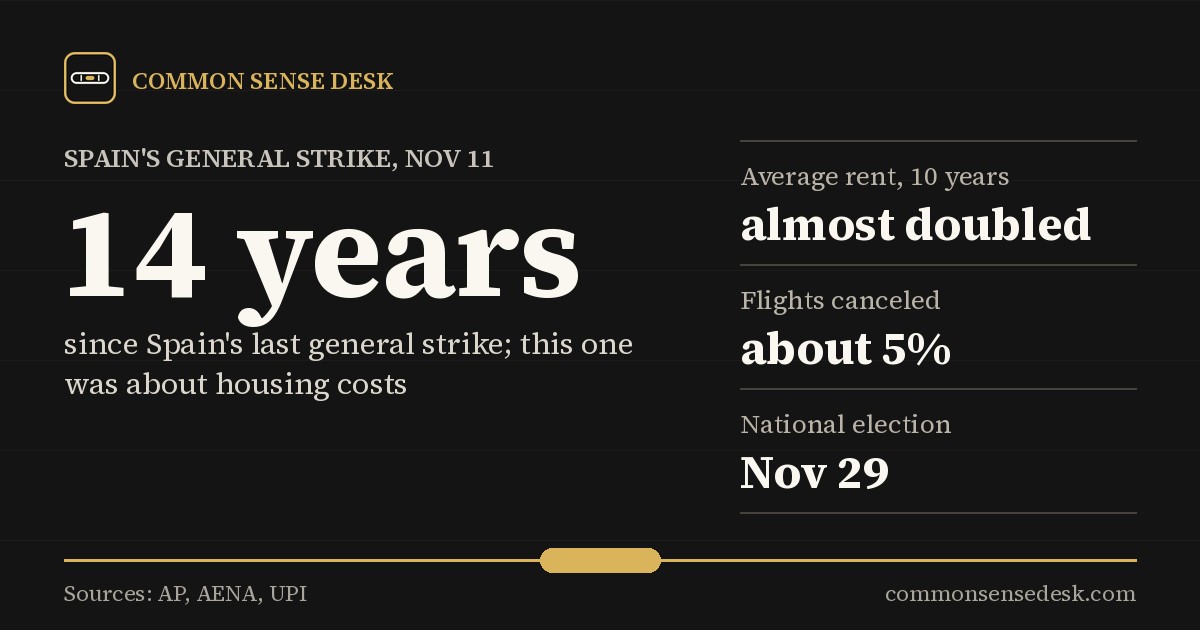
Spain shut down a good part of its economy on Wednesday, November 11. Millions of workers walked off the job in the country's first general strike in 14 years, and the main reason was the cost of a place to live. The slogan on the banners was simple: "Salaries. Housing. Prices."
It comes 18 days before Spaniards vote in a snap national election, so every side is reading it as politics too.
Who called it
The strike was called by Spain's two biggest unions, CCOO and UGT, together with tenants' groups. It was a 24-hour strike, and protests were planned in more than 50 cities and towns, according to the Associated Press.
The unions themselves said this one was unusual. Most general strikes target a specific new law. This one grew out of anger over housing, which boiled over after a televised eviction last month. An 87-year-old woman in Madrid, Maricarmen Abascal, was put out of her apartment, and her death after the eviction made her a national symbol for people who feel rent is eating their paychecks, according to AP and UPI.
"Housing is the fault line. Young people of Spain, this is your day," the CCOO leader said, according to UPI. UGT's leader, Pepe Álvarez, said housing costs are rising so fast that no salary can keep up, and that "this strike is directed at every level of government."
How big was it?
Big, but it depends who you ask.
- Union figures: CCOO and UGT said 90 percent of workers stopped in the auto industry and ports, 85 percent in meat processing, 82 percent in waste collection and 75 percent in energy. These are the unions' own numbers.
- Flights: about 5 percent of flights across Spain were canceled, according to the airport operator AENA.
- Cities: in Barcelona, most shops on a main shopping street were boarded up and the subway ran only at rush hour. In Madrid, strikers marched through the rain and blocked the Gran Vía, though big-brand stores stayed open, according to AP.
- Schools: many schools and universities closed or ran at minimum capacity.
- Not everyone joined: one survey cited by UPI found 36.3 percent of employees opposed the strike. In the region of Cantabria, the Popular Party and Vox said the strike had "fizzled."
It wasn't all peaceful. Strikers set tires on fire at roadblocks in Barcelona, and police used pepper spray near a wholesale market outside Madrid. At least 27 people were arrested in the first 12 hours, mostly for public-order offenses such as blocking highways, with the most arrests in the Basque Country and the Valencia region, according to UPI.
What they want
Unions want the government to step in more in the housing market and a new minimum-wage deal with employers. Housing activists go further: they want to get rid of pricey tourist apartments, crack down on real estate speculation, and change how leases are renewed to protect renters, according to AP. Union leaders also told a rally to "run the vulture funds out of town," meaning big investment funds that buy up homes.
The anger has a basis in numbers. Average rent in Spain has almost doubled in the past 10 years, according to AP.
What the government and opposition say
Prime Minister Pedro Sánchez leads a left-wing coalition. After the eviction protests, his government passed emergency measures to limit evictions and help tenants. Parliament's right-wing parties refused to ratify them, arguing the rules would push owners to pull their homes off the rental market. Sánchez then called an early election for November 29. His government will try again on Thursday to get a reduced interim parliament to approve the two housing decrees, according to AP.
In a video, Sánchez pointed to past policies and said, "It wasn't easy, but they changed Spain." He warned that the right would bring back austerity.
The conservative Popular Party and the right-wing Vox party oppose the government stepping into the housing market, except to encourage more building. They say the unions are trying to keep Sánchez in power. Polls have shown voters leaning right for months, according to AP.
What it means for your wallet
If you're traveling to Spain soon, check your flights and trains. Today's strike was a one-day action, but it's a reminder of how fast plans can change there before the election.
For everyone else, Spain is a useful example of a problem many countries share. Housing costs are what's squeezing working families, in Europe and here at home. The debate in Spain is the same one Americans have: one side wants rent rules and limits on investors and short-term rentals, the other says the real fix is to build more homes, because limits scare owners away from renting. The vote on November 29 will show which argument Spaniards buy.
Spain isn't alone in Europe. France has had its own wave of cost-of-living protests. We covered that here: France's protests: thousands arrested as anger over prices grows.
What to watch next
- Thursday's vote on the two housing decrees in the interim parliament.
- Final turnout figures, from the unions and from employers.
- The November 29 election, and whether housing decides it.
Sources
- AP via Springfield News-Sun: Spain's workers hold a general strike over housing costs ahead of a national election springfieldnewssun.com
- UPI: General strike over wages, housing and high prices underway in Spain upi.com
- OKDiario: Última hora de la huelga general del 11-N okdiario.com
- Kloshletter: Arranca la huelga general con la vivienda como principal reivindicación kloshletter.substack.com