

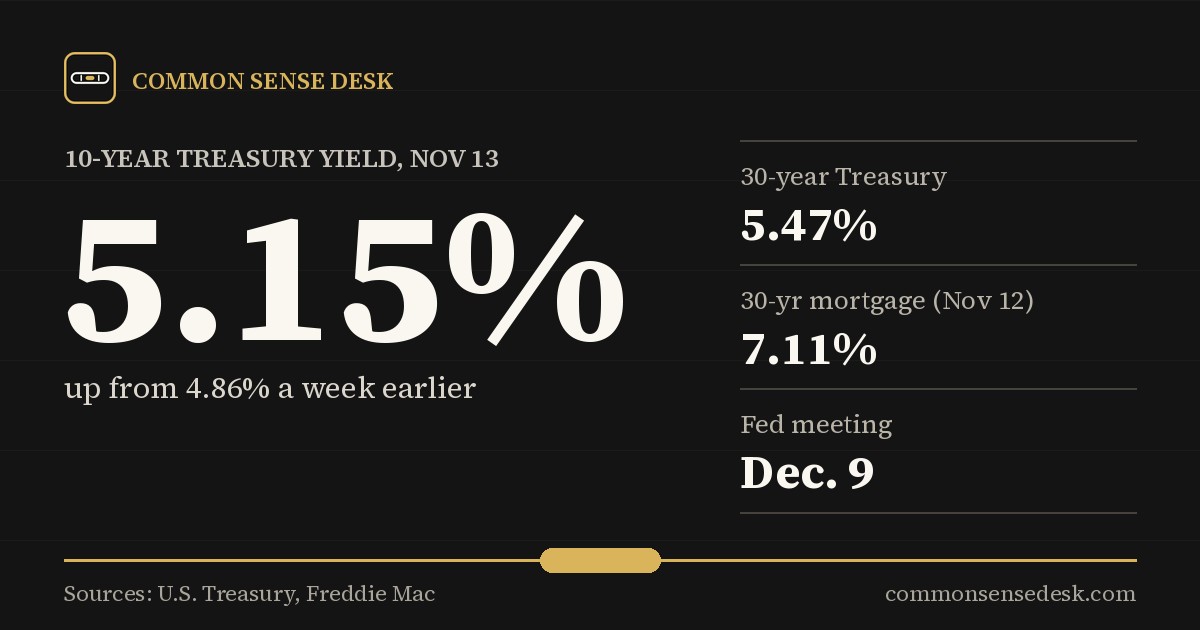
One number moved a lot last week, and it touches almost every loan in America. The interest rate on the 10-year U.S. Treasury note closed at 5.15% on Friday, November 13, according to the Treasury Department. A week earlier it was 4.86%. At the same time, gold slid to around its lowest level in a year.
Those sound like Wall Street numbers. They're not. Here's what they mean for your mortgage, your car loan and your savings.
What happened
The Treasury Department's daily figures show the 10-year yield climbing almost every day last week:
- November 6: 4.86%
- November 9: 4.88%
- November 10: 4.98%
- November 12: 5.10%
- November 13: 5.15%
(Bond markets were closed November 11 for Veterans Day.) That's a jump of nearly 0.3 percentage points in a week, which is a big move for this market. The 30-year Treasury closed at 5.47%.
Gold went the other way. It fell to around $3,880 to $3,890 an ounce, roughly its lowest in a year, according to market reports. Gold pays no interest, so when safe government bonds pay more than 5%, holding gold looks less attractive to investors.
Why rates are rising
In one word: inflation. October's inflation report came in hotter than expected, and investors now widely expect the Federal Reserve to raise interest rates again at its December 9 meeting. We covered that report in our October inflation story.
When people expect higher inflation and higher Fed rates, they demand more interest to lend money to the government for 10 years. That pushes yields up. A stronger dollar has added to the pressure on gold.
Why the 10-year matters to you
The Fed sets short-term rates. But many of the long-term loans families actually take, especially mortgages, follow the 10-year Treasury more closely than they follow the Fed. When the 10-year goes up, mortgage rates usually follow within days.
Your mortgage
Freddie Mac's weekly survey had the average 30-year fixed mortgage at 7.11% on November 12, down slightly from 7.18% the week before. That survey was taken before most of last week's jump in yields, so don't be surprised if this week's number moves higher.
Here's what the rate means in real money, on a $300,000, 30-year loan (principal and interest only):
- At 6.24% (a year ago): about $1,845 a month
- At 7.11% (now): about $2,018 a month
- At 7.5%: about $2,098 a month
That's more than $170 a month, over $2,000 a year, compared with a year ago, on the same house.
If you're buying, a common-sense move is to ask your lender about locking your rate once you have a contract, and to compare at least three lenders. Quotes on the same day can differ by a quarter point or more. If you already have a fixed-rate mortgage, none of this changes your payment.
Your car loan and credit cards
Car loans and credit cards follow short-term rates more than the 10-year, so the bigger driver there is what the Fed does in December. If the Fed hikes, expect credit card rates to tick up within a billing cycle or two.
For a rough sense of scale: on a $35,000, five-year car loan, going from 7% to 8% adds about $17 a month. It's not huge on its own, but it adds up with everything else. If you're shopping for a car, check your credit union's rate before you walk into the dealership.
Credit card debt is where higher rates hurt most. If you carry a balance, paying it down is still the best guaranteed return you'll get anywhere.
Your savings
Here's the good news. Higher rates mean savers finally get paid. When Treasury yields are around 5%, high-yield savings accounts, CDs and Treasury bills tend to pay more too. If your money is sitting in a regular bank savings account paying close to nothing, it's worth a look at what else your bank or a credit union offers. You can also buy Treasury bills directly from the government at TreasuryDirect.
What about gold?
Gold had a big run, and now it's falling. If you own some, a one-year low isn't a reason to panic. Gold tends to do best when people are worried and rates are falling, and worse when rates are high. It's a long-term hedge, not a quick trade. The same old rule applies: don't put more in any one thing than you can afford to see drop for a while.
What to watch next
- Freddie Mac's next mortgage rate survey this Thursday.
- The Fed's decision on December 9, and November's inflation numbers on December 10.
- Whether the 10-year holds above 5% or eases back.
We track gas, mortgage rates and grocery prices every week on our Wallet Watch page.
Sources
- U.S. Treasury: Daily Treasury Par Yield Curve Rates, November 2026 home.treasury.gov
- Freddie Mac: Primary Mortgage Market Survey (Nov. 12, 2026) freddiemac.com
- Market reports on gold prices, Nov. 12-13, 2026 (COMEX futures and spot) investorideas.com