

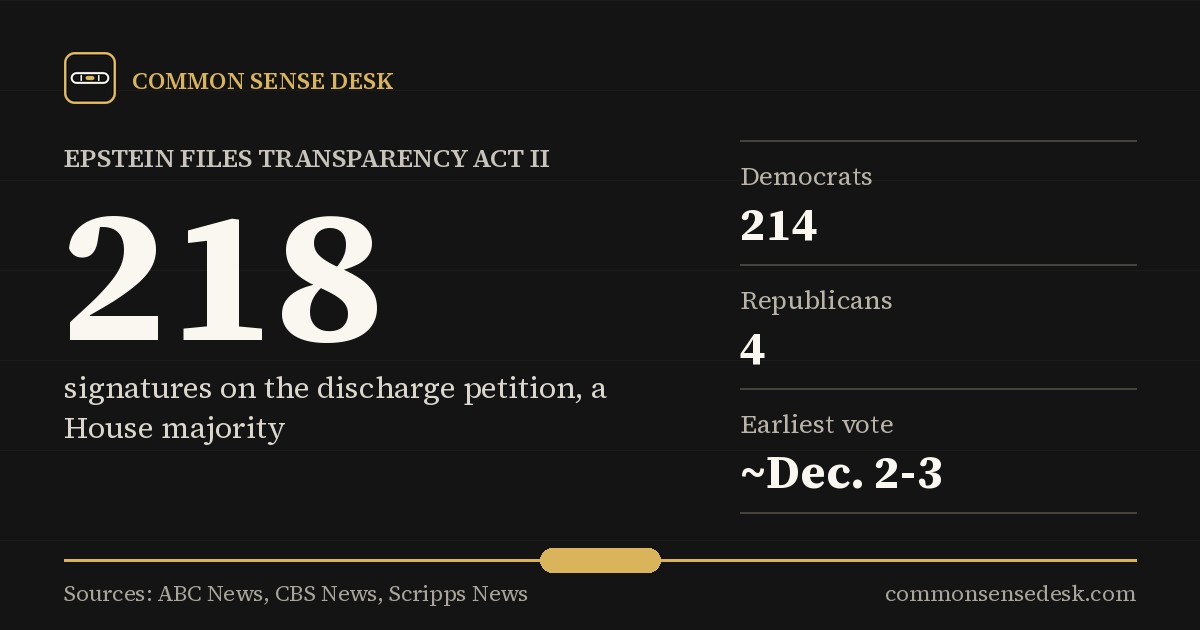
A second bill about the Jeffrey Epstein files has enough support to be forced to a vote in the House, over the objections of party leaders. On Wednesday, November 11, a discharge petition led by Republican Rep. Thomas Massie of Kentucky reached 218 signatures, a majority of the House, according to ABC News and CBS News.
Here's what the bill would do, how it got here, and what happens next, in plain words.
What the bill does
Lawmakers are calling it the Epstein Files Transparency Act II. Scripps News reports it's H.R. 9694. It builds on the law Congress passed about a year ago, the Epstein Files Transparency Act, which ordered the Justice Department to release its investigative records on Epstein.
The new bill adds teeth. It would let three groups sue the Justice Department if it unlawfully withholds or blacks out Epstein records:
- Members of Congress
- State attorneys general
- Epstein's survivors
In other words, it moves the fight over what's still secret from press conferences into court, where a judge could order records released.
Why supporters say it's needed
Massie says the department hasn't followed the first law. In a statement in July, he said the Justice Department "continues to unlawfully withhold over 3 million Epstein files," and that it keeps heavy redactions on the files it has released, according to CBS News. He has accused the department of "flagrantly and consistently" ignoring the law's disclosure rules.
That's Massie's account. We didn't find a Justice Department response to this new bill in the reports we reviewed. The department's position on how much it has released, and why some material is withheld, is something to watch as the bill moves.
Who signed
All 214 House Democrats signed the petition, along with four Republicans, according to ABC News: Massie, Nancy Mace and Ralph Norman of South Carolina, and Brian Fitzpatrick of Pennsylvania. ABC notes all four Republicans are lame ducks, meaning they won't be in the next Congress.
That's notable. Most Republicans, including House leadership, haven't backed this petition, so it's mainly a Democratic push with a handful of Republicans who have been willing to break with their party on the Epstein files.
What a discharge petition is
Normally, the Speaker and House leaders decide which bills get a vote. A discharge petition is the rarely used way around them. If a majority of the House, 218 members, signs, the bill can be pulled out of committee and brought to the floor.
It's slow on purpose. According to ABC News:
- The petition has to sit on the House calendar for at least seven legislative days.
- Then one of the signers can make a motion to bring it up.
- The Speaker has two legislative days to schedule it.
- If that motion passes, the House takes up the bill.
Because of the Thanksgiving recess, the earliest the House could act is after the break, possibly around December 2 or 3.
Massie used the same move last year to force a vote on the first Epstein files bill. That one passed Congress, and President Trump signed it, after weeks of pressure.
What happens next
Getting a House vote is one thing. Becoming law is another. Even if it passes the House, it would need to pass the Senate, where most bills need 60 votes to get past a filibuster, and then be signed by the president.
Timing matters too. A new Congress is sworn in in January. Anything that doesn't pass both chambers by then dies and has to start over. Survivors and their advocates have said they're also looking to the new Congress for accountability, Scripps News reported.
Why it matters
Strip away the politics and this is about two things most people agree on: crimes against children and young women should be fully investigated, and a law Congress passes should be followed. Where people disagree is on how much has really been held back, whether some records must stay sealed to protect victims or ongoing cases, and whether lawsuits are the right tool.
Those are fair questions, and the House floor is the place to argue them in public.
What it means for you
This doesn't touch your wallet directly. But it touches something just as important: whether the government follows the laws that Congress passes and whether victims can get answers. If this matters to you, the most effective thing you can do is the simplest one. Call your representative's office and ask how they plan to vote. Petitions like this one exist precisely because enough members heard from home.
What to watch next
- Whether the House votes in early December, and how many Republicans join.
- Any response from the Justice Department or House leaders.
- Whether the Senate takes it up before the new Congress starts in January.
Sources
- ABC News: Discharge petition on 2nd Epstein files bill secures 218 signatures abcnews.com
- CBS News: House petition for new Epstein files bill gets enough support to force vote cbsnews.com
- Scripps News: Epstein survivors look to new Congress for accountability scrippsnews.com