

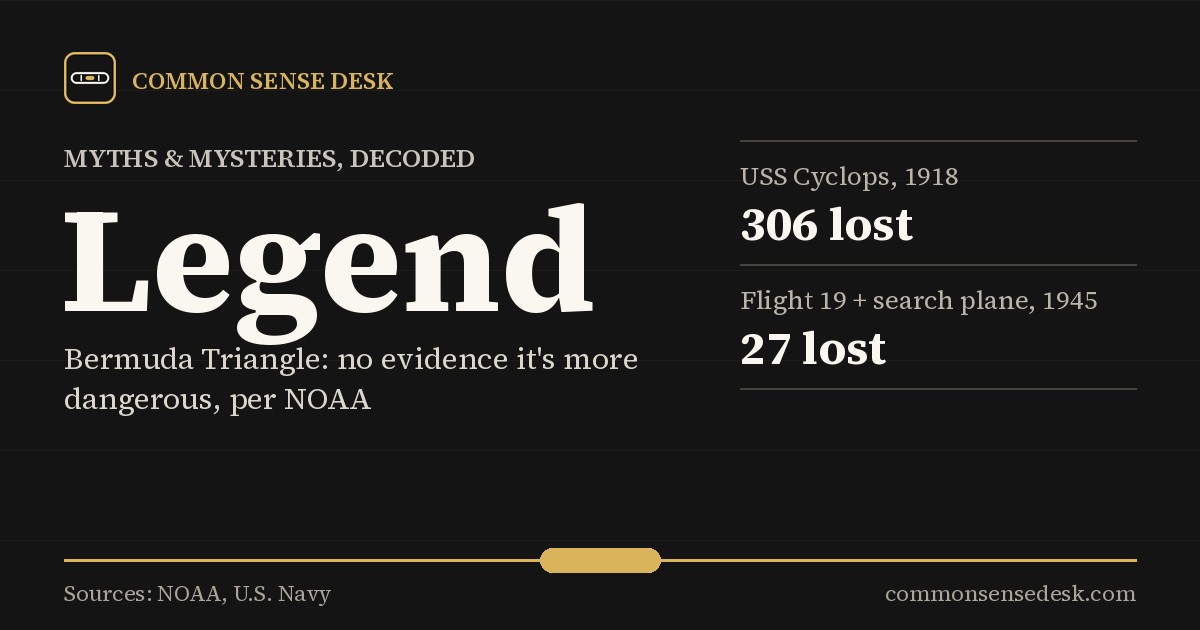
The short answer: Ships and planes really have been lost in this part of the Atlantic, some of them in ways that were never fully explained. But there's no evidence that they vanish there more often than in any other busy stretch of ocean, according to NOAA. The U.S. Navy and Coast Guard say there's nothing supernatural going on.
Draw a line from Miami to Bermuda, then down to San Juan, Puerto Rico, and back to Miami. Inside that rough triangle, the story goes, ships sail off and are never seen again. Planes radio in, sound confused, and disappear without a trace. Compasses spin. The sea swallows everything.
It's one of the most famous mysteries in the world. First the story the way people tell it, then what the records show.
The story
Two cases do most of the work in the legend.
USS Cyclops, 1918. The Navy coal ship Cyclops, more than 500 feet long, stopped at Barbados in early March 1918 on its way to Baltimore, carrying a heavy load of manganese ore. It never arrived. No wreckage, no distress call, no lifeboats. All 306 people on board were lost. The Navy launched one of the biggest searches in its history and found nothing. More than a century later, it's still the largest loss of life in U.S. Navy history not directly involving combat, and the Navy has called it one of the most baffling mysteries in its records.
Flight 19, 1945. On the afternoon of December 5, 1945, five Navy TBM Avenger torpedo bombers took off from Naval Air Station Fort Lauderdale for a routine navigation training flight, led by Lt. Charles Taylor. Radio messages that afternoon suggest Taylor believed his compasses had failed and that he wasn't sure where they were. The flight never came back. That evening, a PBM Mariner flying boat took off from Naval Air Station Banana River to search for them. It disappeared too, with all 13 men on board. In a few hours, six aircraft and 27 men were gone.
Add a few dozen more ships and small planes lost over the decades, and you have the makings of a legend.
How the legend was built
The name came later. Writer Vincent Gaddis's article "The Deadly Bermuda Triangle," published in Argosy magazine in February 1964, is generally credited with popularizing the term. A decade later, Charles Berlitz's 1974 book The Bermuda Triangle became a bestseller and turned the idea into a pop-culture fixture, with theories ranging from lost Atlantis to alien abductions.
Then a librarian went to the sources. Larry Kusche, a reference librarian at Arizona State University, tracked down old newspapers, weather records and official reports for the famous cases. His 1975 book, The Bermuda Triangle Mystery: Solved, found that many of the stories had been exaggerated or got basic facts wrong. Some ships said to have vanished in calm weather had been lost in storms. Some sank far from the triangle.
That's a common pattern with mysteries. The retelling gets more dramatic each time, and the dull details fall away.
What the records show
NOAA, the federal agency that studies the oceans, put it plainly: "There is no evidence that mysterious disappearances occur with any greater frequency in the Bermuda Triangle than in any other large, well-traveled area of the ocean."
A few more facts from NOAA:
- The U.S. Navy and Coast Guard "contend that there are no supernatural explanations for disasters at sea."
- No official maps draw its borders, and the U.S. Board on Geographic Names doesn't recognize "Bermuda Triangle" as an official name.
- "Environmental considerations could explain many, if not most, of the disappearances."
Those environmental factors are real and well understood:
- Busy traffic. This is one of the most heavily traveled patches of ocean in the world, with ships heading to and from U.S. ports, the Caribbean and the Panama Canal. More traffic means more accidents, simply by the numbers.
- Storms. Most Atlantic tropical storms and hurricanes pass through the area, NOAA says, and "in the days prior to improved weather forecasting, these dangerous storms claimed many ships."
- The Gulf Stream. This strong, fast current "can cause rapid, sometimes violent, changes in weather," according to NOAA, and it can carry debris far away quickly. That helps explain why some wrecks were never found.
- Shallow water. The many islands create shoals and reefs that are dangerous to ships.
- Compasses. In parts of this area a magnetic compass can point toward true north instead of magnetic north, NOAA notes. Navigators who don't correct for it can drift off course. That's a known, charted effect, not a magic one.
So what happened to Cyclops and Flight 19?
Honestly, nobody knows for certain, and that's the part of the mystery that's real. But there are ordinary likely explanations.
For Cyclops, the Navy's historians have said the ship "probably sank in an unexpected storm." It was carrying a heavy load of ore, and the Atlantic in March can be brutal. Ships of that era had no satellite tracking, and a fast sinking would leave little behind.
For Flight 19, Navy investigators could not determine the exact cause. The likely sequence, based on the radio messages, is that the flight leader became disoriented, the planes flew the wrong way over open ocean as weather worsened, and they ran out of fuel and went down in rough seas at night. The search plane most likely caught fire in flight, according to the Navy's history command.
Why the legend lasts
A good mystery needs a few things: real losses, missing wreckage, and a simple shape you can point to on a map. The Bermuda Triangle has all three. It's also an easy story to repeat, and every new disappearance anywhere nearby gets added to the list, while the thousands of safe crossings every day don't make the news.
None of that makes the people who were lost any less real. The 306 on Cyclops and the 27 men of Flight 19 and the search plane had families who never got answers. The honest version of the story respects that: the sea is dangerous, and before modern forecasting and tracking, it hid its secrets well.
The verdict
Legend. Real ships and planes were lost, and a few cases remain unsolved. But the idea that this patch of ocean is uniquely, mysteriously dangerous isn't supported by the evidence. Storms, currents, heavy traffic and human error explain the pattern far better than anything supernatural.
Sources
- NOAA Ocean Service: What is the Bermuda Triangle? oceanservice.noaa.gov
- Naval History and Heritage Command: H-Gram 057-4, The disappearance of Flight 19 and Training 49 history.navy.mil
- Navy Times: 100 years later, the question remains what happened to the USS Cyclops (2018) navytimes.com
- Encyclopedia.com: The Bermuda Triangle (Gaddis, Berlitz, Kusche) encyclopedia.com