

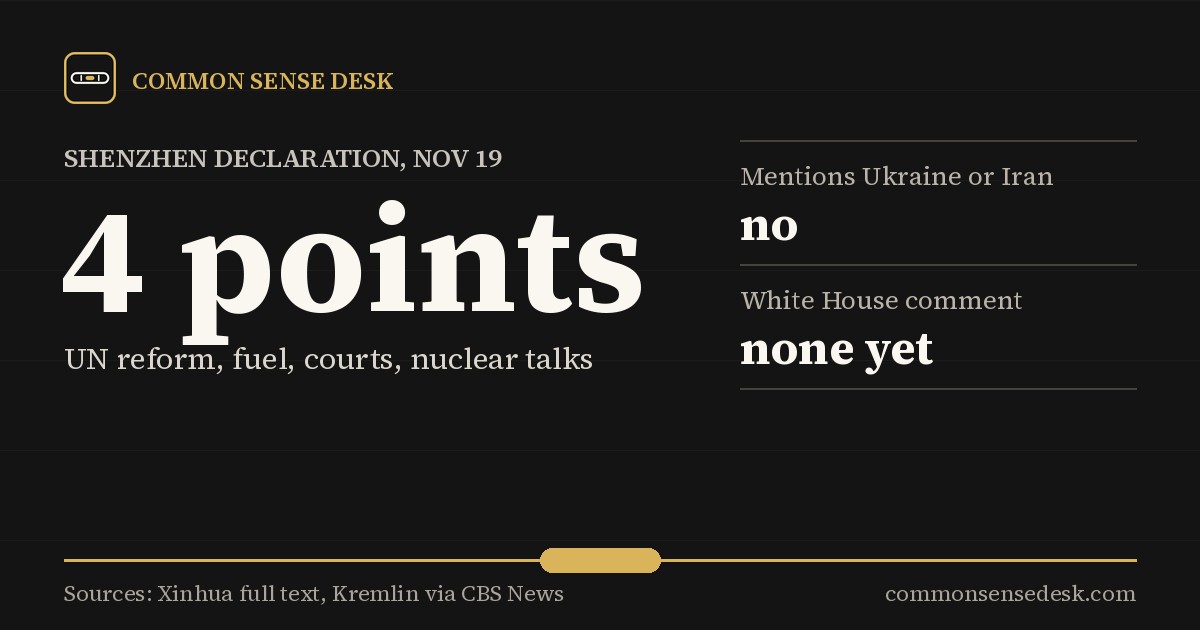
After their meeting in Shenzhen on Thursday, November 19, the leaders of China, Russia and the United States put out a short joint document called the "China-Russia-U.S. Heads of State Declaration toward Peace." China's state news agency Xinhua published the full text, and the Kremlin released the same document. It lists President Xi Jinping, President Vladimir Putin and President Donald J. Trump as the three leaders behind it.
The White House had not commented on the declaration or released its own version as of noon ET Thursday.
It's the first joint statement from the three countries' leaders. It's also short, about four points, and much of it is general language. We covered the meeting itself in our story on what the three leaders said in Shenzhen.
What the declaration says, point by point
The opening says the three leaders had an in-depth exchange of views on the international situation and committed to "maintaining strategic stability and international security," according to the Xinhua text. Then come four points.
1. The United Nations. As three of the five permanent members of the UN Security Council, the countries say they are "committed to reform the UN so that the UN can respond more effectively to global challenges." The text doesn't say what kind of reform. Proposals to change the Security Council have been debated for decades, and the permanent members have generally guarded their veto power.
2. Oil and fuel. The three say they will "increase the production and supply of refined petroleum products for the benefit of all nations" and stress stable energy flows. Refined products means things like gasoline, diesel and jet fuel. All three are major energy producers. This point comes while fighting involving Iran has threatened shipping through the Strait of Hormuz and pushed up fuel and freight costs around the world.
3. International courts. The leaders back "the principle of state consent" and immunity for state officials, and say the International Criminal Court and similar bodies "must not abuse their jurisdiction." None of the three countries is a member of the ICC. The court issued an arrest warrant for Putin in 2023, which Russia rejects and calls legally void. The United States under Trump has also sanctioned ICC officials. China has long said international courts need a country's consent to hear a case against it. On this point the three governments already agreed with each other before Shenzhen.
4. Nuclear weapons. The three reaffirm that "a nuclear war cannot be won and must never be fought" and say they will hold a dialogue on reducing nuclear risks and preventing the spread of nuclear weapons. That first sentence goes back to the Reagan-Gorbachev summit in 1985, and the five nuclear powers repeated it in a joint statement in January 2022. The new part is a promise of three-way talks. The last treaty limiting U.S. and Russian nuclear arsenals, New START, expired in February 2026, and China has never been part of any such limits.
What it doesn't say
The document is called a declaration toward peace, but it doesn't mention any specific war.
- There's nothing on Ukraine. Before the meeting, the White House said Ukraine would not be on the agenda because no Ukrainian representative was present. The Kremlin said Ukraine was the main topic of Trump's separate one-on-one meeting with Putin earlier in the day. Neither side announced any result from that meeting. At the three-way meeting, Trump said he hoped both Moscow and Kyiv want the war to end, according to Turkey's Anadolu news agency.
- There's nothing on Iran or the Strait of Hormuz, even though Trump raised Iran in his public remarks and said, "We're not going to let Iran have a nuclear weapon," Anadolu reported.
- There are no numbers. No limits on warheads, no dates for the nuclear talks, no figures for extra fuel output, and no timeline for UN reform.
- There's nothing on trade or tariffs. The U.S.-China tariff truce still runs out on January 10.
In plain terms, the declaration is a statement of shared positions plus one new promise to talk. It doesn't legally bind anyone to anything.
How each side describes it
Chinese state media presented the text as a major result of what Xi called a "groundbreaking" meeting. The Kremlin said the atmosphere was good and that the three leaders jointly agreed to the document, according to CBS News. On the U.S. side, Trump said before the talks that the three countries are uniquely placed to discuss cutting nuclear weapons. He left Shenzhen on Air Force One shortly after the meeting, and reporters traveling with him had not reported any comment from him on the declaration.
Why it matters
For years, the United States has wanted China at the table for nuclear arms talks, and China has said its arsenal is too small to be limited alongside the two biggest powers. A written promise from all three leaders to talk about nuclear risks is a step that hadn't happened before, even if the details are missing.
The energy point could matter sooner. If all three really do push more gasoline, diesel and jet fuel onto world markets, that would ease pressure on prices. But the text gives no amounts and no start date, so it's too early to count on it at the pump.
The court point is the one most likely to draw criticism. Human rights groups have argued for years that courts like the ICC are needed precisely when governments won't hold their own officials to account. The three leaders' statement points the other way.
What to watch
The key questions now are whether the White House releases the same text, when and where the nuclear dialogue would start, and whether any fuel numbers follow. Before the meeting, Kremlin spokesman Dmitry Peskov said the leaders might discuss a possible Putin trip to the G20 summit in Miami in December. Nothing has been announced on that.
Sources
- Xinhua: Full text, China-Russia-U.S. Heads of State Declaration toward Peace (Nov. 19, 2026) english.news.cn
- The National: Full text of China, Russia and US peace declaration (Nov. 19, 2026) thenationalnews.com
- CBS News: Trump, Xi and Putin sit down for a rare three-way meeting in China (Nov. 19, 2026) cbsnews.com
- Anadolu Agency: Trump, Xi, Putin discuss nuclear risks, UN reform, energy (Nov. 19, 2026) aa.com.tr