

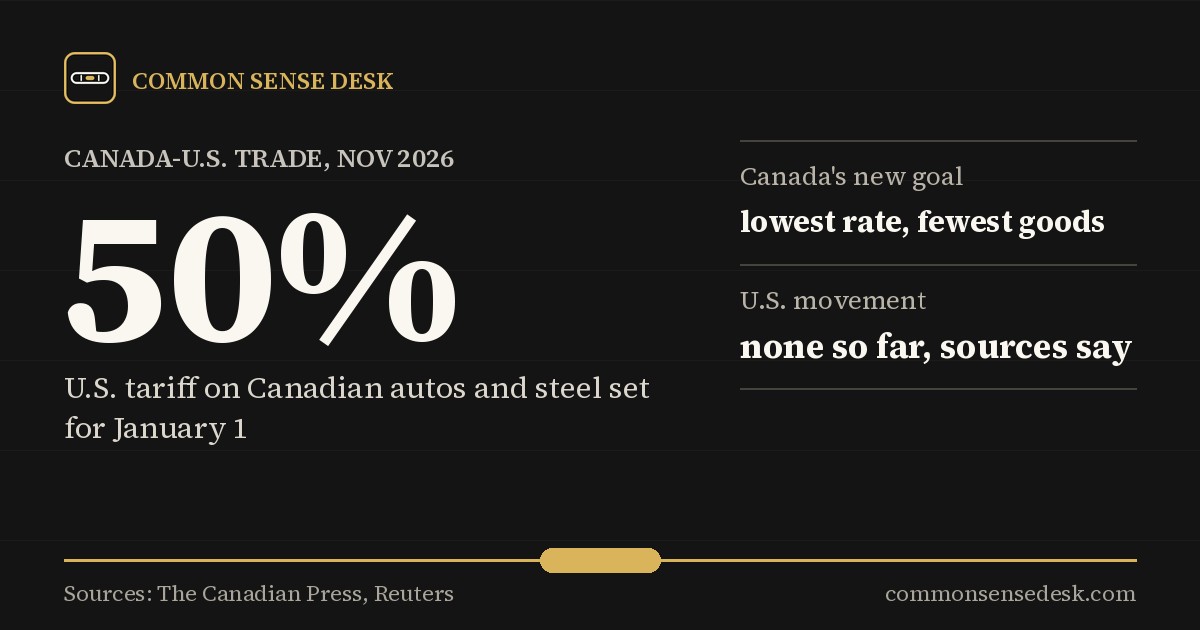
For most of the past year, Canada's goal in trade talks with Washington was simple to state: get rid of U.S. tariffs on Canadian goods. That goal has quietly changed. Canada's chief trade negotiator, Janice Charette, told MPs this week that the aim now is to "get to the lowest rate of tariff on the narrowest basket of goods," The Canadian Press reported.
In plain terms, Ottawa is preparing for a deal that leaves some U.S. tariffs in place, because a tariff-free arrangement may no longer be possible.
What was said this week
Charette spoke to the House of Commons international trade committee on Tuesday, November 18. According to The Canadian Press, she told MPs Canada has to prepare for a world where trade with the U.S. without tariffs may not come back, and that negotiators are now working to keep the rates as low as possible on as few products as possible.
Prime Minister Mark Carney, after meeting President Trump at the APEC summit in Shenzhen, China, on Wednesday, said a "very good trade arrangement" with the U.S. is still possible, CP reported. He also said Canada won't simply sit and wait for one.
Dominic LeBlanc, the minister responsible for Canada-U.S. trade, briefed the government's advisory committee on Canada-U.S. economic relations on Wednesday. Two people familiar with that briefing told Reuters that LeBlanc said "so far the US has made no movement" on tariff relief. One added: "if the US makes movement, then we can move quickly." LeBlanc's office confirmed the briefing and said Canada remains committed to reaching "a mutually beneficial agreement," according to Reuters. The U.S. Commerce Department and the U.S. Trade Representative's office didn't respond to Reuters.
The January deadline
The pressure is the calendar. After talks broke down in August, President Trump announced that U.S. tariffs on Canadian cars, trucks, auto parts and steel would rise to 50% on January 1, 2027, with exemptions for vehicles built in the United States. Reuters reported this week that tariffs on Canadian steel, autos and lumber are set to rise to 50% from 25% in January, and that industry groups have warned the increase "could dismantle decades-old supply chains."
The U.S. also put 50% tariffs on a wide range of other Canadian goods in August under Section 338 of a 1930 trade law. And in July, Washington declined to simply renew the U.S.-Mexico-Canada trade agreement (CUSMA), which set off a yearly review process that could last up to a decade, according to CP.
What the critics have said
The Conservative opposition has argued for months that Ottawa is losing ground. In an August 9 letter, Conservative Leader Pierre Poilievre urged Carney to get a tariff-free deal for Canadian goods, CTV News and BNN Bloomberg reported. After talks collapsed later that month, Poilievre called on Carney to recall Parliament and release the text of the deal Canada had rejected, saying "Canadians must see it to judge what options are on the table," and asked how the government would protect steel, aluminum, lumber and auto jobs.
Unions took a different view of the August breakdown. Unifor president Lana Payne praised negotiators for walking away, saying Canada couldn't trade good jobs for a bad deal that would lock in what she called "unjust, industry-killing tariffs," according to a Unifor statement.
Some critics have also questioned the government's deals with China. Last week Carney agreed to extend tariff relief on 32 more Chinese steel and aluminum products in exchange for China dropping its tariffs on Canadian pork and seafood, which we covered in our story on the Carney-Xi meeting. Critics say Canada should be careful about getting closer to Beijing while it's trying to repair trade with its largest customer.
No new statement from the Conservatives or major industry groups on this week's shift had been published as of Friday.
Why "lowest rate" matters
About three-quarters of Canada's exports go to the United States. A deal that cuts tariffs to, say, 10% or 15% on some products would still cost Canadian companies more than the near-zero tariffs they had for three decades under NAFTA and then CUSMA. But it would be far better than 50%.
Other countries that have reached deals with the Trump administration, including Britain, Japan and the European Union, kept some U.S. tariffs in place. Canada's shift brings its goal closer to what those countries accepted.
What it means for your wallet
If tariffs on Canadian cars, parts and steel jump to 50% in January, prices could rise on both sides of the border, because many vehicles cross the border several times as parts before they're finished. For Canadian workers in autos, steel and lumber, the risk is layoffs if U.S. buyers switch suppliers.
A deal at a lower rate wouldn't make those costs disappear, but it would make them much smaller and more predictable.
What to watch
Whether any arrangement is reached before January 1, whether Washington delays the 50% increase, and whether the formal CUSMA review starts. Canada's chief negotiator has been clear about expectations: the question now is how low the tariffs go, not whether they disappear.
Sources
- The Canadian Press (via BNN Bloomberg): LeBlanc gives update on U.S. trade talks to Canada-U.S. advisory committee (Nov. 19, 2026) bnnbloomberg.ca
- Reuters (via Yahoo Finance): Canada sees little US movement on tariff relief, sources say (Nov. 19, 2026) ca.finance.yahoo.com
- The Canadian Press (via BNN Bloomberg): Conservative leader urges prime minister to get tariff-free deal (Aug. 9, 2026) bnnbloomberg.ca
- The Canadian Press (via BNN Bloomberg): Conservatives call on prime minister to reconvene Parliament (Aug. 24, 2026) bnnbloomberg.ca
- Unifor: Unifor commends holding the line for a fair trade deal (Aug. 2026) unifor.org