

Prime Minister Mark Carney met Chinese President Xi Jinping in Shenzhen on Tuesday, November 17, and came away with China dropping tariffs on more Canadian food exports. In return, Canada is easing duties on dozens more Chinese steel and aluminum products. Carney says the two countries can "work together more broadly, pragmatically to solve problems." Critics say Canada is getting too close to Beijing.
Here's what was agreed, what wasn't, and what it means for farmers, fishers and consumers.
What China agreed to
According to The Canadian Press:
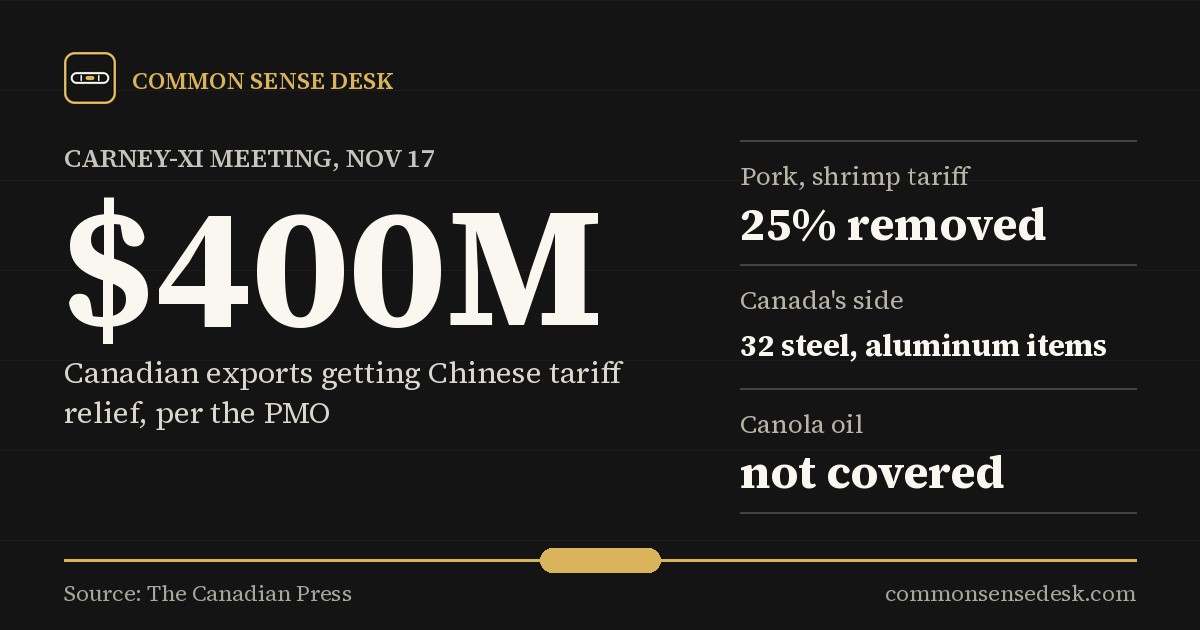
- Pork and shrimp: China will remove its 25% tariff on Canadian frozen pork cuts and frozen cold-water shrimp. Greenland halibut, some mollusks and sea cucumber were added too. Carney's office put the value at about $400 million in Canadian exports a year.
- Pulses: China will open its market to Canadian fava beans, chickpeas and lentils.
- More to come: both sides will work toward deals on pet food and wild seafood products by year-end.
- The January deal extended: the earlier arrangement, which opened China to Canadian canola meal and crab, now runs to late 2028.
What Canada gave
Canada will expand tariff relief, called remissions, to 32 more Chinese steel and aluminum products: 23 steel items and 9 aluminum items. The two countries also declared 2027 a "year of e-commerce," Canada will send a major trade mission to China next year, and they're renewing funding for environmental projects and university exchanges.
This builds on the January deal, when Canada cut its 100% tariff on Chinese electric vehicles to 6.1% for up to 49,000 vehicles a year in exchange for relief on canola. Just this week, Carney also said Canada could turn to Chinese automakers if U.S. trade talks fail, as we covered in our story on Carney and Chinese automakers.
What's still missing
Canola oil isn't covered, and canola seed still faces a Chinese import duty. Kody Blois, a parliamentary secretary traveling with Carney, called canola oil "a much smaller priority." The Canadian Meat Advocacy Office welcomed the pork access but noted that offal, the organ meats China buys a lot of, is still blocked.
"There are areas where we will disagree," Blois said.
Where Carney met Xi
The meeting took place at a guest house in Shenzhen, the southern Chinese tech hub hosting this week's Asia-Pacific Economic Cooperation summit. "In our lifetimes, this has grown from a rustic fishing village to an innovation-forward megacity," Carney said in his opening remarks. "Much has been achieved since my visit," he told Xi, referring to his earlier trip and the January deal.
Foreign interference
Before leaving Canada, Carney said he would raise foreign interference with Xi. Canada has accused Beijing of meddling in its politics in recent years. A Chinese government spokesperson denied any such activity, The Canadian Press reported. Neither side released details of what was said on that point.
What Xi said
Xi spoke in Mandarin and wasn't quoted directly in the reports we reviewed. He praised progress in the relationship and said both countries benefit from focusing on shared goals and setting aside differences. Human rights activists have criticized that framing as a way of avoiding tough subjects.
The case for and against
For Canadian farmers and fishers, this is real money. China is a huge market, and tariffs there have hurt pork producers, seafood harvesters and pulse growers for years. "We're confident with the momentum that we've had here," said Kyle Larkin of the Canadian Meat Council. And with the U.S. less predictable, having more customers is common sense.
The worries are serious too. Cheaper Chinese steel and aluminum can undercut Canadian producers and workers. Closer ties with Beijing could complicate Canada's trade talks with Washington, which still buys most of what Canada sells. And trading with a government accused of interfering in Canadian politics raises questions that tariff cuts don't answer. A good deal on pork doesn't settle those.
What it means for your wallet
For Canadian consumers, the effects are small and gradual. More export sales for pork, shrimp and pulses support farm and fishing incomes, especially in the Prairies, Quebec and Atlantic Canada. Cheaper Chinese steel and aluminum could slightly lower costs for some manufacturers and builders, but could also squeeze Canadian mills. For Americans, the main question is whether closer Canada-China ties become a sticking point in U.S.-Canada trade talks.
What to watch next
- Whether canola oil and seed get relief in later talks.
- Any reaction from Washington, and from Canadian steel producers.
- Trump's meeting with Xi in Shenzhen this week.
We may earn a commission from Amazon links on this page, at no extra cost to you. As an Amazon Associate, Common Sense Desk earns from qualifying purchases.
Sources
- The Canadian Press (via CFJC Today): Xi opens more pork access as Carney loosens steel restrictions during China visit cfjctoday.com
- The Globe and Mail: China rolls back tariffs on Canadian pork, seafood in new trade deal with Ottawa theglobeandmail.com