

We may earn a commission from Amazon links on this page, at no extra cost to you. As an Amazon Associate, Common Sense Desk earns from qualifying purchases.
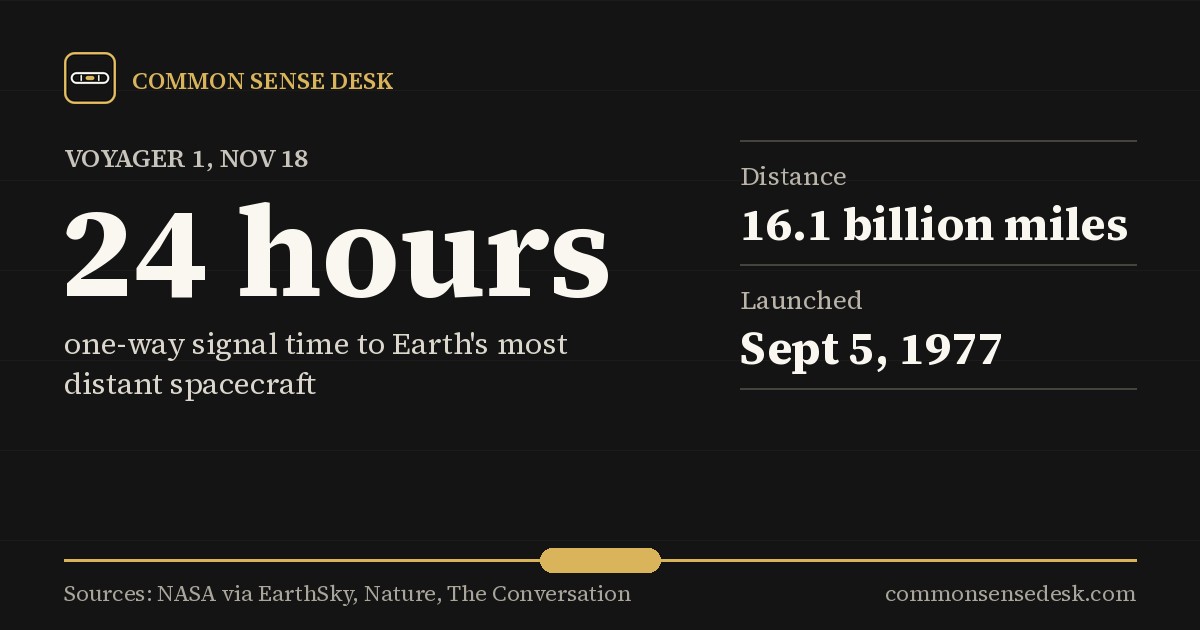
A spacecraft launched in 1977 just crossed a line nothing built by people has ever crossed. NASA's Voyager 1 reached one light-day from Earth early Wednesday, November 18, at 10:16 UTC, or 5:16 a.m. Eastern. That means a radio signal, moving at the speed of light, now needs a full 24 hours to get from Earth to the probe, and another 24 to come back.
How far is a light-day?
Light travels about 300,000 kilometers every second, fast enough to circle Earth more than seven times in one second. In a whole day, it covers about 25.9 billion kilometers, or roughly 16.1 billion miles. That's where Voyager 1 is now, according to EarthSky and other reports on NASA's figures.
A few ways to picture it:
- It's about 173 times as far from us as Earth is from the sun. Astronomers call the Earth-sun distance one astronomical unit, so Voyager is at about 173 AU.
- Sunlight takes about eight minutes to reach Earth. It takes about a day to reach Voyager 1.
- Neptune, the farthest planet, is only about four light-hours from the sun.
It took Voyager 1 49 years, 2 months and 11 days to get there.
What talking to it is like
When engineers at NASA's Jet Propulsion Laboratory in California send a command, they wait a day for it to arrive and another day to hear if it worked. If something breaks, there's no quick fix.
The signal from Voyager is also incredibly faint by the time it reaches us. NASA listens with the giant dish antennas of its Deep Space Network, in California, Spain and Australia, to pick it up at all.
Running low on power
Voyager 1 runs on heat from decaying plutonium, turned into electricity. The output drops a little every year, roughly 4 watts a year, according to NASA. To keep the probe alive, engineers have switched off one system after another.
Only a couple of its original ten science instruments are still sending data. In April this year, NASA turned off the Low-Energy Charged Particle instrument, which measured electrons, ions and cosmic rays, though it could be turned back on later, according to EarthSky. At some point in the next few years, there won't be enough power to run any instruments, and the mission will end. Even then, the probe itself will keep flying.
A long trip
Voyager 1 launched on September 5, 1977, from Cape Canaveral, Florida. Its twin, Voyager 2, launched a few weeks earlier. Their main jobs were to fly past the giant outer planets:
- Voyager 1 passed Jupiter in 1979 and Saturn in 1980, sending back the first close-up pictures of their moons and rings.
- In 1990, it turned its camera back toward home and took the famous "Pale Blue Dot" photo, showing Earth as a tiny speck in a sunbeam.
- In 2012, it crossed the heliopause, the edge of the bubble of particles blown out by the sun, and became the first human-made object to reach interstellar space.
Each Voyager also carries a gold-plated record with sounds and images from Earth, including greetings in dozens of languages, music and natural sounds, meant as a message in case anyone ever finds it.
What's next
Voyager 1 is moving at about 17 kilometers per second, or roughly 38,000 miles an hour. It will be one light-day from the sun, not just from Earth, on February 4, 2027, and two light-days from Earth in December 2075, according to EarthSky. Voyager 2, which is about 3.2 billion kilometers closer, should reach the one light-day mark in November 2035, though it's not clear it will still be talking to us by then.
Even at that speed, Voyager 1 won't come close to another star for tens of thousands of years.
Why it matters
This milestone doesn't come with new pictures or a big scientific discovery. It's a reminder of how big space is, and how much a few spacecraft built in the 1970s, with a tiny fraction of the computing power of a modern phone, have managed to do. Voyager 1 is still sending data about a part of space no other working spacecraft has reached.
If you'd like to read more, The Interstellar Age by planetary scientist Jim Bell tells the Voyager story in plain language. For kids, a children's book about the Voyager probes is a nice way in.
Sources
- EarthSky: Voyager 1 reaches 1 light-day from Earth (Nov. 18, 2026) earthsky.org
- Nature: Voyager 1 achieves a cosmic first, one 'light day' from Earth nature.com
- The Conversation: NASA's Voyager 1 probe reaches distance milestone of one light-day from Earth theconversation.com
- NASA Scientific Visualization Studio: Voyager 1 one light-day svs.gsfc.nasa.gov