

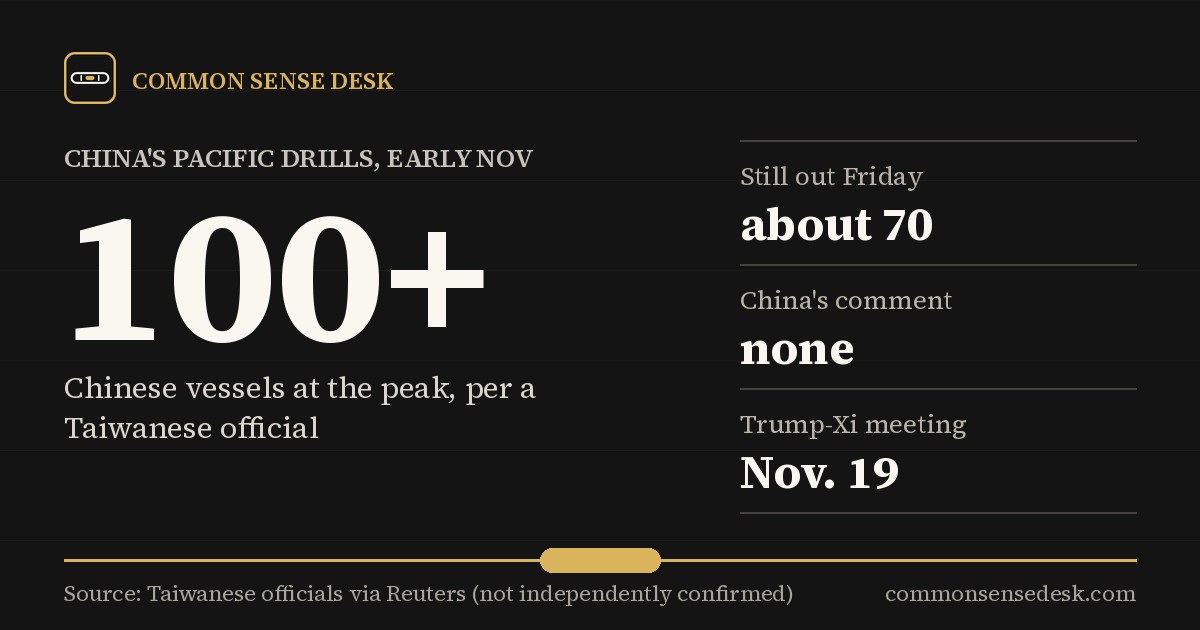
China staged a large military exercise in the western Pacific and around Taiwan in early November without announcing it, Taiwanese officials say. At its peak, more than 100 Chinese navy and coast guard vessels were involved, according to a senior Taiwanese security official who spoke to Reuters. Taiwan calls it "silent intimidation." China hasn't commented.
It comes days before President Trump is expected to meet Chinese leader Xi Jinping in Shenzhen. Here's what's known, what each side says, and why it matters even if you never think about Taiwan.
What Taiwan says happened
According to Taiwanese officials, as reported by Reuters on November 13:
- China's military and coast guard massed more than 100 vessels in the region in early November, one senior security official said.
- The drills included simulated attacks on other militaries and on cities, including Taiwan's, the official said.
- About 70 vessels were still operating inside the "first island chain," the string of islands from Japan through Taiwan to the Philippines, on Friday, according to two Taiwanese security officials.
- Taiwan's National Security Council Secretary-General Joseph Wu said on X that groups from three Chinese military commands, plus the aircraft carrier Liaoning and its strike group, were still operating east of the Philippines.
Taiwan's defense minister, Wellington Koo, described them as "area denial" drills in the western Pacific, involving an aircraft carrier and other naval groups. In plain words: practicing how to keep other countries' ships and planes out of an area, which in a crisis would mean keeping the U.S. and its allies away from Taiwan.
The official said the deployment was bigger than "Justice Mission 2025," China's last formally named drill around Taiwan, about a year ago. The same official said a Chinese submarine also test-launched an intercontinental ballistic missile from the Yellow Sea during the drills.
Important caveat: the vessel numbers come from Taiwanese officials, mostly speaking anonymously. They haven't been independently confirmed.
What China says
China's defense ministry didn't respond to Reuters' request for comment. Beijing has said its carrier is on "routine" exercises not aimed at any country.
On Thursday, Xi gave a major speech on Taiwan, urging peaceful "reunification" and not mentioning the use of force, according to Reuters. China considers Taiwan part of its territory. Taiwan's government rejects that and says only Taiwan's people can decide its future.
A foreign intelligence source told Reuters the lack of any announcement appeared deliberate: it lets Beijing apply pressure while avoiding the diplomatic backlash a named, publicized exercise would bring.
The timing
China hosts the Asia-Pacific Economic Cooperation (APEC) summit in Shenzhen this week. Trump and Xi are expected to meet there on Thursday, November 19, their third meeting this year. We covered what's expected in our Shenzhen preview. Taiwan also takes part in APEC.
Big shows of force right before big meetings aren't new. Both sides often use them to signal strength going into talks.
Why it matters to you
Taiwan may be far away, but it's woven into your daily life in a few big ways:
- Chips. Taiwan makes most of the world's most advanced computer chips, the ones inside phones, cars, laptops and the data centers that run online services. Any serious disruption there would hit prices and supplies of almost everything with a chip in it.
- Shipping. The waters around Taiwan and the Philippines are some of the busiest shipping lanes on earth. Large military exercises can slow traffic, raise insurance costs and, in a real crisis, block trade outright.
- Markets. Tension over Taiwan tends to move stocks, especially tech companies, and pushes some investors toward safer assets. If you have a 401(k), you're exposed to it, even if indirectly.
None of that means a crisis is coming. Exercises like this happen regularly, and so far they've ended without shots fired. But they're a reminder of why stability in the region matters to American wallets, not just to diplomats.
What it means for your wallet
For now, nothing has changed at the store or the gas pump because of these drills. The common-sense takeaway is the same one we keep coming back to: make sure your savings aren't riding on any one company or one part of the world, and don't make big money moves based on scary headlines.
What to watch next
- Whether Taiwan comes up when Trump and Xi meet on Thursday.
- Whether Chinese ships pull back after the summit.
- Any statement from China's defense ministry, the U.S. or Japan.
Sources
- Reuters (via Honolulu Star-Advertiser): China stages unannounced Pacific drills in intimidation of Taiwan staradvertiser.com
- Taipei Times: China drills 'silent intimidation': Taiwan taipeitimes.com