

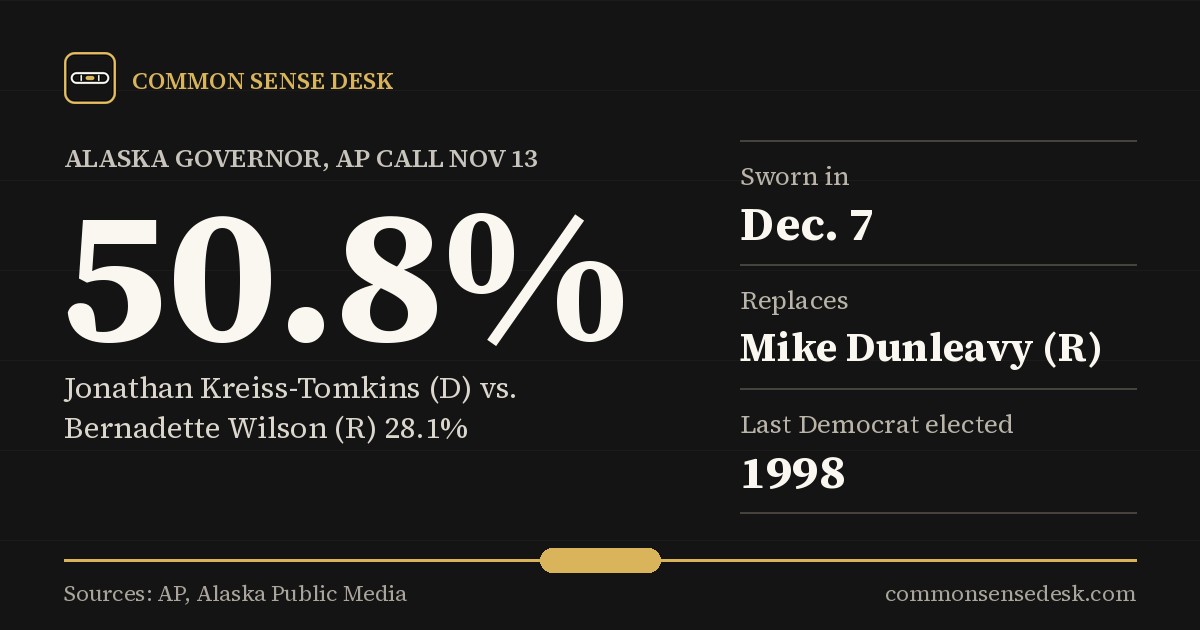
Alaska has elected a Democrat as governor for the first time since 1998. The Associated Press called the race on Friday, November 13, for Jonathan Kreiss-Tomkins, a former state lawmaker from Sitka. He won more than half the first-choice votes, so Alaska's ranked-choice count won't be needed. Trump-backed Republican Bernadette Wilson conceded.
It's a big flip in a state that usually votes Republican for president. Here's who won, how, and what he says he'll do.
The result
Kreiss-Tomkins had about 50.8% of the vote to Wilson's 28.1%, according to the AP's count. Two other Republicans were also on the ballot, including former Anchorage Mayor Dave Bronson. Because he cleared 50% in the first round, he wins outright. The results are unofficial until certification, planned for November 25.
He'll be sworn in at noon on December 7, replacing Gov. Mike Dunleavy, a Republican who has served since 2018 and couldn't run again because of term limits. The last Democrat elected governor of Alaska was Tony Knowles, who won re-election in 1998 and left office in 2002.
Who he is
Kreiss-Tomkins is 37, which makes him the youngest governor in Alaska's history, and the first governor born after Alaska became a state. He served about 10 years in the state Legislature, representing Sitka.
He ran as a self-described "man of the middle," promising a "high-energy, bipartisan, problem-solving approach," according to Alaska Public Media. He was endorsed by three former governors, a Democrat, a Republican and an independent, and by Republican U.S. Sen. Lisa Murkowski. President Trump endorsed Wilson.
"Alaskans want change," Kreiss-Tomkins said after the call. "I really want to focus on making government work."
How the other side took it
The losing candidates were gracious. Wilson told the Alaska Beacon she was glad someone born in Alaska had been elected, even though they deeply disagree on the way forward. Bronson said: "Alaskans have made their choice, and I respect their decision."
That's how elections are supposed to end, and it's worth noticing when it happens.
What he says he'll do
According to Alaska Public Media, his early priorities include:
- Making government work faster, like cutting wait times for permits and for Medicaid.
- A "moderate" Permanent Fund dividend, the yearly oil-wealth check every Alaskan gets.
- A constitutional amendment to tighten limits on how much can be taken out of the Permanent Fund each year, and putting part of any budget surplus into the state's rainy-day fund.
- More money for public schools.
He's hinted he may keep some of Dunleavy's commissioners, and expects to name his team soon.
The Permanent Fund, in plain words
Alaska saves a share of its oil money in the Permanent Fund, created by voters in 1976. Since 1982, the fund has paid a yearly dividend to almost every resident, man, woman and child. For years, the size of that check has been the biggest fight in Alaska politics, because the same fund now also pays for much of state government. A bigger check means less money for schools and services, and the other way around. That's why Kreiss-Tomkins' promise of a "moderate" dividend and firmer limits on withdrawals matters so much to Alaskans.
What he inherits
The timing has some good news: oil prices have been high, and the state budget could show a surplus in the hundreds of millions of dollars, with an updated revenue forecast due next month. But the list of problems is long: rising costs, school closures and bigger class sizes, a looming natural gas shortage in the Anchorage area, and people leaving the state.
He'll also be working with a Legislature where both chambers are run by coalitions made up mostly of Democrats, which should make it easier to pass his agenda than it was for Dunleavy.
The bigger picture
Alaska is in the spotlight this year. Its U.S. Senate race is still being counted, with Democrat Mary Peltola leading Republican Sen. Dan Sullivan and a ranked-choice count set for Wednesday, November 18. We're following that in our Alaska Senate story.
Alaskans have a long habit of voting for the person over the party, and this result fits it. A moderate candidate backed by a Republican senator and former governors from both parties won a state Trump carried easily in past elections.
What it means for you
If you live in Alaska, the biggest practical questions are the size of next year's dividend and whether state services get faster. For everyone else, it's one more sign of what worked this election: candidates who ran on costs and competence, not party labels.
We may earn a commission from Amazon links on this page, at no extra cost to you. As an Amazon Associate, Common Sense Desk earns from qualifying purchases.
Sources
- Alaska Public Media: Alaska elects Democrat Jonathan Kreiss-Tomkins governor alaskapublic.org
- AP (via HuffPost): Kreiss-Tomkins becomes first Democrat since 1998 elected governor in Alaska huffpost.com
- NPR: Democrat Jonathan Kreiss-Tomkins wins race for Alaska governor npr.org