

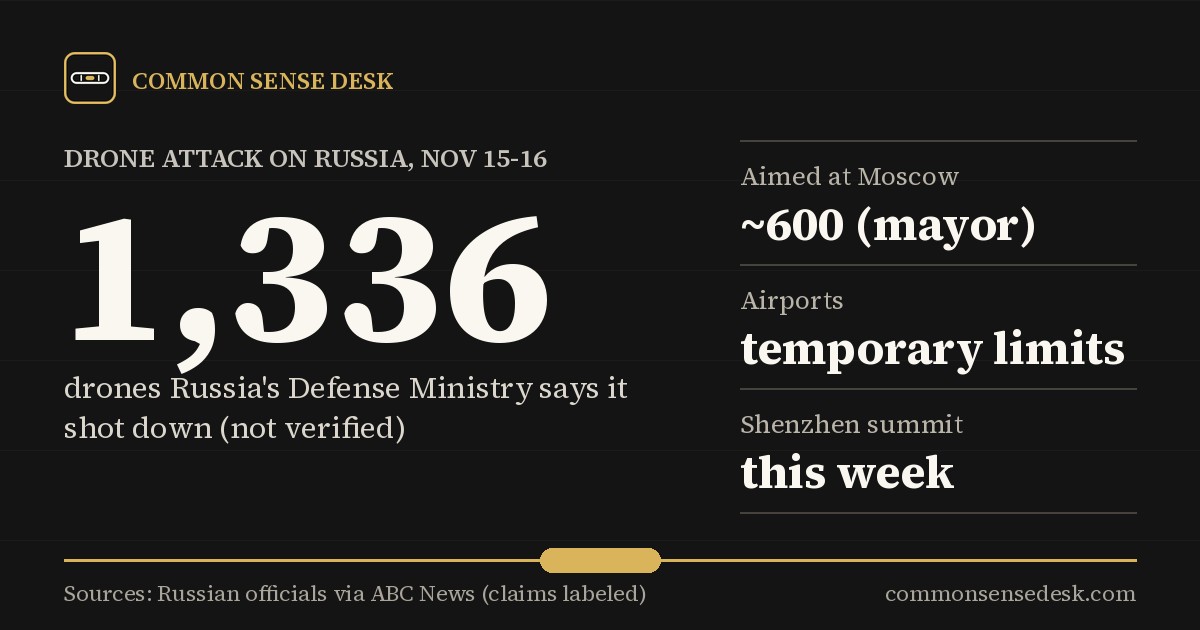
Russia says it shot down 1,336 Ukrainian drones overnight from Sunday into Monday, November 16, one of the largest drone attacks Russia has reported since the full-scale war began. About 600 were aimed at Moscow, according to the city's mayor. People were hurt in southern Russia, and airports around Moscow briefly closed. The numbers come from Russian officials and can't be independently confirmed.
The same night, Russia hit Ukrainian cities too. As always, it's ordinary people on both sides who pay first.
What Russia says
- The count: Russia's Defense Ministry said its forces shot down 1,336 Ukrainian drones overnight, according to ABC News. That's higher than the ministry's previous reported record in October, which outlets put at between 1,214 and 1,254.
- Moscow: Mayor Sergei Sobyanin said about 600 drones were launched toward the city. Most were destroyed far from the capital, and 191 were shot down as they approached.
- Airports: Russia's aviation agency reported temporary flight restrictions at Moscow's Vnukovo and Sheremetyevo airports, and in Yaroslavl, Kaluga, Nizhny Novgorod, Krasnodar and Sochi.
- The Kremlin: Spokesman Dmitry Peskov called the attack "massive" and said, "Our air defense systems continue to operate very effectively."
The people hurt
In Russia's Rostov region, Governor Yuri Slusar said at least three people were wounded around the city of Azov, where fires broke out at four industrial sites, ABC News reported. In the Krasnodar region, officials said six people were injured when drone debris fell on a house.
Sergei Aksyonov, the Moscow-appointed head of Crimea, said the Crimean Bridge was attacked and traffic on it was restricted until midday.
On the other side, ABC News reported that Russian drones struck Ukrainian cities overnight, including Dnipro, where one person was killed and others were injured, and Odesa, which saw damage to infrastructure. We're reporting those figures as ABC News reported them.
Why the numbers matter, and why to be careful with them
Drone numbers in this war are claims from the two sides, and each side has reasons to present them a certain way. A government saying it shot down 1,336 drones is telling you both that the attack was huge and that its defenses worked. Neither part can be checked independently right now. That's why we label these as Russia's figures.
What is clear is the trend: both sides are firing more drones than ever, and the targets increasingly include oil depots, refineries and energy sites far from the front. Those hits matter well beyond the battlefield.
A drone war
Drones have become the main weapon of this war for both sides. Long-range attack drones are cheap compared with missiles, often costing tens of thousands of dollars each, and they can be launched in huge numbers to overwhelm air defenses. Shooting them down can cost far more than the drones themselves. That math is why both countries keep building more, and why the numbers in each new attack keep climbing. It also means that the people living under these flight paths, in Russian and Ukrainian cities alike, face more nights like this one.
The talks backdrop
The attack comes during a week of high-stakes diplomacy. U.S. envoys Steve Witkoff and Jared Kushner hosted three-way talks with Ukraine and Russia in Abu Dhabi last week without an apparent breakthrough; we covered how those talks started in our Abu Dhabi story. President Trump, Vladimir Putin and Xi Jinping are expected to meet later this week at the APEC summit in Shenzhen, China. ABC News reports the two sides remain far apart: Moscow hasn't moved from its core demands, and Kyiv wants a ceasefire along the current front line, which the Kremlin has repeatedly rejected.
Big attacks right before big meetings aren't unusual in wars. Both sides often try to show strength going into talks. That makes it all the more important that the talks actually go somewhere.
What it means for your wallet
For North Americans, the main link is energy. Strikes on oil depots and refineries in Russia, and on energy sites in Ukraine, can tighten fuel supplies in Europe and nudge world oil and diesel prices. Diesel is already about $6 a gallon in the U.S., as we reported in our gas price update. One night of strikes rarely moves prices much on its own, but a steady campaign against energy sites can.
What to watch next
- Whether Russia responds with a large strike of its own on Ukraine.
- Any independent confirmation of damage to Russian oil facilities.
- Whether the war comes up when Trump, Putin and Xi meet in Shenzhen.
Sources
- ABC News: Ukraine fires 1,336 drones into Russia in one of war's largest attacks, Moscow says abcnews.com
- Russian Defense Ministry statement (via APA): 1,336 Ukrainian drones shot down overnight en.apa.az