

We may earn a commission from Amazon links on this page, at no extra cost to you. As an Amazon Associate, Common Sense Desk earns from qualifying purchases.
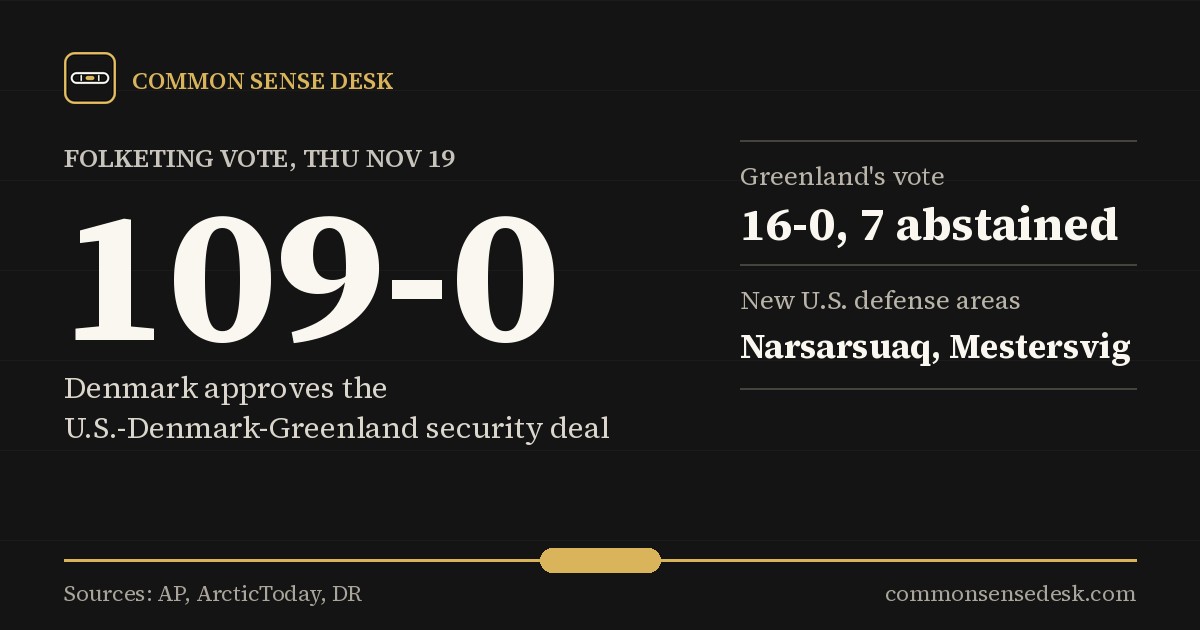
Denmark's parliament, the Folketing, voted 109 to 0 on Thursday, November 19, to approve a security agreement between the United States, Denmark and Greenland. It was the last parliamentary vote the deal needed. Greenland's own parliament approved it earlier this month, also with no votes against, according to the Associated Press.
The agreement gives the U.S. military more room to operate on Greenland while keeping the island under Danish sovereignty. It is not a formal treaty, so it doesn't need a vote in the U.S. Senate, AP reported.
What the deal does
Greenland is a huge, mostly ice-covered island of about 57,000 people. It's a self-governing part of the Kingdom of Denmark, and Denmark handles its defense and foreign policy. The U.S. has had a base there since World War II, under a 1951 defense agreement. The new deal builds on that agreement and has no end date, according to ArcticToday.
Under the agreement, according to AP and ArcticToday:
- The U.S. can "modernize and expand" its activities at Pituffik Space Base in the far northwest, its only base on the island today. Pituffik tracks missiles and satellites over the Arctic.
- The U.S. can set up new "defense areas" at Narsarsuaq in the south and Mestersvig in the northeast. The terms for those two sites still have to be negotiated.
- Any other new locations need approval from both Denmark and Greenland. The vote doesn't let the U.S. build anywhere it wants.
- The agreement allows parts of the planned U.S. "Golden Dome" missile defense system to be placed in Greenland.
- Countries outside NATO and the European Union, and investors from those countries, are barred from gaining "significant influence" in sensitive sectors on the island. That's widely read as aimed at China and Russia.
The text also restates Denmark's sovereignty over Greenland and recognizes Greenlanders as a people with the right to self-determination under international law. If Greenland someday becomes independent, the agreement stays in force as long as Greenland joins NATO.
How it got here
President Trump first floated buying Greenland in 2019 and brought the idea back before he returned to office in 2025. Tensions peaked in January 2026, when he said the U.S. would act on Greenland "whether they like it or not" and threatened tariffs on European allies, according to ArcticToday. At the World Economic Forum in Davos later that month, he dropped the tariff threat, ruled out using force, and talked about "the framework of a future deal" with NATO Secretary General Mark Rutte.
Formal talks on updating the 1951 agreement followed. The deal was negotiated quietly over several months, AP reported, to answer Trump's security concerns while easing fears in Copenhagen and Nuuk of a U.S. takeover. Trump, Danish Prime Minister Mette Frederiksen and Greenland Premier Jens-Frederik Nielsen signed it in New York on September 22, during the UN General Assembly.
Greenland's parliament, the Inatsisartut, approved it 16 to 0, with seven members abstaining. The opposition party Naleraq, which won about a quarter of the vote in Greenland's 2025 election, opposes the deal. It wants a referendum and argues Greenland gets nothing out of it, according to ArcticToday.
What each side says
The U.S. ambassador to Denmark, Kenneth Howery, praised the "strong support" in the Danish parliament and said it was "paving the way for it to enter into force," according to AP. He called the agreement "a tremendous accomplishment" for the security of the U.S., Denmark, Greenland and NATO.
For Denmark, the vote ends a long and uneasy year with its closest ally. All 109 lawmakers present voted yes, with no debate before the vote, according to Euronews. The Folketing has 179 seats.
What happens next
The agreement takes effect once Denmark and Greenland send the U.S. diplomatic notes saying their parliaments have finished all required steps, AP reported. That's expected to be a formality now.
After that, the practical work starts: negotiating the terms for Narsarsuaq and Mestersvig, planning the Pituffik upgrades, and deciding what Golden Dome equipment, if any, goes on the island. The U.S. has said it aims to have Golden Dome finished by 2028, ArcticToday noted.
Why it matters
The Arctic is getting more crowded. As sea ice shrinks, shipping routes and minerals are becoming easier to reach, and Russia and China have both increased their activity in the region. Greenland sits between North America and Europe on the shortest path for missiles flying over the North Pole, which is why the U.S. has cared about it since the Cold War.
For Greenlanders, the deal settles, for now, the question that hung over the island all year: whether the U.S. would try to take it. It also leaves the bigger question, independence from Denmark, in Greenlanders' own hands. If you've never looked at the region on a globe, a polar map of the Arctic shows quickly why all three countries care so much about this island.
Sources
- AP (via CBS News/Yahoo): Danish lawmakers OK Greenland security deal with U.S. (Nov. 19, 2026) yahoo.com
- ArcticToday: Danish parliament ratifies expanded US military access to Greenland (Nov. 19, 2026) arctictoday.com
- AP (via WJTV): Denmark approves security deal with US and Greenland (Nov. 19, 2026) wjtv.com