

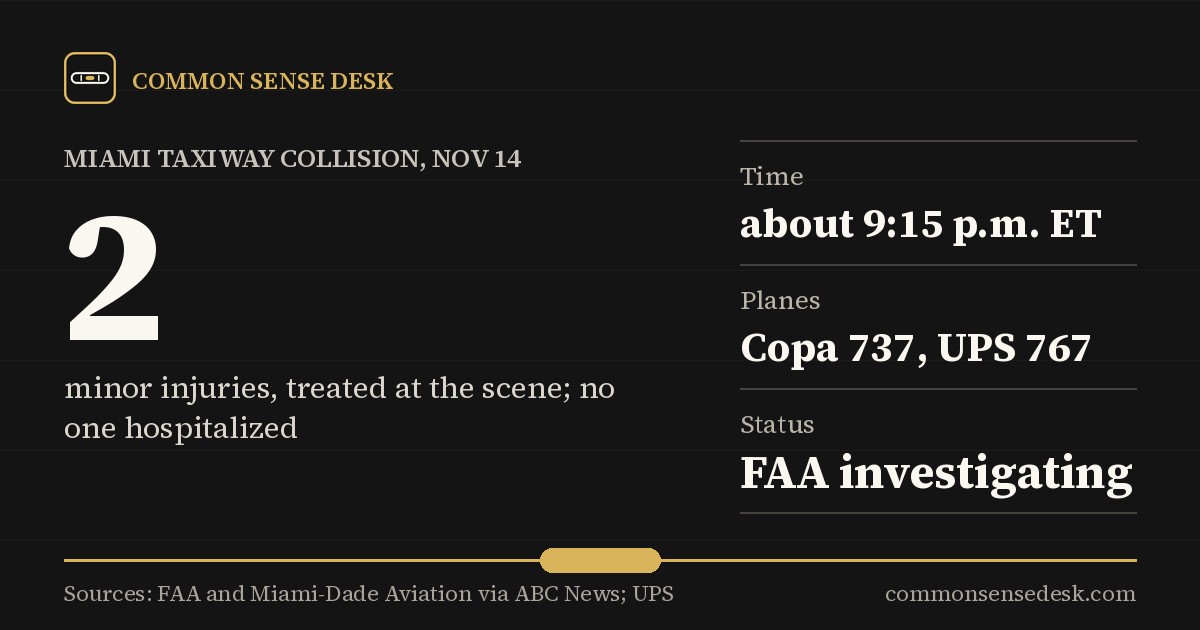
Two planes bumped into each other on the ground at Miami International Airport on Saturday night, November 14. A Copa Airlines passenger jet and a UPS cargo plane touched while taxiing, and two people had minor injuries. Nobody went to the hospital. It's a small accident as these things go, but it comes one day after the biggest air traffic shutdown in decades, and it's the kind of close call the Federal Aviation Administration takes seriously.
What happened
At about 9:15 p.m. Eastern, the two planes met at the intersection of two taxiways, according to the airport and the FAA as reported by ABC News.
- The Copa Airlines Boeing 737, a passenger jet from Panama's national airline, had landed and was taxiing to its gate.
- The UPS Boeing 767, a cargo plane, was taxiing out to take off for Bogotá, Colombia.
The tip of the Copa jet's wing struck the nose of the UPS plane, the FAA said. Air traffic controllers had told the UPS crew to give way to the Copa flight, according to the FAA. On air traffic control audio, a pilot can be heard saying, "Somebody hit us."
Two people were treated at the scene by Miami-Dade Fire Rescue for minor injuries and didn't need to be taken to the hospital, according to Miami-Dade Aviation, which runs the airport. Officials haven't said whether they were crew or passengers, or how many people were on the Copa flight.
What the companies and the FAA say
"We are aware of an incident involving one of our aircraft on the ground in Miami," UPS said. "Our crew is safe, and we are committed to working with authorities to determine what happened."
We didn't find a public statement from Copa Airlines as of Sunday morning.
The FAA is investigating. The key question is the one its early account already points to: controllers say they told the UPS crew to yield, so investigators will look at what the crew heard, what they understood, what they could see, and exactly where each plane was when they met. Investigations like this usually take weeks or months, and early accounts can change, so it's fair to wait for the final word before blaming anyone.
The airport said flights were sent around the blocked area on other taxiways, so there was no impact on airport operations.
A rough few days for air travel
This came one day after a telecommunications failure forced a nationwide ground stop on Friday, November 13. For more than four hours, nothing took off from any U.S. airport, and thousands of flights were canceled into the weekend. Transportation Secretary Sean Duffy said the trouble started during work to switch old copper phone lines to fiber, when a router began flooding the FAA's network. We covered that in detail in our ground stop story.
The two events aren't connected as far as anyone has said. But together they're a reminder of how much depends on a system that's stretched thin: aging equipment, busy airports and crews and controllers working long days to catch up after a big disruption.
How often does this happen?
Ground bumps between planes, usually a wingtip clipping a tail or another plane, aren't unheard of at big, crowded airports. They usually happen at low speed and rarely hurt anyone, but they can do expensive damage, and they get investigated because the same kind of mix-up at higher speed on a runway can be deadly. That's why the FAA treats "who was supposed to give way" so seriously.
Miami is one of the busiest airports in the country for both passengers and cargo. It's the main U.S. gateway for flights to Latin America, which is why you'll often see Copa jets and cargo planes headed to Colombia sharing the same taxiways at night.
What it means for travelers
If you're flying this weekend, here's the common-sense part:
- Check your flight before you leave home. Airlines were still working through the backlog from Friday's ground stop, and schedules can stay messy for a day or two after a big disruption.
- Know your rights. If your flight is canceled, U.S. rules say you're owed a refund if you choose not to travel, even on a non-refundable ticket. If you want to rebook, ask the airline to put you on the next available flight.
- Use the app, but don't only use the app. Rebooking options often show up in the airline's app first. If the line at the counter is long, call the airline at the same time.
- Pack what you can't be without in your carry-on, like medicine and chargers, in case you end up stuck overnight.
And for nervous flyers: this incident is a good example of the system's safety layers doing their job. The planes were moving slowly, crews stopped, fire rescue was there in minutes, and nobody was seriously hurt. Flying is still by far the safest way to travel long distances.
What to watch next
- The FAA's findings on why the UPS plane didn't hold short as instructed.
- How badly the two planes were damaged and when they're back in service.
- Whether airline schedules are back to normal by Monday.
Sources
- ABC News: UPS plane, Copa Airlines flight collide on taxiway at Miami International Airport abcnews.com
- Federal Aviation Administration: statement via ABC News faa.gov