

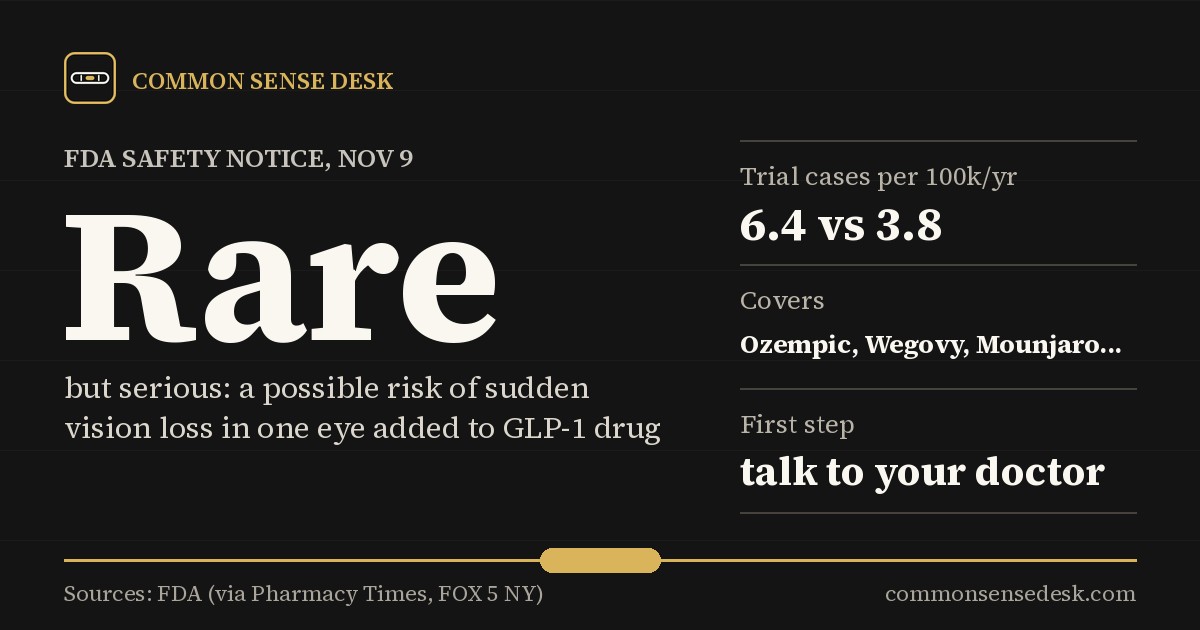
If you or someone in your family takes Ozempic, Wegovy, Mounjaro, Zepbound or a similar drug, there's a new warning on the label. The Food and Drug Administration announced on Monday, November 9, that it is requiring the makers of all GLP-1 drugs to add information about a possible increased risk of a rare but serious eye condition called NAION.
Here's what that means, calmly and in plain words.
What the FDA did
The FDA issued a Drug Safety Communication requiring all makers of GLP-1 receptor agonists to add the potential risk of NAION to the "Warnings and Precautions" section of their labels. It applies to the whole class of drugs, whether they're used for diabetes or for weight loss, according to Pharmacy Times.
"FDA concluded that there is a potential increased risk of rare NAION events in patients taking GLP-1 RAs," the agency said, according to FOX 5 New York.
The drugs covered include semaglutide (Ozempic, Wegovy, Rybelsus), tirzepatide (Mounjaro, Zepbound), liraglutide (Victoza, Saxenda), dulaglutide (Trulicity), exenatide, the combination products Xultophy and Soliqua, and the newer pill orforglipron (Foundayo), according to Pharmacy Times.
What NAION is
NAION stands for non-arteritic anterior ischemic optic neuropathy. In plain words, it's when blood flow to the front of the optic nerve, which connects the eye to the brain, drops suddenly. It can cause sudden, painless loss of vision in one eye, and the loss can be permanent.
It's rare. In adults over 50, it happens to roughly 2 to 10 people out of every 100,000 each year, according to the background cited by Pharmacy Times. Many of the risk factors, such as diabetes, high blood pressure, sleep apnea, smoking and kidney disease, are common in people who take these drugs, which makes it hard to tell what causes a given case.
How big is the risk?
This is the part worth reading slowly, because the numbers are small and the research isn't all in agreement.
- The FDA's review of clinical trials: across 126 trials with more than 134,000 patients, there were 15 probable NAION cases in total: 10 among people taking GLP-1 drugs and 5 among people on a placebo. That works out to about 6.4 cases per 100,000 people per year on the drugs, compared with about 3.8 on the comparison drugs, according to Pharmacy Times.
- An FDA real-world study of adults with type 2 diabetes from 2019 to 2024 found no significant difference in risk compared with one common class of diabetes drugs, and a somewhat higher risk compared with another.
- A 2024 study in JAMA Ophthalmology, from one academic eye center, reported a higher risk with semaglutide. The FDA noted limitations in that study but said the question deserved a closer look.
So the FDA's language is careful: a "potential" increased risk of a "rare" event. That's why it's a label warning, not a recall.
Symptoms to know
According to the FDA's guidance as reported by Pharmacy Times, people taking these drugs should contact a health care professional right away if they notice:
- Sudden, painless vision loss in one eye, possibly noticed on waking up
- Blind spots or tunnel vision
- Colors looking faded or different
- Blurry or hazy vision in the center
Doctors are being told to refer suspected cases to an eye specialist quickly, and to consider stopping the drug in patients who develop NAION unless the benefits clearly outweigh the risk. People who have had NAION before are at higher risk of it happening again.
What it means for you
For most people on these drugs, nothing changes today. Millions of Americans use them to control diabetes or lose weight, and for many, the health benefits are real. The common-sense steps are simple:
- Don't stop or change your medicine on your own. Talk to the doctor who prescribed it first.
- Know the warning signs above, and act fast if they happen. With vision, time matters.
- If you've had NAION or other optic nerve problems before, make sure your doctor knows.
- Keep up with regular eye exams, especially if you have diabetes.
- If you're thinking about starting one of these drugs, ask your doctor about this new warning and whether your own health history changes the picture.
Side effects can be reported to the FDA's MedWatch program online or at 1-800-332-1088.
This article is general information, not medical advice.
Sources
- FDA: Drug Safety Communications (Nov. 9, 2026, GLP-1 RAs, rare but serious eye condition) fda.gov
- Pharmacy Times: FDA requires class-wide GLP-1 RA labeling changes for potential NAION risk pharmacytimes.com
- FOX 5 New York: Ozempic, Zepbound, Wegovy among GLP-1s with new FDA warning fox5ny.com
- Ophthalmology Times: FDA requires NAION warning across the GLP-1 receptor agonist class ophthalmologytimes.com