

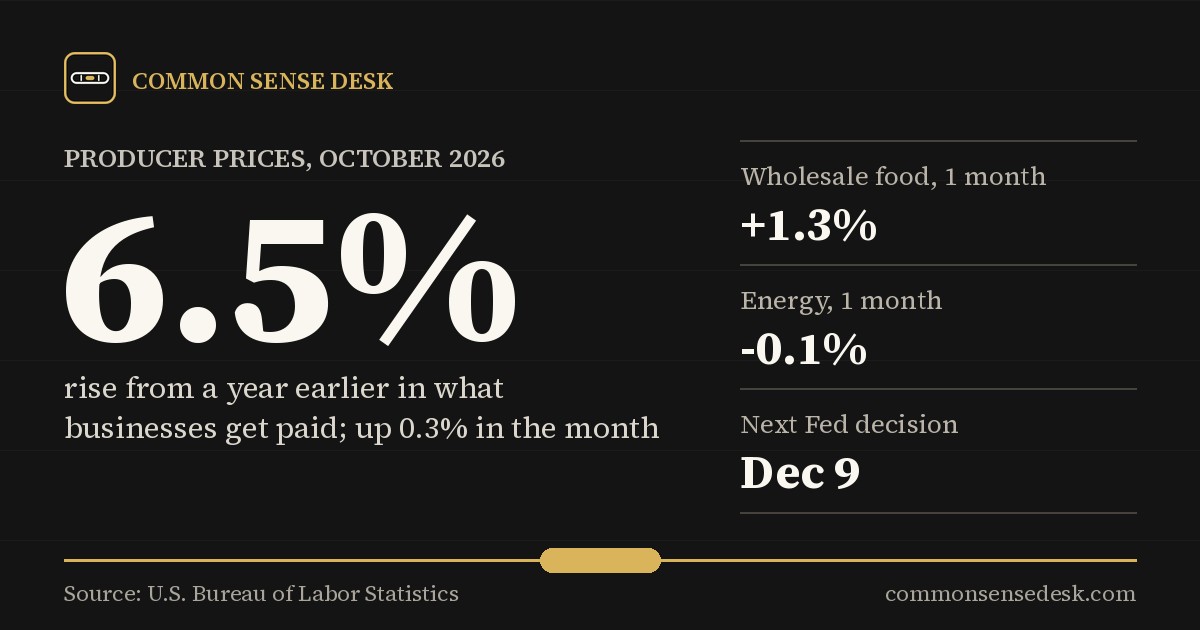
Two days after the October consumer price report came in hotter than expected, we got the other half of the inflation picture. The Producer Price Index, which tracks what businesses get paid for their goods and services, rose 0.3 percent in October, according to the Bureau of Labor Statistics report released on Thursday, November 13.
That monthly number was a welcome slowdown after a 1.4 percent jump in September. But the yearly number tells a different story. Producer prices were up 6.5 percent from a year earlier, a faster pace than September's 6.3 percent, according to the government's figures.
What the PPI is, in plain words
The consumer price index measures what you pay at the store. The producer price index measures what businesses get paid one step earlier: farmers selling crops, factories selling parts, trucking companies moving goods, wholesalers selling to stores. Think of it as the price tag before it reaches the shelf.
That's why economists watch it. When businesses pay more for what they buy, many of them pass some of those costs on to customers, usually weeks or months later. A rising PPI is often an early warning of what's coming at the checkout.
The October numbers
According to the BLS (seasonally adjusted, month over month unless noted):
- Overall (final demand): up 0.3 percent in October, after 1.4 percent in September and 0.4 percent in August. Up 6.5 percent over 12 months.
- "Core" (without food, energy and trade services, which jump around): up 0.5 percent for the second month in a row. Up 4.9 percent over 12 months.
- Goods: up 0.5 percent, after 2.5 percent in September. Up 10.2 percent over 12 months.
- Food: up 1.3 percent, after 1.1 percent in September. Two strong months in a row.
- Energy: down 0.1 percent, after a 10 percent spike in September.
- Services: up 0.2 percent, the fifth monthly rise in a row. Transportation and warehousing jumped 2.0 percent.
The good news and the bad news
The good news is that the big energy spike from September didn't repeat. Energy prices at the producer level actually dipped a little in October, which fits with what drivers have seen at the pump: the U.S. average for regular gas has fallen from about $4.37 a month ago to $3.91 this week, according to AAA.
The bad news is in the details. Wholesale food prices rose 1.3 percent in one month. Transportation and warehousing, the cost of moving goods, rose 2 percent. And core producer prices, the steadier measure, rose 0.5 percent again. Those are the costs that tend to show up later in grocery bills and store prices.
How it fits with this week's consumer prices
On Tuesday, the consumer price index showed prices rising 0.4 percent in October, more than the 0.3 percent economists expected. We covered that here: U.S. inflation runs hotter than expected in October.
Put the two reports together and the message is the same: inflation isn't cooling as fast as the Federal Reserve wants. The Fed's target is 2 percent a year. Producer prices are running more than three times that.
What it means for the Fed
The Fed held its key interest rate at 3.75 to 4 percent on October 28, but two members wanted a hike. Its next decision is December 9. Before this week's reports, markets already saw a strong chance of a rate increase in December. A softer monthly PPI number takes a little pressure off, but the 6.5 percent yearly pace and rising food costs don't give the Fed much reason to relax.
What it means for your wallet
- Groceries: rising wholesale food prices usually reach store shelves within a few months. If you have room in the freezer or pantry, stocking up on staples when they're on sale makes sense.
- Gas: this is the bright spot for now. Energy prices eased in October, and pump prices have kept falling into November.
- Borrowing: if the Fed raises rates in December, credit card and car loan rates tend to follow. Paying down variable-rate debt before then is a common-sense move.
- Mortgages: the 30-year rate averaged 7.11 percent this week, according to Freddie Mac. That's down from the week before, but almost a point above a year ago.
We track all of these every week on our Wallet Watch page.
What to watch next
- The Fed's decision on December 9.
- November consumer prices on December 10, and whether this fall's wholesale food increases show up at the store.
- Gas prices, which could turn back up if oil stays higher after this week's Iran news.
Sources
- U.S. Bureau of Labor Statistics: Producer Price Index, October 2026 bls.gov
- Benzinga: Producer Price Index data benzinga.com
- Federal Reserve: FOMC statement, October 28, 2026 federalreserve.gov
- AAA Gas Prices gasprices.aaa.com
- Freddie Mac: Primary Mortgage Market Survey freddiemac.com