

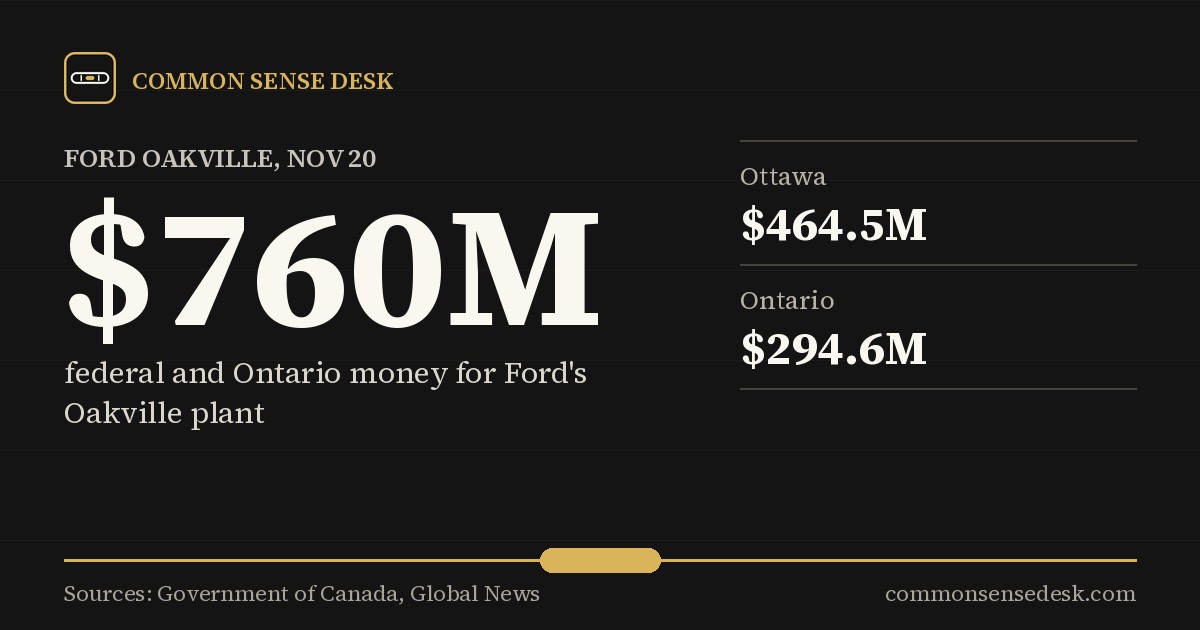
The federal and Ontario governments are putting about $760 million into Ford's assembly plant in Oakville, Ontario, to help it build heavy-duty pickup trucks, they announced on Thursday, November 20. Ottawa is contributing $464.5 million and Ontario $294.6 million, according to the federal government's announcement and Global News.
The money supports what both governments describe as a nearly $5 billion project to retool and expand the plant to make the Ford F-Series Super Duty truck. Industry Minister Mélanie Joly said it will protect more than 2,000 jobs.
What's being built
The Oakville Assembly Complex, west of Toronto, will be expanded and retooled to build the Super Duty, Ford's largest pickup, along with a new stamping plant that makes large body parts, Global News reported. Joly said the plant will be able to build up to 100,000 vehicles a year, for sale across North America and for export.
The federal money comes from Ottawa's Strategic Response Fund, which was set up to help Canadian industries hit by U.S. tariffs. The announcements describe the money as an "investment" and don't say whether any of it is a loan to be repaid. The governments haven't published the conditions attached, such as how long Ford must keep the jobs.
What leaders said
"This is our auto strategy in action," Joly said, according to Global News. "Ford's decision to invest in Oakville is a signal to the world that Canada is open for business, Canada is competitive and Canada is the place to build auto in North America."
Ontario Premier Doug Ford, who is no relation to the company, said the announcement "clearly shows that we are fighting back and we are standing up for Canada." He added: "I love the Americans. I really do. But we're gonna give Kentucky a run for their money." Ford builds Super Duty trucks at its Kentucky Truck Plant in Louisville.
Ford of Canada's president, Bev Goodman, said the investment "reflects our confidence in Canadian manufacturing," according to the federal announcement.
Why governments are paying
Canada's auto industry is under heavy pressure from U.S. tariffs. Canadian-built vehicles and parts that aren't covered by trade exemptions face a 25% U.S. tariff, and the Trump administration has threatened to raise that to 50% on January 1, as we covered in our story on the Canada-U.S. talks. Most of the vehicles built in Ontario are sold in the United States.
Governments in both countries are competing to keep auto plants. U.S. states routinely offer large incentives, and the Trump administration has pushed carmakers to move production to the U.S. Ottawa and Ontario are betting that public money will keep Ford building trucks in Canada even with tariffs in place.
The questions
Large subsidies to profitable companies always draw questions about value for taxpayers. Global News's own headline described the deal as Ford getting "$760M from taxpayers." Key questions that weren't answered in Thursday's announcements: how much Ford itself is putting in, what happens if tariffs make the trucks too expensive to sell in the U.S., and what Ford must repay if it cuts jobs.
Those questions aren't theoretical. On the same day, Joly said the government is prepared to go after Stellantis to recover "hundreds of millions of dollars" over its Brampton, Ontario, plant, Global News reported. Ottawa says Stellantis is in default of a 2022 funding agreement and Stellantis is selling the Brampton plant to another company, Roshel. "I'm fed up, workers are fed up and Canadians are fed up," Joly said.
No statement from opposition parties or taxpayer groups on the Ford funding had been published as of Thursday afternoon.
What it means for you
For the thousands of people who work at the Oakville plant and its suppliers, the deal means more job security after a long period of uncertainty. For taxpayers in Ontario and across Canada, it's a large public bet on one plant, and the details of what Ford has promised in return matter.
For truck buyers, nothing changes right away. Whether Canadian-built Super Duty trucks end up costing more in the U.S. depends on how the trade talks turn out before January 1.
What to watch
Whether the governments publish the terms of the deal, when production of the Super Duty starts in Oakville, and whether the U.S. goes ahead with the 50% tariff in January.
We may earn a commission from Amazon links on this page, at no extra cost to you. As an Amazon Associate, Common Sense Desk earns from qualifying purchases.
Sources
- Government of Canada: announcement of investment in Ford Motor Company of Canada (Nov. 20, 2026) newswire.ca
- Global News: As trade war hits auto sector, Ford gets $760M from taxpayers for Ontario plant (Nov. 20, 2026) globalnews.ca