
Some diseases are so rare that most of us will never hear their names. Niemann-Pick disease type C is one of them. It affects an estimated 1 in 150,000 people, and in its most severe form it takes children's lives before they reach their teens. Until this week, no medicine had ever been shown to help those children live longer.
That changed on Tuesday, November 17, when the U.S. Food and Drug Administration approved a drug called Lembaz (adrabetadex). The FDA says it is "the first treatment shown to help people with a severe form of Niemann-Pick disease type C (NPC) live longer."
What the disease does
NPC is inherited. A child gets a faulty gene from each parent, and as a result the body can't properly move cholesterol and other fats around inside its cells. Those fats build up, mostly in the brain. Over time, according to the FDA, that causes "progressive neurological decline, including loss of movement, coordination, and the ability to swallow."
When symptoms start before age 6, called infantile-onset NPC, the outlook is hardest. Children whose symptoms begin before age 2 have died at an average age of about 5 and a half, and those whose symptoms start between 2 and 6 at about 13, according to figures cited by NeurologyLive and Contemporary Pediatrics. Beren Therapeutics, the company behind the drug, estimates roughly 475 children in the U.S. have this form.
Two other NPC medicines were approved in 2024. They can help with symptoms, but neither has been shown to reduce the risk of death, and both have age or weight limits that leave out many of the youngest children, the FDA said.
What the new drug showed
Lembaz is given every two weeks as an injection directly into the spinal canal, so it can reach the brain. It's approved for children and adults who weigh at least 7 kilograms, about 15 pounds, and whose neurological symptoms began before age 6.
The FDA looked at 36 patients treated with Lembaz across three clinical studies and an expanded access program, and compared them with a closely matched group of untreated patients. According to the FDA:
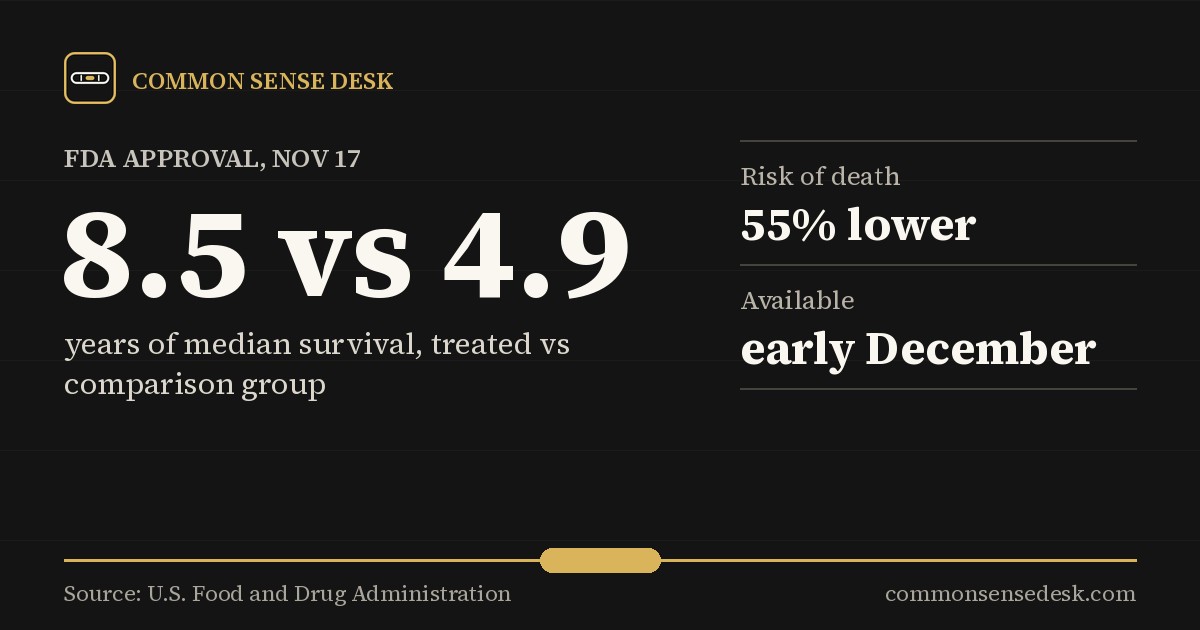
- The treated group had a 55% lower risk of death.
- Median survival was 8.5 years for treated patients, compared with 4.9 years for the comparison group.
- The benefit showed up whether or not patients were also taking another drug, miglustat, that doctors already use for NPC.
In plain terms, that's years. For a family facing this disease, an extra three or four years with their child is not a small thing.
"For families living with Niemann-Pick disease type C, today's approval marks an important milestone," said Acting FDA Commissioner Kyle Diamantas. "For the first time, there is a treatment shown to help adults and children with this serious disease live longer."
Dr. Elizabeth Berry-Kravis, a professor of pediatrics and neurological sciences at Rush University Medical Center in Chicago, who led the drug's expanded access program, put it this way in a statement released by the company: the drug "gives children more time to be children."
The honest caveats
This isn't a cure. The drug slows the disease; it doesn't reverse damage already done. As Berry-Kravis noted, neurological function that's lost can't be regained, which is why early diagnosis matters so much.
It also has real side effects. Lembaz carries the FDA's strongest warning, a boxed warning, for hearing loss, which can be permanent. Patients need hearing tests before starting and regularly during treatment. Other common side effects include trouble with balance, tiredness, vomiting, back pain and headache.
And the evidence came from comparing treated patients with a matched group from outside the studies, not from a large randomized trial. With a disease this rare, that's often the only practical way to measure survival, and the FDA accepted it here. Still, it's worth knowing.
The company says the drug will be available at treatment sites around the country in early December. No price had been announced.
What it means for you
Most readers will never need this drug. But it's a reminder that rare diseases, taken together, are not rare. Thousands of them affect millions of Americans, and many families wait years for any treatment at all. Each approval like this one tends to make the next one a bit easier, because researchers learn how to run studies and prove benefit in very small groups of patients.
If your child has unexplained problems with balance, coordination, eye movements or swallowing, especially alongside an enlarged liver or spleen, it's worth asking a pediatrician about a referral to a genetics or neurology specialist. Most of the time it's something else. But for conditions like NPC, an early answer now makes a real difference.
For the families who have waited years for this news, it's a good Friday.
Sources
- FDA: FDA approves first drug shown to help patients with infantile-onset Niemann-Pick disease type C live longer (Nov. 17, 2026) fda.gov
- NeurologyLive: FDA approves adrabetadex (Nov. 17, 2026) neurologylive.com
- Contemporary Pediatrics: FDA approves adrabetadex for infantile-onset Niemann-Pick type C (Nov. 17, 2026) contemporarypediatrics.com