

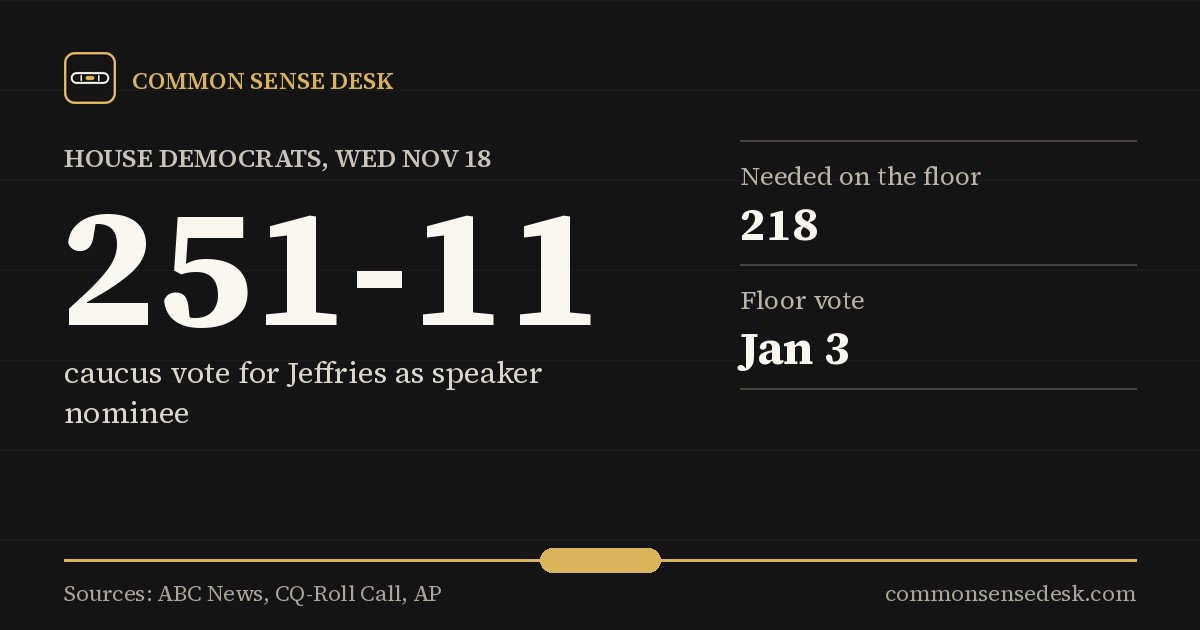
House Democrats picked Hakeem Jeffries of New York on Wednesday, November 18, as their candidate for speaker of the House. The closed-door caucus vote was 251 to 11, according to ABC News and CQ-Roll Call. If the full House confirms him when the new Congress meets in January, he'll be the first Black speaker in the country's history.
Democrats won control of the House in the November 3 midterms. The Associated Press count stood at 256 Democratic seats to 171 Republican as of Monday, November 16, with a handful of races still uncalled. That's well past the 218 needed for a majority.
How the vote went
Jeffries had no announced opponent, so he could have been chosen by acclamation, a simple voice vote. He asked for a recorded ballot instead. His allies described that as a show of strength, CQ-Roll Call reported. Jeffries said the process matched how the caucus handled its last leadership change in 2018, and that it let members weigh his "track record, experience and vision."
The ballot was secret. Multiple people in the room told ABC News that 262 ballots were cast, with 251 for Jeffries and 11 against.
Seven of the 11 no votes came from progressive Democrats, most of them newly elected, who released a joint statement afterward. They said they'd had "good-faith" talks with Jeffries about Medicare for All, immigration enforcement and Gaza, but hadn't gotten commitments, so "our vote in caucus today was no," according to The Washington Post. Their message, as ABC put it, was that "there is still work to be done" on the party's direction. Two members-elect, Don Leonard and Angela Gonzales-Torres, confirmed publicly that they voted no. The other four no votes haven't been identified.
One incoming member, Rep.-elect Frederick Haynes, missed the vote. His office said he woke up ill.
The rest of the leadership team
Democrats also filled the other top jobs for the next Congress, according to ABC News:
- Katherine Clark of Massachusetts as majority leader, the first woman in that post
- Pete Aguilar of California as majority whip, the first Latino in that post
- Ted Lieu of California as caucus chair
Former Speaker Nancy Pelosi, who is leaving Congress, arrived at the vote chanting "Hakeem Jeffries!" CQ-Roll Call reported. Outgoing Rep. Steny Hoyer of Maryland, the party's longtime No. 2, said Jeffries "has the confidence of the caucus."
What comes next
A caucus vote is only a nomination. The real election happens on the House floor when the new Congress is sworn in. The Constitution sets January 3 as the start date. Every member, Republican and Democrat, stands and says out loud who they're voting for. The winner needs a majority of the members who vote for a named candidate, which is 218 if all 435 seats are filled and everyone votes.
With roughly 256 Democrats, Jeffries can lose a few dozen of his own members and still win, as long as they don't all back one alternative candidate. It isn't clear yet whether any of Wednesday's no votes will vote against him on the floor. Members sometimes vote no in a private caucus to make a point and then back the nominee in public.
That's a big change from recent years. In January 2023, Republican Kevin McCarthy needed 15 rounds of voting over four days to become speaker because a small group in his own party held out. A large majority makes that kind of fight much less likely.
What Jeffries says he'll do
Jeffries has said the economy will be the main focus. Speaking to Americans who are struggling with costs, he said: "We hear you. We see you. We feel you," according to ABC News. He has also outlined a health care agenda, immigration legislation and investigations into the Trump administration, CQ-Roll Call reported.
Any bill the House passes still needs the Senate and the president's signature. Democrats also won the Senate majority this month, including an upset in Alaska, where Mary Peltola beat Sen. Dan Sullivan. President Trump keeps his veto, and overriding a veto takes two-thirds of both chambers, which neither party has.
The Senate side has its own leadership contest. Sen. Chris Van Hollen of Maryland is challenging Chuck Schumer for the Democratic leader's job, with a vote expected in early December.
Who Jeffries is
Jeffries, 56, represents a district in Brooklyn and has led House Democrats since 2023, when he took over from Pelosi. Before Congress he was a lawyer and served in the New York State Assembly. As minority leader for the last four years, he's been the main face of House Democrats in budget fights and shutdown standoffs with Republicans.
What it means for you
A change in which party runs the House changes which bills get a vote. Democrats have said health care costs and prices will be early priorities, while Republicans in the Senate minority and the White House can slow or block what they don't like. Expect more committee investigations and more divided-government standoffs over spending, including the government funding deadlines that come up in the new year.
Nothing changes until January 3. Until then, Republicans still run the House under Speaker Mike Johnson.
We may earn a commission from Amazon links on this page, at no extra cost to you. As an Amazon Associate, Common Sense Desk earns from qualifying purchases.
Sources
- ABC News: In historic move, House Democrats nominate Hakeem Jeffries for speaker (Nov. 18, 2026) abcnews.com
- CQ-Roll Call (via Decatur Daily): Democrats nominate Jeffries to be House speaker, a historic first (Nov. 2026) decaturdaily.com
- The Washington Post: At least seven progressives voted against Hakeem Jeffries for speaker (Nov. 18, 2026) washingtonpost.com
- Axios: House Democrats formally nominate Hakeem Jeffries for speaker (Nov. 18, 2026) axios.com