

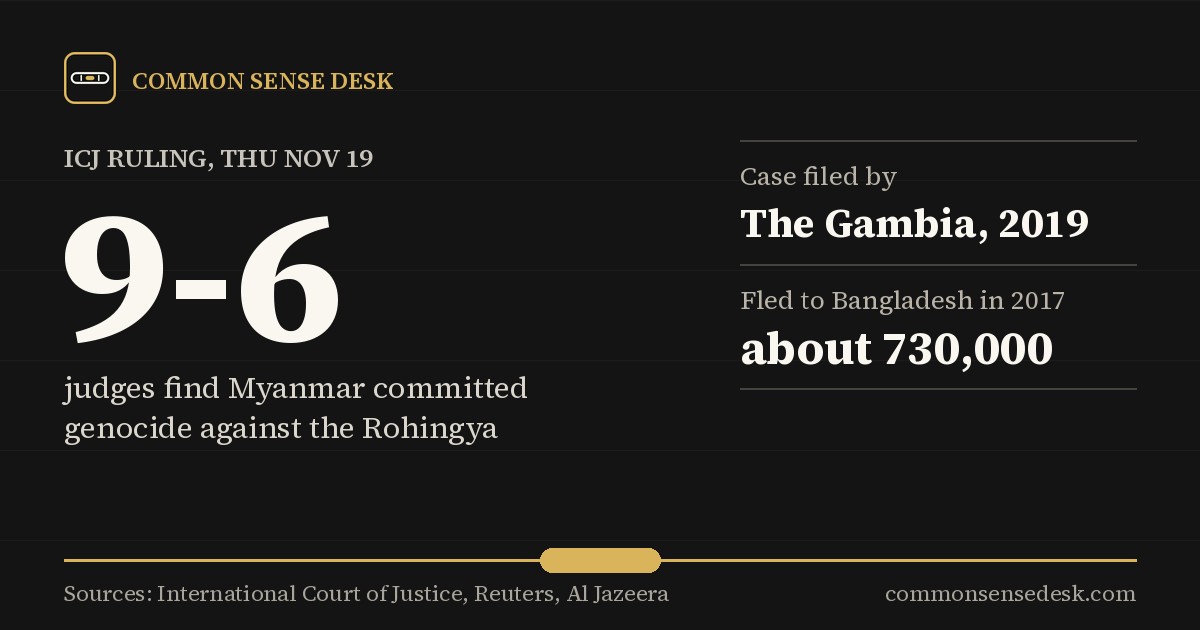
The International Court of Justice in The Hague ruled on Thursday, November 19, that Myanmar committed genocide against the Rohingya, a mostly Muslim minority, during its 2017 military campaign in northern Rakhine state. The vote among the judges was 9 to 6.
It's the first time the court, the United Nations' highest court, has found a country responsible for committing genocide in its 80-year history, according to Reuters. Reuters also reports it's only the fourth time since the Holocaust that an international court has found the legal bar for genocide was met.
What the court found
The court's president, Judge Yuji Iwasawa of Japan, read the judgment. He said Myanmar "has committed genocide against the Rohingya group in northern Rakhine state," according to Al Jazeera and Euronews.
Genocide is hard to prove in law. A country has to be shown to have acted with the intent to destroy a group, in whole or in part, not just to have committed mass killings. The court said the "only reasonable inference" from the evidence was that Myanmar intended to destroy a "substantial part" of the Rohingya, Al Jazeera reported.
Iwasawa said Myanmar's security forces "killed thousands of Rohingya civilians" and carried out widespread sexual violence. According to Al Jazeera, he said the evidence shows the forces killed about 10,000 Rohingya.
The judges also found that Myanmar broke its duty to prevent genocide. They said the government should have known about the risk once armed civilians joined the military campaign.
The ruling is binding and can't be appealed.
Myanmar's side
Myanmar has always denied genocide. At hearings in January, its lawyers argued that the 2017 "clearance operations" were a response to attacks on police posts by fighters from the Arakan Rohingya Salvation Army, a militant group, and that the country had a right to fight what it called terrorism. Its representative told the court that Myanmar was not obliged to stay idle and let militants have free rein.
The court rejected that defense. The judges did not accept that the operations were only counter-terrorism.
Myanmar's military government had not commented on the ruling when this was published. After an earlier order from the same court in 2020, Myanmar's government said there had been no genocide in Rakhine.
What Myanmar was ordered to do
The court ordered Myanmar to make reparations to the Rohingya. According to Al Jazeera and the reactions compiled by Reuters, that includes:
- allowing and helping the safe, voluntary and dignified return of Rohingya who fled
- returning or replacing property that was destroyed
- searching for people who disappeared and making sure the dead are properly buried
- physical and mental health care for survivors
- protecting the Rohingya from further persecution and guaranteeing it won't happen again
- compensation
How the case got here
The Gambia, a small country in West Africa, filed the case in November 2019 under the 1948 Genocide Convention, which both countries signed. It brought the case with the backing of the 57-member Organisation of Islamic Cooperation. Eleven other countries joined the case, mostly in support of The Gambia.
In 2022 the court rejected Myanmar's objections and said it had the power to hear the case. The main hearings took place in January 2026.
About 730,000 Rohingya fled into neighboring Bangladesh during the 2017 crackdown. The UN says more than 1.3 million Rohingya are still displaced across South and Southeast Asia, including about 1.2 million living in camps in Cox's Bazar, Bangladesh, according to Al Jazeera. Most Rohingya in Myanmar are not recognized as citizens.
Myanmar has changed a lot since 2017. The military took power in a coup in February 2021, and the country has been in a civil war since then. The same military that ran the 2017 campaign now runs the government.
Reactions
UN human rights chief Volker Türk said the ruling confirms the state's responsibility for a grave crime and called the Rohingya's suffering "a stain on the conscience of humanity," according to Reuters.
Yasmin Ullah, a Rohingya survivor who was part of The Gambia's delegation, said the Rohingya never needed a court to tell them what happened to them, but they needed the world to hear it, Reuters reported.
Human Rights Watch called on Myanmar to comply quickly. Amnesty International called the ruling "a historic and authoritative recognition of the atrocities committed against the Rohingya."
Former Bangladesh Prime Minister Sheikh Hasina, who led the country during the 2017 exodus, called it "a proud moment for Bangladesh" because Bangladesh helped gather witness evidence in the refugee camps.
What happens next
The court has no police force. It can't make Myanmar pay or let refugees return. If a country ignores a ruling, the other side can take the issue to the UN Security Council, where any of the five permanent members can block action with a veto. China and Russia have both shielded Myanmar's military at the Council in the past.
Lawyers and rights groups say the ruling still matters. It's a formal legal finding that other courts and governments can rely on. The International Criminal Court, a different court that tries individuals rather than countries, has a separate investigation; in November 2024 its prosecutor asked judges for an arrest warrant for Myanmar's military leader, Min Aung Hlaing. Two British lawmakers who chair Parliament's Burma group urged the UK to bring back regular sanctions on Myanmar's military and push for a Security Council resolution to enforce the judgment.
For the Rohingya in the camps, the practical questions are the same as before: whether it will ever be safe to go home, and whether they'd be treated as citizens if they did. Rohingya activist Nay San Lwin told Reuters that justice means restored citizenship, recognized identity and a safe return home.
Sources
- International Court of Justice: The Gambia v. Myanmar, case page and Nov. 19, 2026 press release icj-cij.org
- Reuters (via Yahoo): Reactions as top UN court finds Myanmar guilty of genocide against Rohingya (Nov. 19, 2026) yahoo.com
- Al Jazeera: UN's top court finds Myanmar guilty of genocide against Rohingya (Nov. 19, 2026) aljazeera.com
- Euronews: Myanmar guilty of genocide against Rohingya, UN court rules (Nov. 19, 2026) euronews.com