

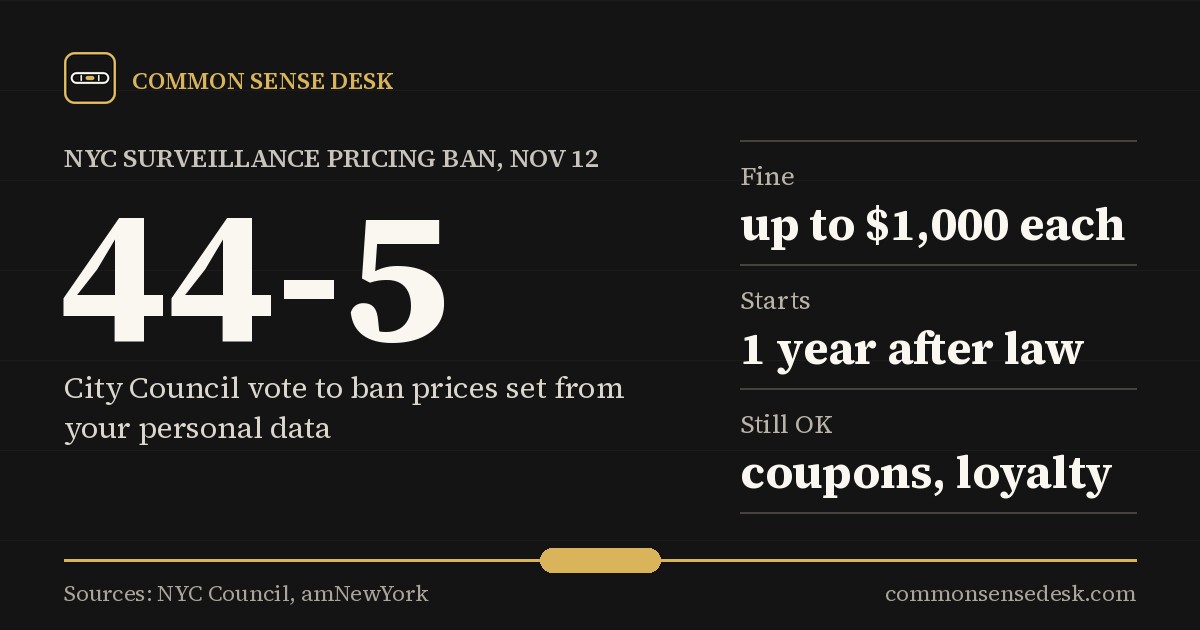
Ever check a price on your phone, then see a different price for the same thing on your spouse's phone? There's a name for that when it's done on purpose using your personal data: "surveillance pricing." On Thursday, November 12, the New York City Council voted 44-5 to ban it.
It's one of the first laws of its kind in the country, and it touches something every family cares about: whether the price you see is the real price, or a price set just for you based on what a company thinks you'll pay.
What surveillance pricing is
Stores have always had sales, coupons and loyalty cards. Surveillance pricing is different. It's when a company uses your personal data, like your location, browsing history, what you've bought before, what kind of phone you use or even how often you open an app, and runs it through an algorithm to set a price just for you.
Two people can look at the same item or the same ride at the same moment and be charged different amounts, without either of them knowing why.
The City Council looked into it with its own test. Staff used 10 rideshare accounts to run about 370 price checks on three routes. Some accounts kept getting automatic discounts that others didn't, on the same route at the same time, and at least one account never got a discount at all, according to amNewYork.
What the new law does
The bill, called Introduction 891-A, was sponsored by Council Speaker Julie Menin. Here's what it does, according to the Council and amNewYork:
- Bans companies from using New Yorkers' personal data and algorithms to set or adjust individual prices.
- Bans collecting, selling or sharing personal information to help do that.
- Fines of up to $1,000 per violation, and each affected customer or sale can count as a separate violation.
- Enforcement by the city's Department of Consumer and Worker Protection, which can investigate complaints.
- Small businesses get a warning for a first violation and 30 days to fix it, including paying customers back, before fines kick in.
The ban takes effect one year after it becomes law. The first draft would have started in 120 days, but that was pushed back.
What's still allowed
This was the big fight. Business groups worried the first draft, just two pages long, would wipe out normal deals. The Hotel Association of New York City warned that customers "would be unable to accrue or use rewards program benefits" under the original language. DoorDash said it could stop restaurants from offering promotions to win new customers. Retail and tech groups raised similar concerns.
The final bill grew to 10 pages and spells out exceptions. Still allowed:
- Ordinary sales, coupons and buy-one-get-one deals.
- Loyalty and rewards programs.
- Discounts for groups like veterans, seniors and students.
- Some discounts based on what you've bought before, with disclosure rules and limits on how the data is used.
- Pricing in already regulated areas like insurance and credit.
In plain words: a company can still give everyone a deal, or give a deal to a group, as long as it's out in the open. What it can't do is quietly use your personal profile to charge you more than the next person.
What both sides say
"The City Council is putting consumers first by ending the deceptive and insidious practice of surveillance pricing," Menin said. She called the practice "unethical" and said it "worsens our affordability crisis."
Council Member Harvey Epstein, who chairs the consumer protection committee, warned that "when pricing is based on personal and biometric data," the chance of discrimination "skyrockets."
The five votes against came from the Council's Republicans. Industry groups, while they won changes, have argued that personalized offers often mean lower prices for some customers, and that rules this broad can make it harder to run normal promotions.
One thing the bill doesn't do: let individual shoppers sue. The city's consumer protection commissioner, Sam Levine, had asked for that, saying enforcement by the city should be backed up by private lawsuits. It was left out, so enforcement will be up to the city.
The state may follow
State lawmakers passed a similar bill, the One Fair Price Act, in June. It would ban surveillance pricing statewide, with the state attorney general enforcing it. Gov. Kathy Hochul hadn't signed it as of last week.
What it means for your wallet
Even if you don't live in New York, this is worth paying attention to, because big companies tend to change their apps everywhere rather than run one version just for one city. And it's a reminder that the price on your screen may not be the same for everyone.
Common-sense habits help no matter where you live:
- Compare before you buy. Check the price logged out, in a private browser window, or on a different device. If it changes, that tells you something.
- Don't rush. "Price going up soon" pressure is a classic tactic.
- Limit what apps know. Turn off location for apps that don't need it, and clear cookies now and then.
- Use the deals that are open to everyone, like posted sales and loyalty points, instead of mystery "just for you" prices.
Paying the price on the tag, the same as your neighbor, isn't too much to ask.
Sources
- New York City Council: press release on Intro 891-A council.nyc.gov
- amNewYork: NYC Council passes ban on companies using your data to set prices amny.com
- City & State New York: Julie Menin's surveillance pricing ban passes the council cityandstateny.com