

We may earn a commission from Amazon links on this page, at no extra cost to you. As an Amazon Associate, Common Sense Desk earns from qualifying purchases.
New York City is breaking up the NYPD unit that handles big protests. On Monday, November 16, Mayor Zohran Mamdani and Police Commissioner Jessica Tisch announced that the Strategic Response Group, known as the SRG, will be disbanded. Its jobs are being split up among new and existing teams, and some protest tactics are being banned outright.
Supporters say it's a long-overdue fix after years of complaints. Police unions say it puts officers and the public at risk. Here's what's changing and what each side says.
What the SRG did
The SRG was created in 2015. It had two main jobs: counterterrorism, such as heavily armed officers posted at key sites around the city, and responding to large protests and crowds.
The protest side is where the criticism came from. The unit faced accusations of excessive force, especially during the 2020 George Floyd protests, and the city paid major legal settlements. A 2023 settlement, which came partly out of the detention of more than 100 demonstrators in 2020, set rules on how and when the SRG could be sent to protests, according to NBC New York.
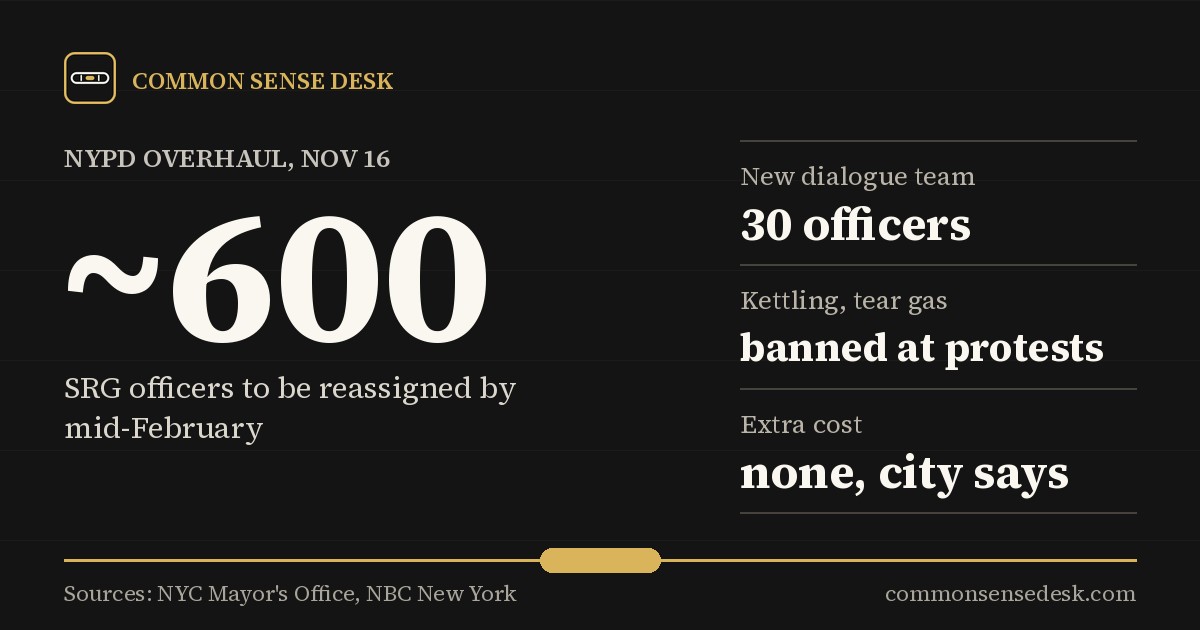
About 600 officers are in the unit, according to NBC New York. Some other outlets put the number closer to 500.
What replaces it
According to the Mayor's Office, the SRG's work is being divided like this:
- Counterterrorism moves to the NYPD's existing Intelligence and Counterterrorism Bureau, including heavy-weapons teams at critical infrastructure.
- Patrol Support Division: vetted officers with crowd-management training. They'll spend most of their time on regular patrol work, like missing-person searches, big events and traffic posts in bad weather. They can still make arrests at protests, but the city says that should be rare.
- First Amendment Support Team (FAST): 30 uniformed officers in the Community Affairs Bureau, trained in talking with protesters and calming tense situations.
- Community Dialogue and De-escalation Division: a new civilian team in the Mayor's Office of Community Safety. Its members won't carry weapons or have arrest powers. It's expected to start in the new year. Until then, FAST handles that role.
The SRG is to be fully dissolved by mid-February under the mayor's order, according to NBC New York. The city says the changes cost nothing extra and don't raise or cut the NYPD's total headcount.
Tactics that are now banned or limited
The Mayor's Office listed new rules for protests and other First Amendment activity:
- Kettling, where police surround and box in a crowd so people can't leave, is formally banned.
- Long guns and tear gas are not allowed during protests.
- Pepper spray can no longer be used as a general crowd-control tool.
- Sound devices (long-range acoustic devices) are capped at 90 decibels.
- Bicycles can be used as a force tool only to prevent death or serious injury.
What supporters say
Mamdani made breaking up the SRG a campaign promise. "I promised New Yorkers that we would disband the Strategic Response Group," he said. "Protecting New Yorkers' rights and keeping our communities safe go hand in hand." Asked whether police response times to big incidents would suffer, he said "absolutely" not, according to NBC New York.
Donna Lieberman of the New York Civil Liberties Union welcomed the move: "Good news for New Yorkers. Good news for public safety. Good news for the first amendment."
Tisch had disagreed with the mayor on this issue before, according to Fox 5 New York, but she backed the final plan. "I would never support changes that diminish the NYPD's ability to protect New Yorkers," she said. She said the new setup keeps counterterrorism together, supports patrol officers and handles protests in a way that fits both public safety and the First Amendment.
What critics say
Police unions are against it. Patrick Hendry, president of the Police Benevolent Association, the main union for NYPD officers, told the New York Daily News before the announcement that the plan means "forcing cops to sit on the sidelines until a demonstration has already turned violent." He said it "puts both police officers and the public at greater risk."
Scott Munro, president of the Detectives' Endowment Association, said: "Why change it? It doesn't need to be changed. It's working."
David Sarni, a John Jay College professor and former NYPD detective, called it a mistake and warned of a "major chilling effect" on officers, according to Fox 5 New York.
What it means for you
For most New Yorkers, day-to-day policing won't look different. The city says total police staffing stays the same. The real test will come at the next big protest: whether the new teams can keep things calm and safe, and whether the unions' warnings or the supporters' hopes turn out to be right.
For taxpayers, the city says there's no added cost. The bigger money question is lawsuits. Protest-policing cases have cost New York heavily over the years, and supporters hope fewer forceful tactics will mean fewer payouts. If you want the background on free speech law, a short guide like a very short introduction to free speech covers the basics.
What to watch next
- The SRG's full breakup by mid-February.
- When the civilian de-escalation team actually starts work.
- How the new setup handles the first large protest.
- Whether the police unions take any formal action.
Sources
- NYC Mayor's Office: Mayor Mamdani and Police Commissioner Tisch disband NYPD's Strategic Response Group (Nov. 16, 2026) nyc.gov
- NBC New York (via NBC News): New York Mayor Mamdani disbands divisive NYPD unit nbcnews.com
- Fox 5 New York: NYPD's Strategic Response Group disbanded in major police overhaul fox5ny.com