

We may earn a commission from Amazon links on this page, at no extra cost to you. As an Amazon Associate, Common Sense Desk earns from qualifying purchases.
In November 2023, The Economist put out The World Ahead 2024, its yearly guess at what the next 12 months would bring. Like every year, the cover was packed with little pictures, and like every year, some people online called it a coded message from the elites.
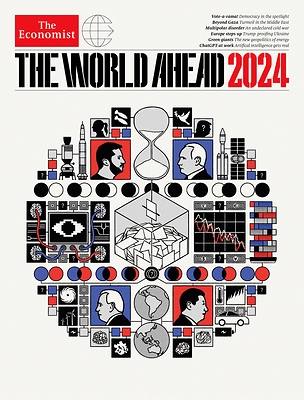
Now 2024 is over, so we can check. Here's what the cover showed, what each picture most likely pointed to, and what actually happened. Hits and misses, both.
First, which cover?
There are two Economist covers from that November, and people mix them up. One was a regular weekly issue with the headline "Donald Trump poses the biggest danger to the world in 2024," as Axios reported at the time. The other is the busy World Ahead 2024 cover, a collage of symbols. This story is about the second one.
The World Ahead 2024 was announced on November 14, 2023, went online November 16 and hit newsstands at the end of the month, according to the magazine's press release. It was edited by Tom Standage. The Economist doesn't publish an official key to its cover pictures, so the readings below come from published descriptions of the cover, matched to the trends the issue itself listed.
The cover, picture by picture
 A ballot box in the middle. The issue's top theme was "Voterama," a record year of elections, with more than 70 votes and about 4.2 billion people living in countries going to the polls. What happened: a hit. Some 70 countries, home to about half the world's people, voted, and many governments got punished, according to the Associated Press. In Japan, the ruling LDP lost its majority. In India, the BJP lost its outright majority. South Africa's ANC lost its majority for the first time.
 The U.S. election. The issue called America's vote the biggest question of the year and gave Trump about a one-in-three chance of winning. What happened: the theme was right, the odds weren't. President Biden dropped out on July 21, 2024, and Trump won with 312 electoral votes to 226, according to official results.
 An hourglass, with figures of the Russian and Ukrainian leaders on either side. Most likely the war dragging on, with time as a factor. What happened: there was no ceasefire in 2024. In December, Moscow said there were still "no grounds" for talks, Reuters reported. Each side blamed the other.
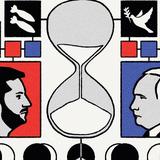 Bombs and doves. The Middle East, and the hope for peace next to the fighting. What happened: a hit on turmoil. The Gaza war went on through all of 2024. A ceasefire only took effect on January 19, 2025, after 15 months of war.
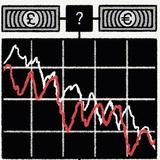 A falling chart with currency signs. Economic worry: the issue expected interest rates to stay high. What happened: mixed. Rates did stay high most of the year. The European Central Bank made its first cut on June 6, and the Federal Reserve's December cut left its key rate at 4.25% to 4.5%. But if the falling chart meant currencies would sink, that didn't happen to the dollar: it rose about 7%, its best year since 2015.
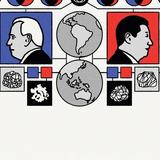 China and America facing away from each other. The issue warned of a "second cold war" with China and possible deflation there. What happened: partly. China's consumer prices rose just 0.2% for the year, so not quite deflation, while factory-gate prices fell 2.2%, according to China's statistics office. Trade tension kept building.
 An eye wired to a brain. Artificial intelligence, under the theme "AI gets real." What happened: a hit. AI tools spread fast, and the European Union's AI Act, the first big AI law, took effect on August 1, 2024.
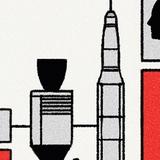 Space rockets. The issue mentioned a possible crewed flight around the Moon, NASA's Artemis II. What happened: a miss for 2024. NASA delayed the mission in December 2024. It finally flew in April 2026.
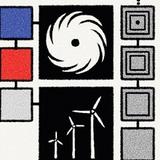 Energy and climate. The issue expected a new energy map and a backlash against climate rules. What happened: 2024 was the warmest year on record, and the first calendar year more than 1.5°C above pre-industrial levels, at about 1.6°C, according to Europe's Copernicus climate service. One hot year doesn't by itself mean the long-term 1.5°C limit has been broken.
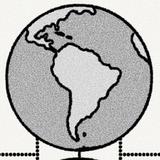 Events that bring people together. The issue pointed to the Paris Olympics and the men's T20 cricket World Cup. What happened: a hit, but an easy one. Both were already on the calendar. India won the T20 World Cup on June 29, and the Paris Games ran from late July into August.
The scorecard
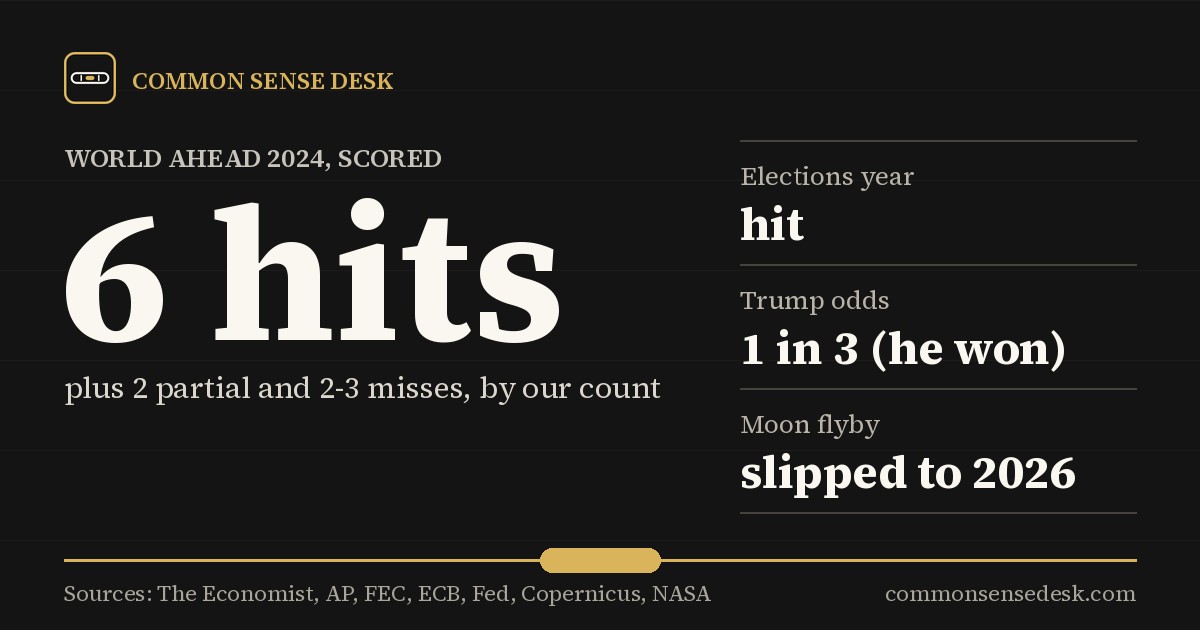
By our count: about six hits, two partial hits and two or three misses. That's a decent record. But look at what kind of calls they were.
The hits were mostly things anyone could see coming: elections already scheduled, wars already going on, sports events already booked, a technology already spreading. The misses were the specific bets, like a date for a Moon flight or the odds on who would win the White House.
That's exactly what you'd expect from smart journalists making educated guesses. It's not what you'd expect from people who secretly control the future. If the cover were a plan, they wouldn't have given the winner only a one-in-three chance.
Why the "secret plan" idea keeps coming back
A cover with a dozen small drawings will always match something. People remember the matches and forget the rest. And fake Economist covers make it worse. In late 2024, a fake "Apocalypse" cover with Trump and Putin went viral. Fact-checkers at Full Fact and AAP showed it was made up. The real cover that week was about Europe's defense.
The simplest test: is the "hidden meaning" also printed, in plain words, inside the same magazine? For World Ahead covers, it almost always is. A secret you publish to millions of readers isn't much of a secret. If you'd like to read more on how forecasting works and why even experts miss, Superforecasting by Philip Tetlock is a good place to start.
What it means for you
- Treat yearly forecasts as a checklist of things to watch, not a script. The 2024 list was useful for that.
- The money calls are the hardest. High rates did hang on, but the dollar went the other way from what a falling chart suggests. Don't make big money moves based on a magazine cover, or on someone "decoding" one.
- Check the cover is real before you believe, or share, a post about it.
Sources
- The Economist (PR Newswire): 2024 will put a spotlight on the global state of democracy prnewswire.com
- Axios: The Economist says Trump poses the biggest danger to the world in 2024 axios.com
- AP (via WDIV): The super year of elections has been super bad for incumbents clickondetroit.com
- European Central Bank: monetary policy decision, June 6, 2024 ecb.europa.eu
- Federal Reserve: FOMC statement, Dec. 18, 2024 federalreserve.gov
- European Commission: AI Act enters into force commission.europa.eu
- ECMWF/Copernicus: 2024 global climate highlights ecmwf.int
- Full Fact: Fake Economist cover with Trump and Putin fullfact.org