

We may earn a commission from Amazon links on this page, at no extra cost to you. As an Amazon Associate, Common Sense Desk earns from qualifying purchases.
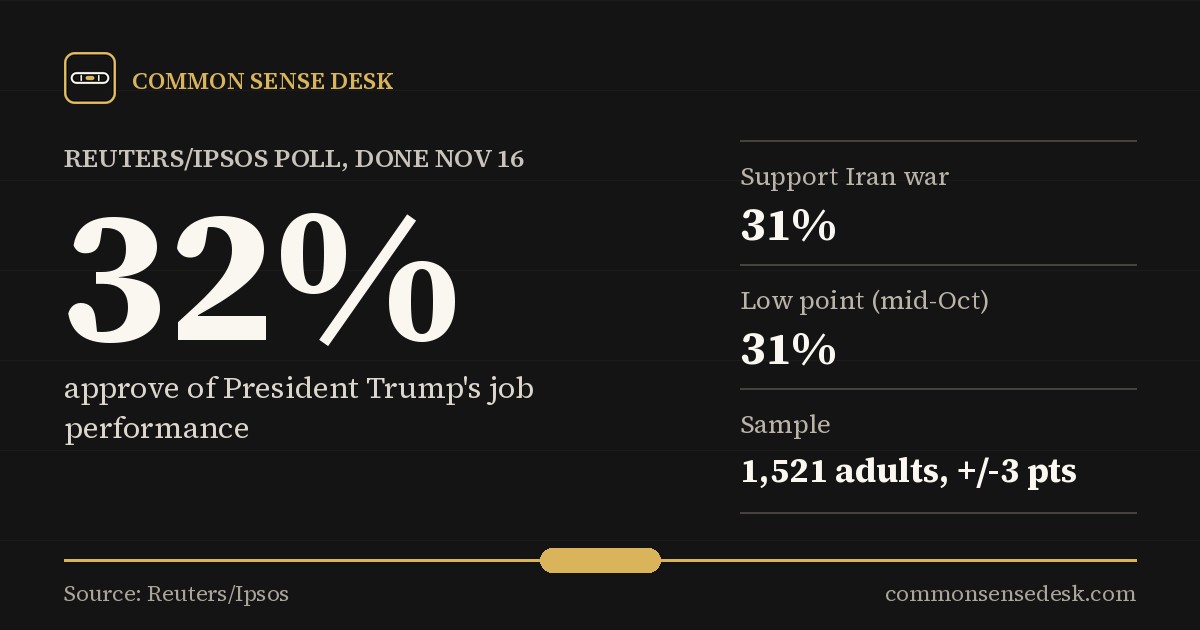
President Trump's approval rating is holding at 32%, according to a new Reuters/Ipsos poll that wrapped up on Monday, November 16. That's close to the lowest of his career, and it's the fourth Reuters/Ipsos poll in a row to land on the same number.
Here's what the poll found, how it compares with earlier surveys, what it says about both parties, and how much weight to give any single poll.
The numbers
- Trump's approval: 32% of Americans approve of how he's doing his job.
- Lowest point: 31% in mid-October, the lowest of his presidency in Reuters/Ipsos polling, according to Reuters.
- Trend: 32% in four straight Reuters/Ipsos polls since then.
- Iran war: only 31% of Americans support it.
- Republicans: 75% say they like Trump, and 77% say they like Vice President JD Vance.
The poll was done online over four days, ending Monday. It surveyed 1,521 U.S. adults across the country, and the margin of error is about 3 percentage points either way, according to Reuters.
How it compares with earlier polls
The number has barely moved for weeks. A Reuters/Ipsos poll taken November 6 to 9 also had Trump at 32%. In that one, only 21% approved of how he's handling the cost of living, according to Reuters.
An Ipsos survey taken October 29 to November 2, just before the midterm elections, also showed 32% approval. In that poll, 52% of likely voters said they'd vote or lean Democratic for Congress, and 44% said Republican, according to Ipsos.
Back in late September, Reuters/Ipsos had Trump at 32% as well, which was a record low at the time. It slipped to 31% in mid-October and has been at 32% since.
Why the numbers are low
Reuters ties the slide mainly to the war with Iran, which started in February, and its effect on prices. Fuel prices jumped sharply as tensions over the Strait of Hormuz rose, and that hit household budgets. Higher gas and diesel prices push up the cost of shipping, food and almost everything else.
Those worries showed up at the ballot box. Republicans lost control of Congress in the November 3 midterm elections, and Democrats will run both the House and the Senate starting in January.
Gas prices have been falling lately as fears about Iran have eased. AAA had the national average at $3.81 a gallon on Monday, down about 50 cents in a month, though it's still well above last year. We covered that in our gas price story. Whether cheaper gas lifts Trump's numbers is one thing to watch in the coming polls.
Democratic leaders aren't very popular either
The poll also asked Democrats about their own party's leaders, and the results weren't glowing.
- Senate Democratic leader Chuck Schumer: 34% of Democrats view him favorably, 43% unfavorably, and 22% have never heard of him. In February, it was 38% favorable and 37% unfavorable.
- House Democratic leader Hakeem Jeffries: 40% of Democrats view him favorably, 29% unfavorably, and 29% don't know who he is.
Schumer is facing a challenge for his leadership job from Sen. Chris Van Hollen of Maryland. That vote among Senate Democrats is expected in early December. Sen. Bernie Sanders has already said he won't back Schumer, as we reported in our earlier story.
So the picture is mixed. Voters are unhappy with the president, but Democrats aren't thrilled with their own leaders either.
How much to trust one poll
A few things are worth keeping in mind:
- Margin of error. With about 3 points either way, the "real" number could be anywhere from roughly 29% to 35%.
- Polls differ. Different pollsters ask questions in different ways and survey different groups, such as all adults, registered voters or likely voters. This one surveyed all adults. Other polls may show somewhat different numbers.
- The trend matters more than one result. The useful part here is that Reuters/Ipsos has shown the same number four times in a row. That suggests opinion is steady, not moving much in either direction.
If you want a deeper look at how polling works and where it goes wrong, a plain-language book on polling can help.
What it means for your wallet
Approval ratings don't change your bills directly. But they do shape what Washington does next. A weak approval number and a Democratic Congress starting in January make big new spending or tax changes harder to pass without deals between the two parties.
The issues that drive these numbers are the same ones you feel: gas, groceries and the cost of borrowing. Gas prices are falling, the Federal Reserve meets on December 9, and the next inflation report comes out December 10. Those will matter more for your budget than any poll.
What to watch next
- Whether Trump's approval rises as gas prices keep falling.
- Any progress on talks with Iran.
- The Senate Democrats' leadership vote in early December.
- Government funding and debt-limit fights in the lame-duck Congress before the new one takes over in January.
Sources
- Reuters (via U.S. News & World Report): Trump approval holds near career low at 32%, Reuters/Ipsos poll finds usnews.com
- Ipsos: Reuters/Ipsos early November survey (Oct. 29 - Nov. 2) ipsos.com
- Reuters (via The Star): Trump approval holds at 32%, near lowest of his career (Nov. 6-9 poll) thestar.com.my