

We may earn a commission from Amazon links on this page, at no extra cost to you. As an Amazon Associate, Common Sense Desk earns from qualifying purchases.
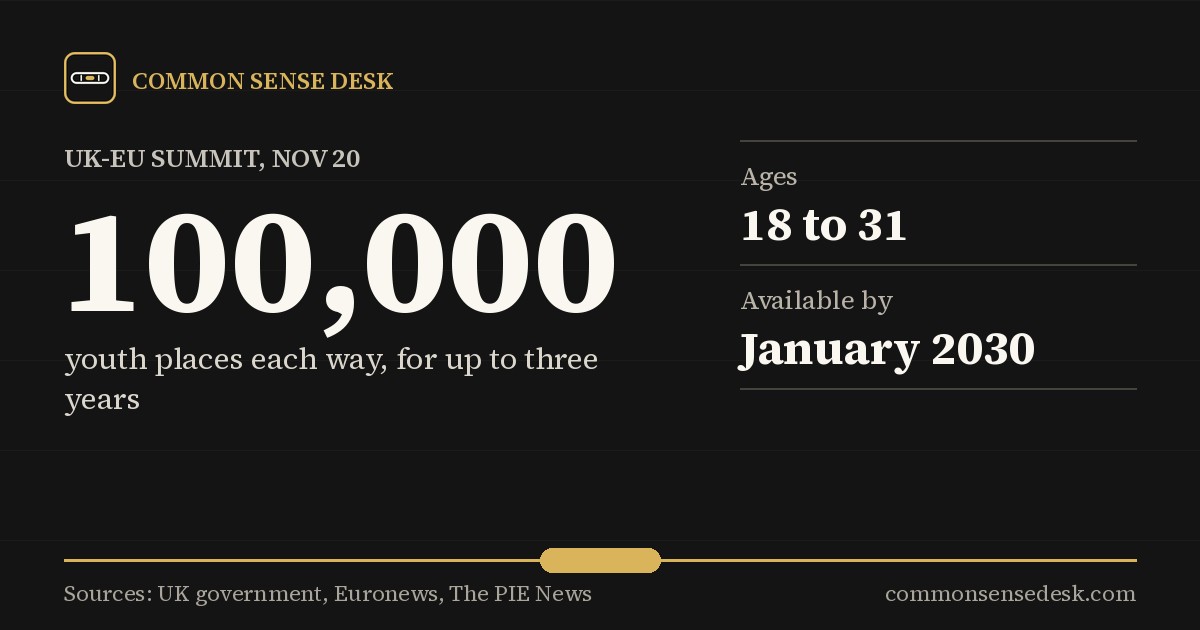
The United Kingdom and the European Union agreed on Friday, November 20, to let up to 100,000 young people from each side live, work and study in the other for up to three years. The deal, called the Youth Experience Scheme, was agreed at a UK-EU summit in Brussels, according to the British government and Euronews.
It's the biggest step toward easier movement between Britain and the EU since Brexit. "Ten years on from Brexit, today we open a new chapter," Prime Minister Andy Burnham said in a government statement.
Who qualifies and what they can do
According to the UK government's announcement:
- The scheme is for people aged 18 to 31.
- Up to 100,000 places are available for young Europeans to come to the UK, and the same number for young Britons to go to the EU, according to Euronews and The PIE News, which covers international education.
- Stays can last up to three years.
- People can work, study, volunteer, work as au pairs or travel.
- There's no need for a job offer, and no language or salary requirements.
- There's no access to welfare benefits and no right to bring dependants.
The government says the scheme will be "capped, time-limited and visa-based," so it's not a return to the free movement Britain had as an EU member. Applicants will still need a visa.
When it starts
Not right away. The two sides aim to have the agreement in force by 2028 and the places available no later than January 2030, according to The PIE News, citing the summit's joint statement. The UK government says a bill to put several parts of the summit deal into law will be introduced in Parliament next week.
What's still unsettled: tuition fees
The biggest open question is university fees. Since Brexit, EU students in England pay international fees, which can be several times what British students pay. The UK has offered to lower them, while the EU wants its students treated the same as British ones, according to Euronews. The two sides failed to settle it and agreed to finish a separate deal within six months.
British universities are watching closely. Hollie Chandler of the Russell Group, which represents leading research universities, warned against changes that "would put pressure on UK student places," The PIE News reported. Vivienne Stern of Universities UK called the deal "pragmatic."
Euronews noted that EU member states could still make final approval of the agreements depend on a deal on fees.
The rest of the deal
The youth scheme was one part of a wider package. According to the UK government:
- Erasmus+: the UK will rejoin the EU's student exchange program from January 1, 2027.
- Food trade: health certificates and many checks on food and farm exports to the EU will be scrapped, which the government says will cut costs and paperwork for farmers and food companies.
- Carbon markets: linking the UK and EU carbon trading systems, which the government says will spare £6.5 billion of British exports from a new EU carbon border charge.
- Migration and security: a new formal dialogue on migration, joint work on Channel crossings, and closer cooperation on defense, cyber threats and Russia's "shadow fleet" of oil tankers.
The government says the whole package could add up to 0.5% to UK GDP by 2040, about £17 billion a year, with the youth scheme alone worth up to 0.2%. Those are the government's own estimates.
"This deal really is about lifting your life chances," Burnham said, addressing young people.
The other side
Not everyone in Britain wants closer ties with the EU, and critics of earlier versions of the plan have argued that any youth scheme risks becoming free movement by another name, adding to immigration numbers the public has repeatedly said are too high. The government's answer is the cap, the time limit, the visa requirement and the bar on benefits and dependants. No statement from the Conservative or Reform UK parties on Friday's deal had been published as of Friday afternoon.
What it means for you
If you're a young person in the UK or an EU country, you'll eventually have a much easier way to spend a year or more abroad working or studying, though probably not before 2028 to 2030. If you're thinking about it, it's worth keeping a passport current and watching for the visa details.
For travellers and students already going back and forth, small practical things help in the meantime, like a UK-to-Europe plug adapter.
What to watch
The tuition fee talks over the next six months, the bill in Parliament next week, and whether EU member states tie their final approval to a fees deal.
Sources
- UK Prime Minister's Office: PM secures deal with EU (Nov. 20, 2026) gov.uk
- UK government: PM speech at UK-EU summit (Nov. 20, 2026) gov.uk
- Euronews (via Yahoo): Young Europeans win a route back to the UK, but not cheaper university fees yet (Nov. 20, 2026) yahoo.com
- The PIE News: UK-EU youth mobility places agreed as tuition fee decision delayed (Nov. 20, 2026) thepienews.com