

Federal regulators closed United Fidelity Bank, a savings bank based in Evansville, Indiana, on Friday, November 27. Its customers did not lose their deposits. First-Citizens Bank & Trust Company, known as First Citizens Bank, took over substantially all of the bank's deposits and assets, and United Fidelity's branches are reopening as First Citizens branches.
Not the same company as Fidelity Investments. Despite the similar name, United Fidelity Bank is not Fidelity Investments, the large brokerage and mutual fund company. The FDIC and the Office of the Comptroller of the Currency closure notices are about United Fidelity Bank, fsb, of Evansville only. Nothing in them involves Fidelity Investments accounts.
What happened
The Office of the Comptroller of the Currency (OCC), which supervises national banks and federal savings banks, closed United Fidelity on Friday evening. It said the bank was "likely to be unable to pay its obligations or meet its depositors' demands in the normal course of business." The OCC then appointed the Federal Deposit Insurance Corporation (FDIC) as receiver, which is the standard step when a bank fails.
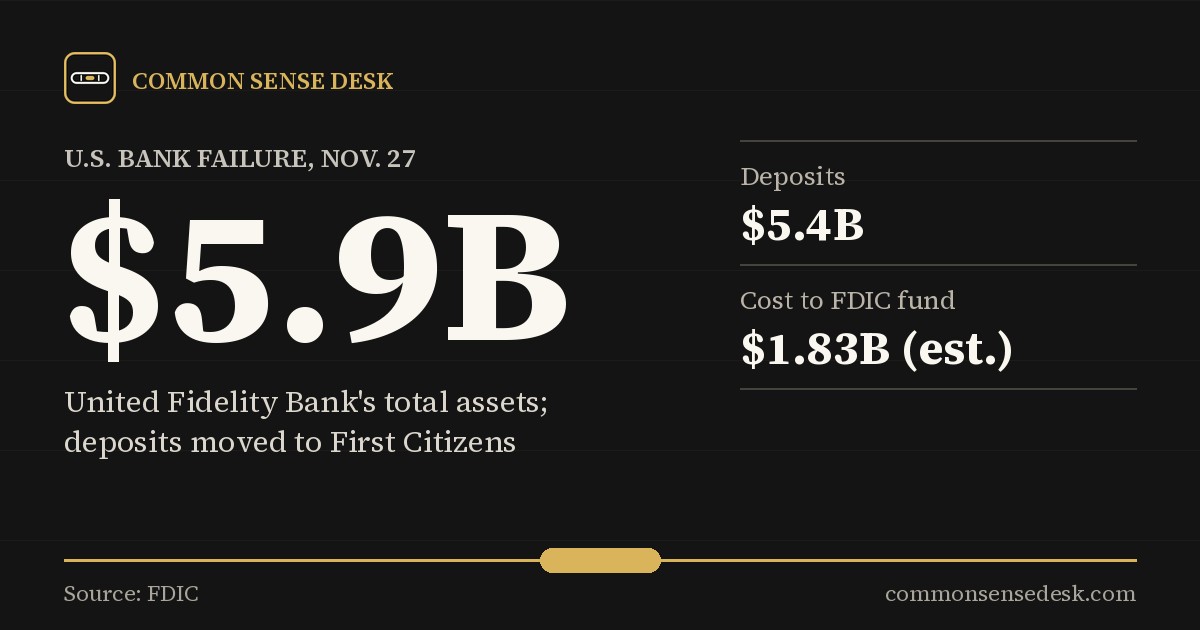
The FDIC reached a deal with First Citizens Bank of Raleigh, North Carolina, to assume substantially all of United Fidelity's deposits and buy substantially all of its assets. According to the FDIC, United Fidelity had about $5.9 billion in total assets and $5.4 billion in total deposits as of September 30. The FDIC estimates the failure will cost its Deposit Insurance Fund $1.83 billion. That fund is paid for by fees on banks, not by taxpayers directly.
It is the seventh U.S. bank failure this year, according to the FDIC, as reported by NPR. News reports describe it as the largest U.S. bank failure since April 2024, when Republic First Bank in Philadelphia was closed with about $6 billion in assets. Neither United Fidelity nor the OCC has publicly explained what caused the bank's problems.
Is my money safe?
If you had money at United Fidelity, the FDIC's answer is yes. In its official questions-and-answers page for this failure, the FDIC says: "No one lost any money on deposits as a result of the closure of this bank." It says substantially all deposit accounts, "regardless of dollar amount," moved to First Citizens. That includes checking, savings, money market accounts, certificates of deposit and retirement accounts.
That matters for people with more than $250,000 in the bank. FDIC insurance normally covers up to $250,000 per depositor, per insured bank, for each account ownership category. Because First Citizens took over the deposits whole, balances above that limit moved over too.
Read next: U.S. inflation ran hotter than expected in October
There is one exception to know about. The FDIC says deposits held through brokers, listed as "Cede & Co." deposits, were not part of the transfer. If you hold a United Fidelity certificate of deposit that you bought through a brokerage account, the FDIC says to contact your broker with questions. Newsweek reported that First Citizens said it agreed to assume $4.5 billion in deposits, less than the $5.4 billion total the bank held at the end of September.
FDIC insurance covers bank deposits only. It does not cover stocks, bonds, mutual funds or crypto, whether you hold them through a bank or anywhere else.
What United Fidelity customers should do now
- Keep using your cards and checks. The FDIC says checks will clear up to your balance and ATM and debit cards keep working as usual.
- Direct deposits continue. Paychecks, Social Security, veterans' benefits and other electronic payments keep arriving as normal.
- Your account and routing numbers stay the same until First Citizens tells you in writing that they are changing. Autopay, bill pay and online banking keep working.
- Keep making loan payments as usual, to the same address, until you are told otherwise in writing.
- Interest is paid through November 27 at your current rate. First Citizens will review the rates and tell you in writing about any change. Until you sign a new agreement with First Citizens, you can take money out of a transferred account without an early-withdrawal penalty.
- Use your usual branch for now. The 22 branches in Indiana, Illinois, Florida, Colorado and the U.S. Virgin Islands reopen as First Citizens branches. Branches that normally open Saturdays reopened Saturday; the rest open Monday during normal hours. Other First Citizens branches won't handle your account until the systems are combined, and First Citizens will tell you when that happens.
- Safe deposit boxes stay accessible.
- Questions: the FDIC call center is at 1-866-431-1725. It is open Sunday from noon to 4 p.m. Central time, Monday from 8 a.m. to 5 p.m., and after that from 8 a.m. to 4 p.m. Central time, according to WFIE in Evansville.
Accounts at United Fidelity and First Citizens are insured separately for at least six months after the merger. So if you already banked at both, your coverage does not shrink right away.
Who is First Citizens?
First Citizens Bank is based in Raleigh, North Carolina. It is the same bank that took over much of Silicon Valley Bank after that bank failed in March 2023. Its chairman and CEO, Frank B. Holding Jr., called the United Fidelity deal "financially and strategically compelling" and said the bank looks forward to "welcoming our new customers, earning their trust." Indiana Senator Jim Banks, a Republican on the Senate Banking Committee, said he will be briefed on the failure on Monday, NPR reported.
Bigger picture: the Fed is in its quiet period
The failure comes just before the Federal Reserve's last meeting of the year, on December 8 and 9, with the rate decision on December 9, according to the Fed's own calendar. Fed officials entered their usual pre-meeting quiet period on Saturday, November 28, so they won't comment publicly on the economy or interest rates until after the decision. Markets have been bracing for a possible rate increase after hotter-than-expected inflation, as covered in our November 25 markets story.
What it means for you
- If you were a United Fidelity customer, you don't need to do anything right now. Watch for letters from First Citizens about any changes.
- If you hold a United Fidelity CD through a brokerage, call your broker.
- If you just want to check your own coverage at any bank, the FDIC's rule of thumb is $250,000 per depositor, per bank, per ownership category. Joint accounts and retirement accounts count as separate categories.
Sources
- FDIC: Frequently Asked Questions for United Fidelity Bank, fsb, Evansville, IN (Nov. 27, 2026) fdic.gov
- WFIE 14 News: Evansville-based United Fidelity Bank closes, deposits transferred to First Citizens (Nov. 28, 2026) 14news.com
- NPR via WUSF: Federal regulators close United Fidelity in biggest U.S. bank closure since 2024 (Nov. 28, 2026) wusf.org
- Newsweek: United Fidelity shut in biggest bank failure in years: is your money safe? (Nov. 28, 2026) newsweek.com
- Federal Reserve: 2026 FOMC meeting calendar federalreserve.gov