

We may earn a commission from Amazon links on this page, at no extra cost to you. As an Amazon Associate, Common Sense Desk earns from qualifying purchases.
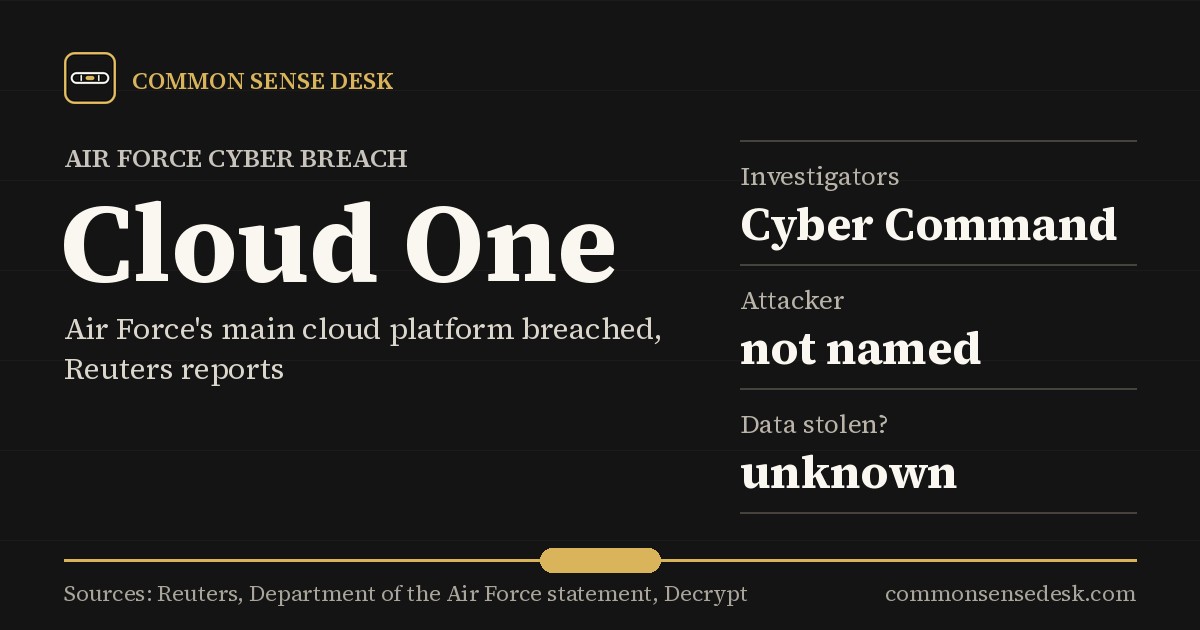
Hackers got into Cloud One, the U.S. Air Force's main cloud computing platform, and the systems it hosts include one that pulls together air defense radar feeds across North America and another that keeps count of bombs and missiles at more than 200 Air Force locations worldwide, Reuters reported on November 27.
Nobody outside the investigation knows yet whether anything was taken. Reuters said it could not determine who the hackers were, how far they got, or whether any data was stolen. The reporting is based on people familiar with the matter who spoke on condition of anonymity.
"A breach here is a big deal," one of them told Reuters.
What the Air Force said
Not much. The service told Reuters it "does not comment on the security posture, vulnerabilities or operational status of specific networks and systems." It added: "We continuously take prudent measures to protect Department (of the Air Force) information, systems and mission capabilities."
That's neither a confirmation nor a denial. Investigators have brought in U.S. Cyber Command, the military's own cyber force, to assess the damage, according to Reuters. Cyber Command did not respond to the news agency's requests for comment.
What Cloud One actually does
Cloud One launched in 2017 as a one-stop shop for the Air Force's computing needs. Instead of each office running its own servers, applications sit on a shared platform that draws on cloud capacity from Microsoft, Amazon, Oracle and Alphabet. It runs software for personnel records, pay, logistics and maintenance, and Reuters described it as one of the U.S. military's largest cloud platforms.
Two of the systems on it stand out. The Cloud-Based Command and Control system collates air defense radar and other data feeds from across North America, the kind of picture used to watch the skies over the continent. The Theater Integrated Combat Munitions System tracks the Air Force's bombs and missiles at those 200-plus sites. Reuters said it was unclear whether the hackers reached data on aircraft status or the movement of spare parts.
For anyone wondering how state-level hacking got to the point where a military cloud is a target, Nicole Perlroth's This Is How They Tell Me the World Ends traces the market for software flaws that makes these break-ins possible.
Read next: CIA and ODNI hit by cyber breach of unclassified intelligence system; no classified systems affected
How they got in, according to one source
One person told Reuters the intruders exploited a software vulnerability to reach the platform's control plane. That's the management layer of a cloud system, the part administrators use to set up, change and oversee everything running on top of it. Getting there is more serious than breaking into one app, because it can open the door to many of them. Reuters couldn't identify which vulnerability was used.
The intrusion was found within roughly the past month, during work to upgrade the system, two people said.
The break-in has caused disruption across the platform. Plans to move more back-office applications onto Cloud One have been paused. Updates to the applications already there were blocked, which means staff couldn't apply fixes even as new software vulnerabilities were being made public. Some users had their administrator rights taken away.
That freeze is an awkward trade-off. Locking a system down keeps an intruder from using normal update channels, but it also leaves known holes unpatched for longer.
The contractors
SAIC was Cloud One's prime contractor until 2026, when Leidos took over, according to Reuters. SAIC did not respond to a request for comment, and Leidos referred questions to the Air Force. Other outlets that carried the story gave different years for the handover, so that detail may still shift.
In a 2023 commentary for FedScoop, Cloud One's leadership described the number of attempts to break into the platform as "staggering" and claimed a "100% success rate" in stopping them. "There is no room for error when it comes to security," they wrote.
Andy Greenberg's Sandworm is a good, readable account of what happens when attackers reach systems that run real-world operations, not just office email.
A rough month for government networks
This isn't landing in a quiet week. Reuters noted the U.S. government is already dealing with at least six other recently disclosed cyber incidents, including ones at the FBI, the Pentagon, the Department of Homeland Security, two spy agencies and the Treasury Department.
We've covered some of them. Earlier this week, a breach of an unclassified intelligence system used by the CIA and the Office of the Director of National Intelligence came to light, and the FBI is looking into a suspected breach of the NCIC crime database that police use every day. Officials haven't publicly tied any of these incidents to each other or to Cloud One.
Reuters also noted growing concern about intrusions that use artificial intelligence tools. No one has said whether that played any role here.
What's still unknown
- Who was behind it. No suspect has been named.
- Whether data was copied out, or whether the hackers only reached the system.
- How long the intruders had access before they were spotted.
- When normal updates on the platform resume.
What it means for you
For most people, nothing directly. Cloud One holds military operations and personnel data, not consumer bank or shopping accounts. Service members and Air Force civilian staff are the ones to watch for any notice from the service if personnel records turn out to be involved.
The broader lesson is the same one this month keeps repeating, from leaked Chase customer emails to Bell's business customers: big organizations get breached, and your own accounts are only as safe as the login protecting them. A hardware security key is much harder to phish than a text-message code, and a different password for every account means one leak doesn't unlock the rest.
Sources
- Reuters (via Hawaii Tribune-Herald), Nov. 27-28, 2026: Hackers breach US Air Force flagship Cloud One computing platform hawaiitribune-herald.com
- Decrypt, Nov. 27, 2026: Hackers hit US Air Force cloud system running air-defense and munitions data decrypt.co