

We may earn a commission from Amazon links on this page, at no extra cost to you. As an Amazon Associate, Common Sense Desk earns from qualifying purchases.
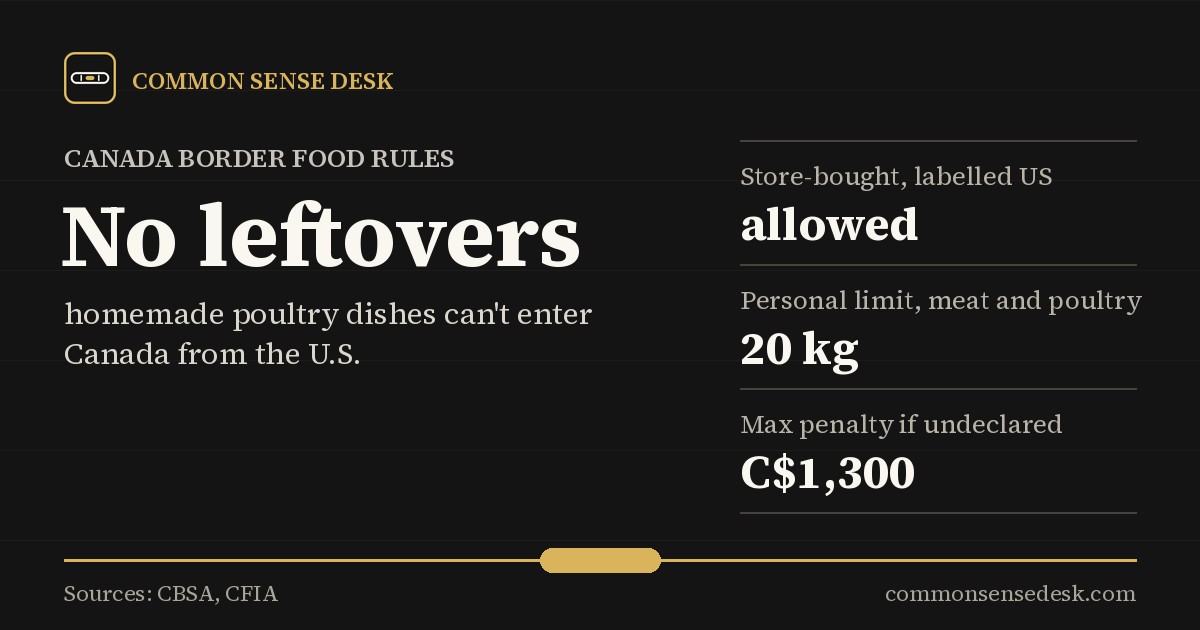
If you're driving back to Canada after American Thanksgiving with a container of leftover turkey, leave it behind. Canadian border rules don't allow homemade food or leftovers containing poultry to enter the country from the United States, because of bird flu.
"Homemade food or leftovers containing poultry cannot be brought into Canada," the Canada Border Services Agency said in its travel advisory. The rule applies to Americans visiting Canada and to Canadians coming home after celebrating with family south of the border.
It isn't a new ban, despite some headlines this week. It's a standing rule from the Canadian Food Inspection Agency, in place because of outbreaks of highly pathogenic avian influenza in both countries. But it matters more this week, when thousands of people cross the border for U.S. Thanksgiving.
What you can't bring
According to the Canadian Food Inspection Agency, the restricted items for travellers include:
- leftovers and homemade food containing poultry, such as turkey sandwiches, casseroles or stuffing made with poultry stock;
- restaurant food containing poultry;
- poultry products bought at roadside stands, farms or from backyard flocks;
- raw pet food, which is never allowed for travellers.
Meat, including poultry, also can't be sent into Canada by mail or courier by individuals.
What you can bring
The rule is not a blanket ban on American poultry. The CFIA allows travellers to bring in poultry products that are retail-packaged for human consumption and clearly labelled "Product of the USA," from any U.S. state, even states with current outbreaks.
That includes things like vacuum-packed raw chicken breasts and thighs, rotisserie chickens, frozen whole turkeys, deli meats and eggs from a grocery store, as long as they're in their original packaging and within personal import limits. Those limits are up to 20 kilograms (44 pounds) of meat and poultry products and five dozen eggs per person, Newsweek reported, citing Canadian rules.
If you're bringing a store-bought frozen turkey home, a large insulated cooler bag keeps it frozen on a long drive, and the original label needs to stay on.
Read next: Thanksgiving storm: East Coast faces 65 mph gusts and coastal flooding; king tides flood West Coast
Pets
Cooked kibble and canned pet food with poultry ingredients can come in, as long as the pet is travelling with you. Live pet birds still need official certification from the U.S. Department of Agriculture.
Why the rule exists
Bird flu spreads easily among poultry and wild birds, and outbreaks can force farms to destroy whole flocks. Canada and the U.S. have both had fresh outbreaks this fall. The CFIA set up a new bird flu control zone in Alberta on November 18, and Hong Kong suspended poultry imports from parts of Quebec and four U.S. counties this week after new outbreaks, Newsweek reported.
Commercial poultry crosses the border every day with veterinary paperwork and inspections. Homemade food has no such checks, which is why border rules treat a leftover turkey dinner differently from a sealed package from a grocery store.
What happens if you don't declare it
The CBSA says to declare all food you're carrying. Undeclared food, plant and animal products can be confiscated, and travellers "may have to pay a penalty of up to C$1,300," the agency said. Penalties range from C$500 for minor violations to C$1,300 for very serious ones, according to Newsweek. If you declare an item that isn't allowed, officers will usually just take it.
Drivers are responsible for everything in their vehicle, the CBSA says, including what passengers bring.
Tips for crossing this weekend
- Eat the leftovers before you leave, or leave them with family.
- Keep grocery poultry in its original, labelled package. Don't repack it.
- Check weights if you're bringing a lot. A small luggage scale makes it easy to stay under the 20-kilogram personal limit for meat and poultry.
- Check border wait times before you go. The CBSA recommends early-morning crossings to avoid congestion.
- Have your documents ready. A passport holder keeps everyone's passports in one place at the booth.
Rules can change quickly when new outbreaks are found, so the CFIA advises checking its traveller page before leaving the U.S.
More from Common Sense Desk
Sources
- Canada Border Services Agency: Thanksgiving travel advisory
- Canadian Food Inspection Agency: Information for travellers: restrictions on poultry and birds from the United States inspection.canada.ca
- Newsweek (via Yahoo): Canada bans American Thanksgiving leftovers at border yahoo.com