

We may earn a commission from Amazon links on this page, at no extra cost to you. As an Amazon Associate, Common Sense Desk earns from qualifying purchases.
The short answer: People have reported something strange in Loch Ness for about 90 years, and many of them are sincere. But the most famous photo was a confessed hoax, decades of sonar searches found no large unknown animal, and a 2019 DNA survey of the water found no trace of a reptile. Waves, boat wakes, swimming animals, floating logs and possibly large eels explain the sightings far better than a surviving dinosaur.
Loch Ness is a long, narrow, very deep lake in the Scottish Highlands, about 23 miles long and more than 700 feet deep in places. The water is dark with peat, so you can't see far below the surface. On a calm day the loch looks like black glass, and anything that breaks the surface gets noticed.
That's where Nessie lives, the story goes: a large, long-necked creature that surfaces now and then, shows a hump or two, and disappears before anyone gets a clear look. First the story the way people tell it, then what the evidence shows.
The story
Believers often start in the year 565. A biography of the Irish missionary St. Columba, written about a century after his death by the abbot Adomnán, describes Columba ordering a "water beast" to leave a man alone in the River Ness. The beast fled. It's a saint's miracle story, and it happens in the river, not the loch, but it gets quoted as the first sighting.
The modern legend really begins in 1933. That spring, a new road was finished along the loch's north shore, giving drivers long, open views of the water for the first time. On May 2, 1933, the Inverness Courier reported that a local couple had seen a large animal "rolling and plunging" on the surface. The newspaper called it a monster, and the name stuck.
More reports followed that summer. A London couple, the Spicers, said they saw a strange long-necked animal cross the road in front of their car. Newspapers sent reporters. Then, in April 1934, London's Daily Mail published the photo that made Nessie world-famous: a small head on a long, curved neck rising out of the water. It was credited to a respected London doctor, Robert Kenneth Wilson, and became known as the "surgeon's photograph."
For 60 years that picture was the best evidence anyone had. If you want the full history of how the legend grew, Ronald Binns's The Loch Ness Mystery Solved walks through the early reports one by one.
The photo that wasn't
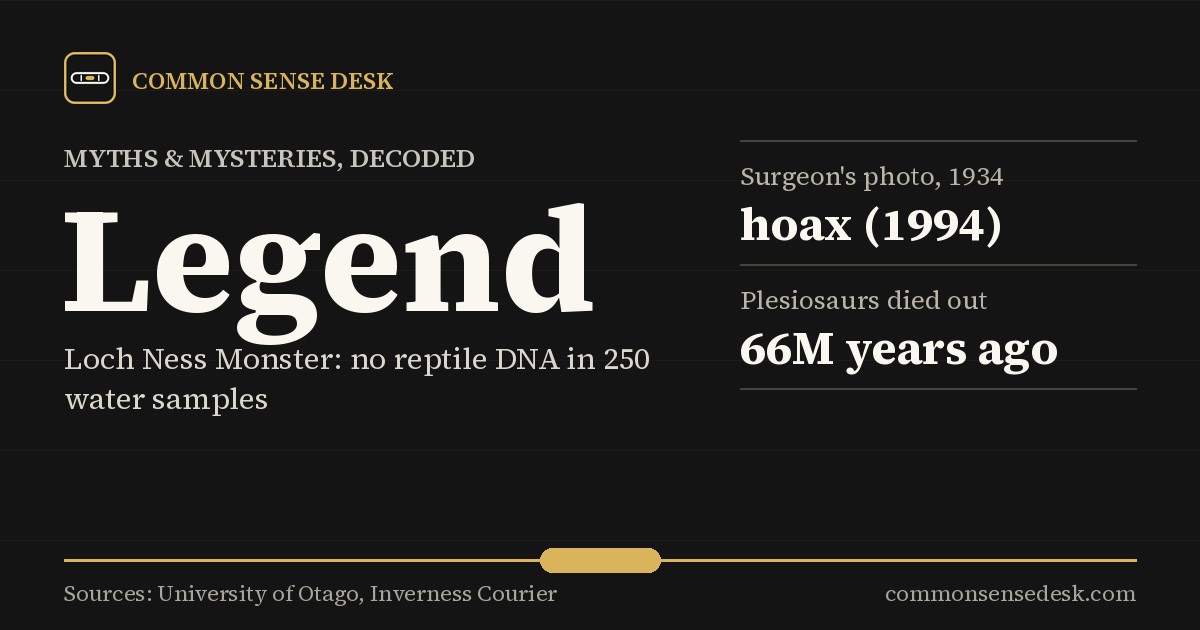
In 1994, the surgeon's photograph was exposed as a fake. Christian Spurling, then in his 90s, told researchers David Martin and Alastair Boyd that he had helped build the "monster" himself: a sculpted head and neck about a foot tall, attached to a toy submarine bought from Woolworths.
According to Spurling, the plan came from his stepfather, Marmaduke Wetherell, a big-game hunter the Daily Mail had hired to find the monster in 1933. Wetherell had found large footprints on the shore, which turned out to have been made with a dried hippo foot, probably an umbrella stand. The newspaper was embarrassed, and Wetherell was angry. The photo was his revenge. The doctor's name was used so the picture would be believed.
Read next: The Bermuda Triangle, decoded: what the records actually show
Searching the loch
People have searched Loch Ness seriously, with real equipment, many times.
- 1987, Operation Deepscan: A line of about two dozen boats with sonar swept the loch side by side. It got a few contacts that were never fully explained, but nothing that showed a large animal.
- 2003, a BBC-backed survey: Researchers used hundreds of sonar beams and satellite tracking to cover the whole loch. They found nothing large enough to be a monster.
- 2018 to 2019, DNA in the water: A team led by geneticist Neil Gemmell of the University of Otago in New Zealand took 250 water samples from across the loch, including the deepest parts, and tested them for environmental DNA, the tiny traces every living thing sheds. The results, announced in September 2019, showed no reptile DNA at all, and no sign of sharks, catfish or sturgeon. What they did find was a lot of eel DNA, at pretty much every spot they sampled.
- 2023, "The Quest": Volunteers, drones and an underwater microphone joined the biggest organized search in decades, run by the Loch Ness Centre. Some odd sounds and shapes were reported, but nothing conclusive.
Gemmell was careful about the eels. The DNA can't tell you how big an animal is, he said, so it could come from one very large eel or many ordinary ones. Giant eels can't be ruled out, but there's no proof of them either.
Anyone visiting the loch to look for themselves will want a decent pair of binoculars. Distances over open water are hard to judge, and a log or a duck at half a mile can look like a lot of things.
What scientists say
The most popular theory, a plesiosaur that survived from the age of dinosaurs, has three big problems.
First, time. Plesiosaurs died out about 66 million years ago, along with the dinosaurs. Second, the loch itself is young. It was buried under thick ice during the last ice age and only filled with water about 10,000 years ago. Third, numbers. A single animal can't survive for centuries. A breeding population would need dozens of large animals, all eating a lot of fish, in a loch that isn't especially rich in food. Animals that size would show up on sonar, in the DNA, and on the thousands of phones pointed at the water every summer.
The sightings themselves have ordinary explanations. Boat wakes can travel across the loch long after the boat is gone and look like a moving hump. Wind lines and standing waves make strange patterns on calm water. Swimming deer, otters, diving birds and floating logs all get reported. People also tend to see what they expect, especially when they've come hoping for something.
Researchers Daniel Loxton and Donald Prothero cover Nessie in detail in Abominable Science!, alongside Bigfoot and other famous creatures. It's a fair, readable look at why these legends last.
Why the legend lasts
Part of it is the setting. Loch Ness really is big, deep and dark, which makes it easy to imagine something hiding in it. Part of it is the photos: blurry pictures can't be disproved, so each new one keeps the question open.
And part of it is money and fun. Nessie is one of Scotland's best-known attractions, and the loch draws visitors from all over the world. If you're planning a trip, Lonely Planet's Scotland guide covers the loch, Urquhart Castle on its shore, and the Highlands around it.
None of that makes the people who report sightings liars. Most are honest about what they saw. The question is what it was, and the evidence keeps pointing to things that are already known to live in or on the loch.
The same skills that help with Nessie help with modern photos too. Our guide to spotting edited listing photos uses many of the same questions: who took it, what's out of frame, and does the scale make sense?
The verdict
Legend. People really do see unusual things on Loch Ness, and a few reports have never been fully explained. But the famous photo was a hoax, repeated sonar searches found no monster, and the DNA in the water shows no reptile. A surviving plesiosaur doesn't fit the science. Big eels are the most interesting remaining possibility, and even that is unproven.
More from Common Sense Desk
Sources
- Adomnán, Life of St. Columba (7th century)
- Inverness Courier, May 2, 1933
- University of Otago: First eDNA study of Loch Ness points to something fishy (Sept. 2019) otago.ac.nz
- David Martin and Alastair Boyd, Nessie: The Surgeon's Photograph Exposed (1999)
- Loch Ness Centre: The Quest (2023)