

We may earn a commission from Amazon links on this page, at no extra cost to you. As an Amazon Associate, Common Sense Desk earns from qualifying purchases.
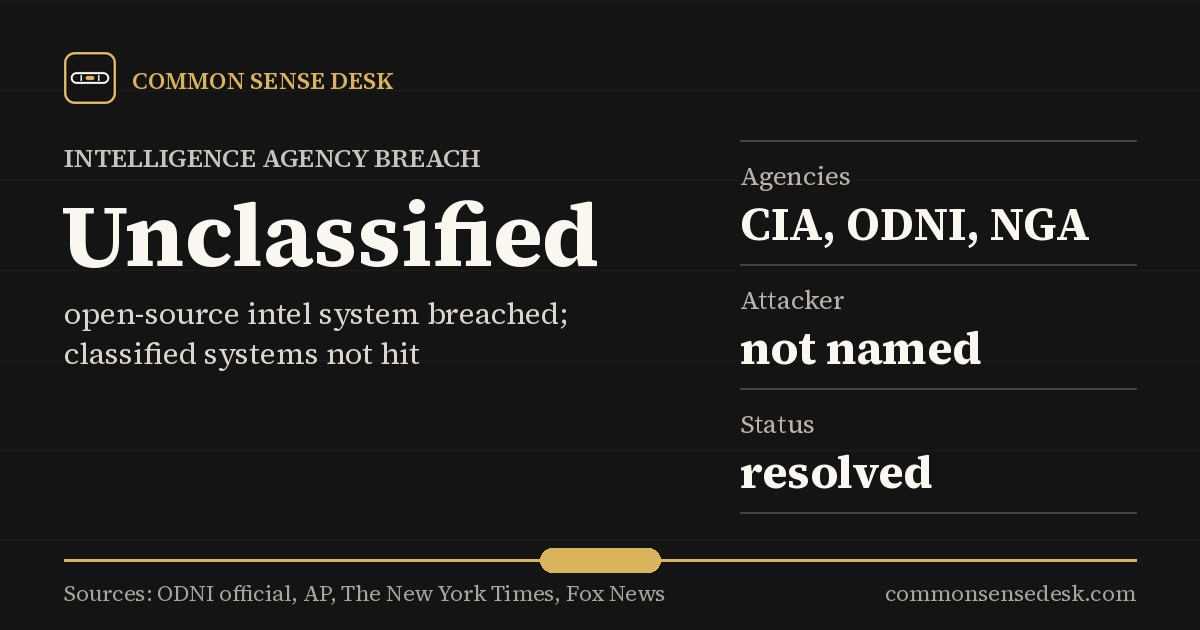
The CIA, the Office of the Director of National Intelligence and at least one other U.S. spy agency were hit by a cybersecurity breach that exposed unclassified information, according to reports first published by The New York Times and confirmed by other outlets on November 24 and 25.
No classified systems were affected, and the problem has been resolved, a person familiar with the incident told the Associated Press. "There have been no disruptions to critical capabilities or classified systems," an ODNI official said.
What was hit
The breach involved a system the agencies use for open-source intelligence, often called OSINT. That's intelligence drawn from publicly available material: news reports, social media, commercial satellite imagery and commercial data sets. Analysts use it alongside secret sources to build a fuller picture.
According to the Times, the agencies affected included the CIA, ODNI and the National Geospatial-Intelligence Agency, which handles satellite and mapping intelligence. Because several agencies feed information into the shared system, others may have been affected too, according to reports.
The intrusion happened last week, Fox News reported, citing multiple sources. Two Pentagon officials told Fox News that the Department of War was not breached.
Why an unclassified system matters
U.S. intelligence agencies keep classified systems separate from the internet, which is a big part of how they're protected, The Washington Post noted. But open-source work is different: analysts need to reach outside websites and networks to collect public information. That makes those systems more exposed by design.
"Unclassified" doesn't mean harmless. What analysts were searching for, which public sources they watched and what they were working on can all reveal what the U.S. government cares about. Agencies treat that kind of information as sensitive even when it isn't formally secret. Officials haven't said exactly what data was taken.
Read next: FBI investigating suspected breach of NCIC, the crime database police use every day
Who did it
That hasn't been announced. Officials have not publicly named a suspect, and it's unclear who was behind the breach, according to Fox News.
The Times reported that officials believe the hackers used an artificial intelligence hacking tool called Artex. The tool was released publicly in July by a Chinese engineer, originally to help organizations with cyber defence, and security researchers have since linked it to attacks on businesses worldwide, the Times reported. Using a tool doesn't by itself show who was behind an attack, since publicly available tools can be used by anyone.
For readers who want the bigger picture on state-backed hacking, Andy Greenberg's Sandworm is a gripping, well-reported account of how cyberattacks became a tool of national power.
The FBI breach
The CIA incident came around the same time as a suspected breach of the FBI's National Crime Information Center, the database police across the country use to look up records during traffic stops and investigations. We covered that in our story on the NCIC breach.
Fox News reported that multiple sources said the CIA, ODNI and FBI were breached on the same day. But two sources told the Times the CIA incident doesn't appear to be related to the FBI hack, and officials have not tied the two together publicly.
Separately, Fox News reported that an internal classified system at the National Security Agency had an outage for several days last week, caused by an internal technology upgrade, not an attack.
What it means for you
For most people, nothing directly. This was a government system holding intelligence work, not a database of consumers' personal or financial details.
But it's one more breach in a month full of them, from Virgin Plus customer data to the FBI's crime database. The lesson for ordinary accounts is the same: if even the CIA's outward-facing systems can be reached, it's worth making your own accounts harder to break into. A hardware security key or an authenticator app is much harder to steal than a text-message code, and different passwords for every account limit the damage when one company is breached.
If you're starting from scratch, Cybersecurity For Dummies is a plain-language guide to the basics.
What to watch
- Whether the government names who was behind the breach.
- What data was taken, and whether other agencies that use the system confirm they were affected.
- Any link, or confirmed lack of one, to the FBI database breach.
- Whether Congress's intelligence committees hold briefings or hearings.
More from Common Sense Desk
Sources
- ODNI official statement, as reported Nov. 24-25, 2026
- The New York Times (as cited by Cox Media Group): CIA and ODNI discover cyber breach of unclassified networks
- Cox Media Group (via WSB-TV): Hackers breach CIA's unclassified computer system wsbtv.com
- Fox News (via Yahoo): CIA hit by cyber breach that exposed unclassified data on intelligence analysis network yahoo.com