

Prime Minister Mark Carney says Canada could turn to Chinese automakers if trade talks with President Trump fail to keep North America's auto industry together. He insists it isn't a bargaining chip. "It's not leverage," he told reporters on Monday, November 16, in Phnom Penh, Cambodia, according to the Associated Press. "But action, reaction."
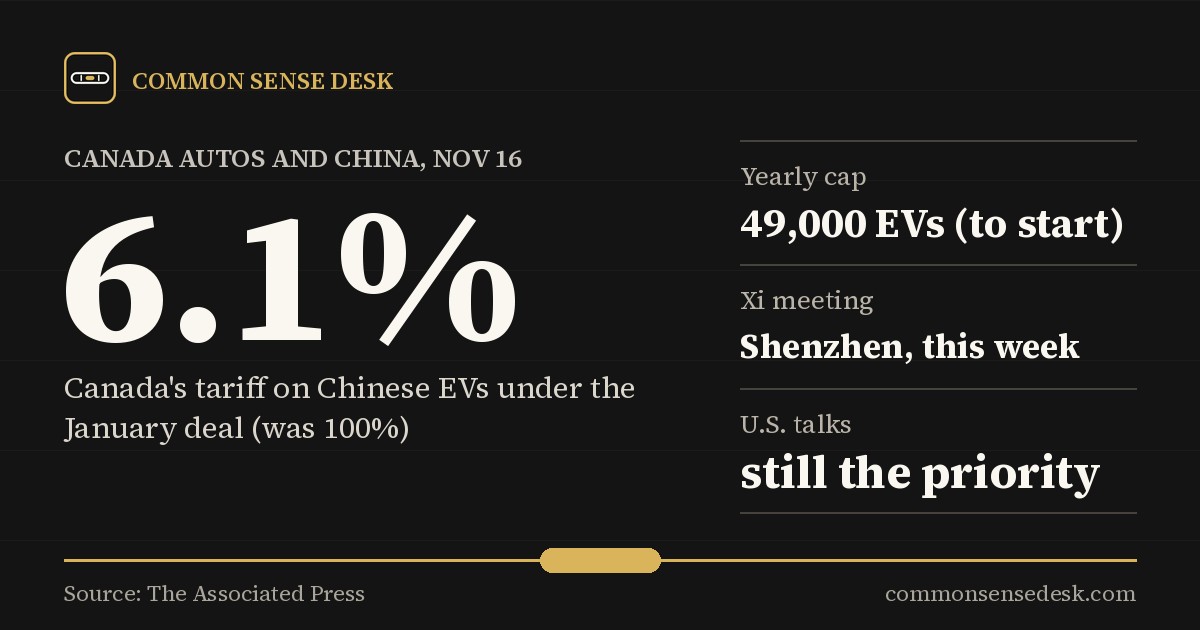
Carney is due to meet Chinese President Xi Jinping this week in Shenzhen, where Chinese auto manufacturing is expected to come up. Here's what he said, why it matters, and what it could mean for car buyers and auto workers.
What Carney said
Canada's auto plants were built to serve the whole North American market, mostly the U.S. With Trump's tariffs disrupting that, Carney said Canada will look for other ways to use them. "If they're not fully utilized in a North American context, that provides other opportunities," he said, adding that "Canada is going to move forward either way." He also mentioned European and Japanese automakers as possible partners.
He drew a line on what Chinese investment would have to look like. "It's not just about kit cars," he said, meaning plants that just bolt together imported parts. "There has to be a manufacturing aspect involved." He said Canada has "the best auto workers in the world" and wants them fully used.
Carney said talks with Washington remain his priority, that he's spoken at length with Trump and senior U.S. officials, and that the two sides are making progress toward a deal, though differences remain.
The China deal already on the books
In January, Canada cut its 100% tariff on Chinese electric vehicles to 6.1%, initially allowing up to 49,000 of them a year, with the cap rising over time, according to the AP. In return, China lowered tariffs on Canadian farm products, including canola. That deal is why Chinese EVs are starting to show up in Canadian showrooms.
The pushback
Not everyone likes it. Ontario Premier Doug Ford, whose province is the heart of Canada's auto industry, has criticized the China deal, warning that Chinese EVs could threaten Canadian jobs and put Canada's access to the U.S. market at risk, the AP reported.
That's the real tension. The U.S. buys most of the cars Canada builds. Washington has made clear it doesn't want Chinese cars or Chinese-owned plants getting a back door into the American market. Bringing in Chinese automakers could help fill idle Canadian plants, or it could make a U.S. trade deal harder to reach. Both sides of that argument are serious.
Why it's happening now
Trump's tariffs have hit Canada's auto sector hard, and he has repeatedly pushed automakers to move production to the U.S. The clearest example is Brampton, Ontario, where Stellantis moved Jeep Compass production to Illinois and agreed to sell its idled plant to a defence company, leaving more than 2,000 workers laid off. We covered that in our Stellantis Brampton story.
When the biggest customer is pulling back, looking for other buyers is common sense. The question is whether China is the right one, given the security concerns and the risk of angering Washington.
Security worries
There's another reason for caution beyond trade. Modern cars collect a lot of data, from location to camera feeds, and connect to the internet. Both the U.S. and Canada have raised concerns about connected vehicles and software from China. Any Chinese automaker building in Canada would likely face questions about who controls that data, and that's a fair question for any government to ask.
The Shenzhen meetings
Carney's meeting with Xi comes during the Asia-Pacific Economic Cooperation summit, where Trump is also expected to meet Xi. That puts Canada's auto future on the table in the same city, the same week, as the biggest U.S.-China talks of the year.
What it means for your wallet
For Canadian car buyers, more Chinese EVs could mean cheaper electric options, since Chinese automakers have built a reputation for low prices. For auto workers and the towns that depend on them, the stakes are jobs: whether idle plants find new work, and whether the U.S. market stays open. For American buyers, little changes right away, but a deeper Canada-China auto link could become a sticking point in the U.S.-Canada trade talks that affect prices on both sides of the border.
What to watch next
- What comes out of Carney's meeting with Xi in Shenzhen.
- Any U.S. reaction to Carney's comments.
- Progress, or not, in the U.S.-Canada trade talks.
We may earn a commission from Amazon links on this page, at no extra cost to you. As an Amazon Associate, Common Sense Desk earns from qualifying purchases.
Sources
- The Associated Press (via ABC News): Carney says Canada could turn to Chinese automakers if Trump trade talks fail abcnews.com