

We may earn a commission from Amazon links on this page, at no extra cost to you. As an Amazon Associate, Common Sense Desk earns from qualifying purchases.
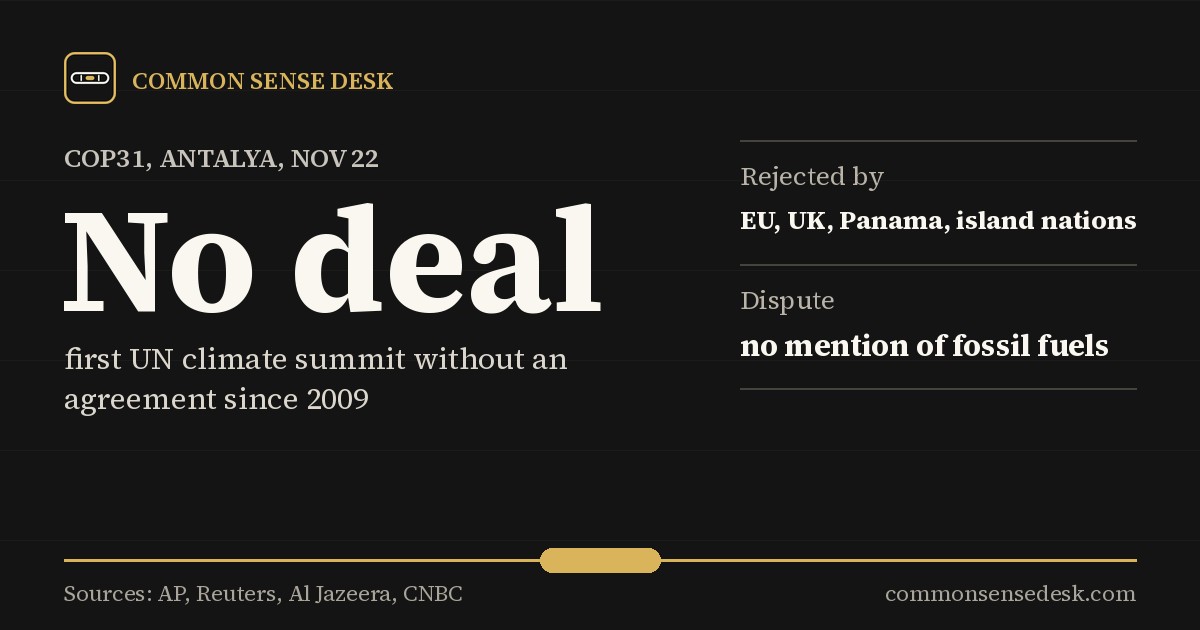
The United Nations climate summit in Antalya, Türkiye, ended on Sunday, November 22, without an agreement. Countries could not settle on a final text after the European Union and several other governments rejected a draft that left out any mention of fossil fuels, according to reports from AP, Reuters and Al Jazeera.
It's the first time since the Copenhagen talks in 2009 that the yearly summit, known as COP31 this year, has ended without a deal adopted by all countries, Al Jazeera reported.
How it ended
The talks started on November 9 and were supposed to wrap up on Friday, November 20. They ran almost two days over as negotiators went through several drafts.
At the closing session, COP31 president Murat Kurum, Türkiye's environment minister, told delegates: "It is clear that there are parties in this hall who oppose this text. We recognise that there is no consensus on this document. Therefore, these decisions have not been adopted."
Australia co-hosted the talks and led the negotiations through its climate and energy minister, Chris Bowen. UN Secretary-General António Guterres said he was "deeply disappointed" that no consensus was reached, CNBC reported.
What the fight was about
The disagreement came down to two words: fossil fuels.
An early draft from Australia on November 17 called for a faster move away from coal, oil and gas. A slimmer version released later in the week removed every mention after Saudi Arabia and other major oil and gas producers reportedly objected, according to Al Jazeera. The final text released Sunday still didn't name fossil fuels, though it referred back to an earlier summit where countries agreed to "transition away" from them.
The EU said that wasn't enough. "We will not endorse a cover decision, or an Antalya Pact, that does not even mention fossil fuels," said Ireland's climate minister, Darragh O'Brien, speaking for the EU. Asked about Saudi Arabia's role, O'Brien said the conference had been "hijacked by some oil states," according to CNBC. Saudi Arabia didn't respond to CNBC's request for comment.
The UK said the draft "moves us backwards on the science." Panama formally objected, and representatives of small island nations refused to sign, according to the reports.
Supporters of the slimmer text argued it still did a lot. It would have acknowledged for the first time that warming is on track to pass 1.5 degrees Celsius, and it encouraged faster development of technology that removes carbon from the air. Kurum also said concerns about helping poorer countries pay to adapt to climate change had been addressed.
What did come out of it
Not everything collapsed. More than 90 countries backed a separate pledge to raise the share of energy use that runs on electricity to 35 percent by 2035, up from about 23 percent today, CNBC reported, citing Bowen. That pledge was made outside the main text, so it doesn't depend on the final deal.
What it means for your wallet
In the short run, probably very little. UN climate agreements don't set gas prices, and even when a deal is signed, countries decide for themselves how and when to act on it. Oil and gas prices today are driven much more by supply, demand and events like the tension around the Strait of Hormuz, which we cover in our Hormuz updates.
U.S. gas prices are falling right now, down to a national average of $3.64 this week, as we reported in our Monday gas story. Nothing that happened in Antalya changes that.
Over the longer term, these summits shape the direction of government policy, especially in Europe: things like rules for power plants, vehicles and home heating, and how much money flows into wind, solar, nuclear and power grids. A summit without a deal means less pressure from the UN process, but individual governments, including the EU, still have their own targets and laws.
For a sense of how the global energy picture fits together, Daniel Yergin's The New Map covers oil, gas and geopolitics, and Vaclav Smil's How the World Really Works is a numbers-first look at why fossil fuels are so hard to replace.
What to watch
- Whether countries try to revive parts of the Antalya text at UN meetings next year.
- How the EU follows up on its own climate targets after rejecting the deal.
- Oil prices, which will keep tracking the Middle East far more than climate talks.
Sources
- Al Jazeera (with AP and Reuters): COP31 talks break down as EU rejects deal without reference to fossil fuels (Nov. 22, 2026) aljazeera.com
- CNBC: Climate talks collapse after draft deal fails to include fossil fuels (Nov. 23, 2026) cnbc.com