
We may earn a commission from Amazon links on this page, at no extra cost to you. As an Amazon Associate, Common Sense Desk earns from qualifying purchases.
Every November, The Economist puts out a special issue called The World Ahead, with a busy, symbol-packed cover about the coming year. And every November, social media fills up with posts "decoding" it as a secret message from the global elite about what they've planned for us.
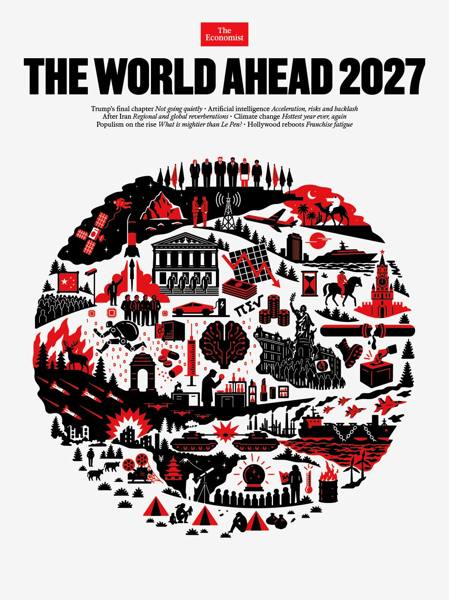
The 2027 edition came out this week, on November 16 and 17. Posts claiming to crack its hidden code are already everywhere. So here's the common-sense version: what's really on the cover, what it most likely points to, and why it isn't a plan for anything.
First: make sure it's the real cover
This matters more than it sounds. In September, a fake "The World in 2027" cover went viral. It showed a "2027" cake, rockets, satellites, robots, pills and hypodermic needles. A spokesperson for The Economist confirmed to AAP FactCheck that it was fake, and AAP found an invisible watermark showing it was made with AI software. At that point, the real 2027 issue didn't exist yet.
Some of the "prophecy" posts still floating around are based on that fake. If a post reads big meaning into needles or a cake, it's likely decoding a picture The Economist never published.
What's on the real 2027 cover
The real cover was drawn by American artist Cleon Peterson, in stark red, black and white. It's a big circle packed with small scenes. The Economist doesn't publish a key to the pictures, but it does print six headlines on the cover itself: "Trump's final chapter: Not going quietly," "Artificial intelligence: Acceleration, risks and backlash," "After Iran: Regional and global reverberations," "Climate change: Hottest year ever, again," "Populism on the rise: What is mightier than Le Pen?" and "Hollywood reboots: Franchise fatigue." Here's what's in the picture, matched with those headlines and the trends inside the issue, edited by Tom Standage.
 Leaders lined up along the top, and a tower marked "TRUMP." U.S. politics. The cover's own headline is "Trump's final chapter: Not going quietly." With Democrats taking over Congress in January, the issue expects a tense two years.
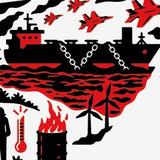 Tanks, missiles, warplanes, an explosion, and an oil tanker in chains. "After Iran." The chained tanker most likely points to the blockade and the fight over shipping through the Strait of Hormuz. The issue expects the war's effects to keep shaking energy markets and fertilizer supplies, which means higher costs for fuel and food.
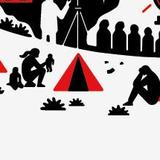 Tents and people sitting on the ground. Most likely people forced from their homes by war, part of the same "regional and global reverberations."
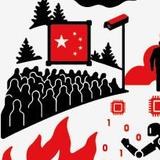 A Chinese flag over a crowd, watched by a camera. China. The issue points to reports that Beijing told its armed forces to be ready for "possible operations against Taiwan by 2027," which keeps tension high in Asia.
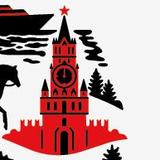 The Kremlin's Spasskaya Tower. A nod to Russia's place in world affairs. The cover's headlines don't name Russia, and the picture doesn't say more than that.
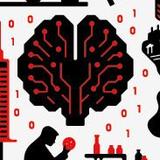 A robot, a brain made of circuits, computer chips and streams of binary code. "Artificial intelligence: Acceleration, risks and backlash." The issue also warns that heavy borrowing to build AI could lead to "a sharp market correction."
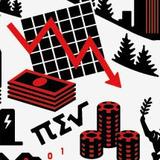 A red arrow falling across a grid, stacks of cash and poker-style chips, and math signs. Markets and debt. The issue flags rising government debt and pressure on bond markets, saying heavy spending and higher borrowing costs "could threaten financial stability in several countries."
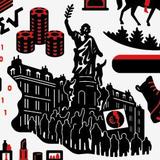 A crowd around what looks like the Marianne statue in Paris, and a hand dropping a vote in a ballot box. "Populism on the rise: What is mightier than Le Pen?" France votes for a new president in 2027, and Marine Le Pen's camp could win.
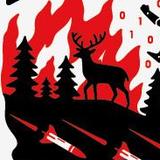 Forest fires, a burning barrel and a thermometer. "Climate change: Hottest year ever, again." A strong El Niño could bring more heat waves, droughts and wildfires.
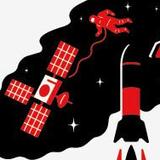 A rocket, a satellite, an astronaut and a telescope. Space. The issue notes that launch costs keep falling, opening space to more countries and companies.
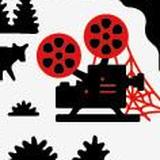 A film projector. "Hollywood reboots: Franchise fatigue." Studios keep leaning on sequels and familiar stories.
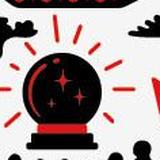 A crystal ball. Probably a wink at the whole issue: it's a forecast. Some "decoders" call it proof of secret knowledge. It's a magazine poking fun at its own job.
The cover also has pills and a syringe next to a lab worker. We've left that one out.
That's it. Every symbol lines up with a headline on the cover or a forecast printed, in plain words, inside the same magazine.
"The elites are telling us their plan"
This claim comes back every year, and it doesn't hold up.
It's a forecast, not a plan. The World Ahead is the magazine's best guess about the year coming up. The cover is a cartoon of that guess. Nobody hides a plan in a drawing on a newsstand, then explains the same ideas in a long article inside.
The forecasts are often wrong. The Economist says so itself. It publishes a yearly check of its own predictions. For 2022, Standage said the "big thing" it missed was Russia's attack on Ukraine: "We went to press in November 2021 and we didn't think Russia was going to invade Ukraine," he told New Zealand's RNZ in January 2023. The same guide also thought inflation would be coming down by the end of 2022. Instead it stayed high. A group that controlled the future wouldn't miss its own biggest events.
Busy pictures invite guessing. A cover with dozens of small drawings will always match something that happens later. People remember the hits and forget the misses. That's how horoscopes work too.
If you're curious how good forecasting really works, and why even experts get it wrong, Superforecasting by Philip Tetlock is a readable place to start.
What it means for you
- No need to prepare for a secret plan. There isn't one. But some of the real trends are worth watching for your budget.
- Energy and food costs depend a lot on the Iran war. Gas has been falling lately, but that could change.
- If you invest, the warnings about debt and AI-related stock prices are a reason to stay spread out, not to panic.
- A hotter year can mean higher cooling bills and more wildfire smoke in some areas. That's worth planning for.
- Before you share a "decoded" cover, check that it's the real one. Fake versions are going around.
The bottom line
The 2027 cover is a dramatic drawing of the magazine's own predictions: war with Iran, Taiwan, Trump's last years in office, AI, debt, Europe's politics and record heat. It's not a code. Some of those predictions will come true, some won't, and The Economist will tell you which next November.
Sources
- AzerNews: The Economist warns of financial shocks, geopolitical tensions and AI risks in 2027 outlook (Nov. 17, 2026) azernews.az
- El Universal: The Economist revela su portada de 2027 (Nov. 16, 2026) eluniversal.com.mx
- AAP FactCheck: Fake Economist cover spreads on social media (Sept. 10, 2026) aap.com.au
- RNZ Afternoons: Tom Standage on what lies ahead in 2023 (Jan. 23, 2023) rnz.co.nz