

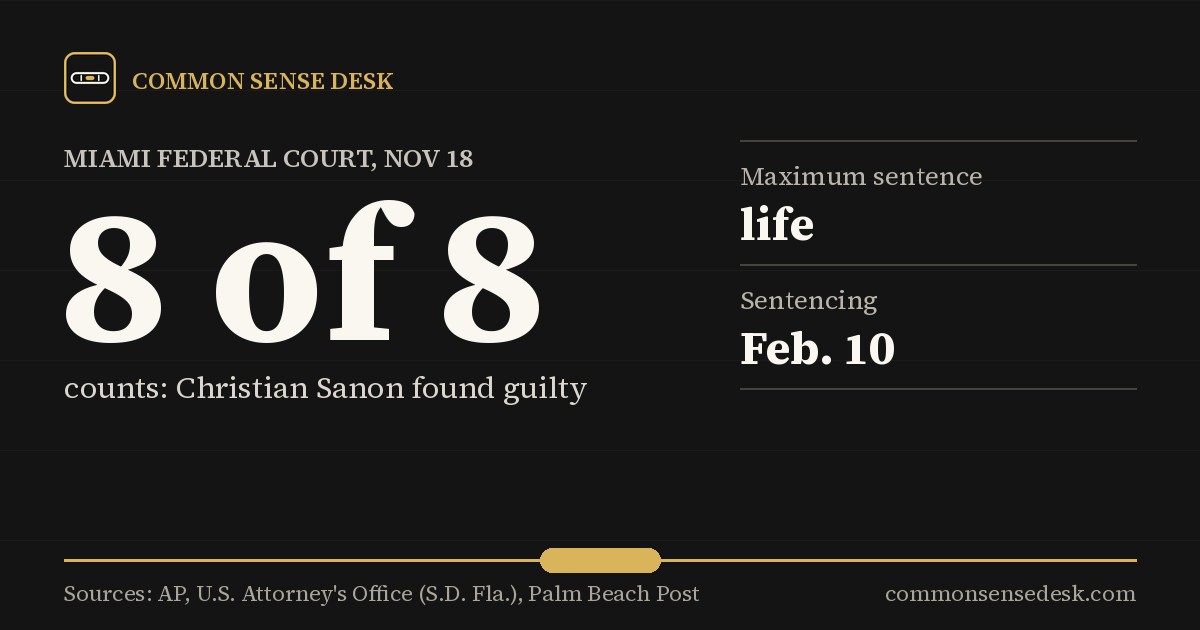
A federal jury in Miami on Wednesday, November 18, convicted Christian Emmanuel Sanon, a 68-year-old Florida pastor, on all eight counts in the plot that ended with the killing of Haitian President Jovenel Moïse in 2021. The most serious charge was conspiracy to kidnap or kill a person outside the United States, according to the Associated Press. He faces up to life in prison and is set to be sentenced on February 10.
Sanon, who holds both U.S. and Haitian citizenship, is the fifth person convicted at trial in the U.S. case. His lawyer says he'll appeal.
What the jury found
Sanon was convicted on all eight counts, including providing material support for the plot and taking part in a military expedition against a foreign country, the Palm Beach Post reported. The trial in federal court in Miami lasted nearly eight weeks, according to AP.
Prosecutors declined to comment after the verdict, AP reported. Sanon's lawyer, Zeljka Bozanic, said in a statement: "We respect the jury's decision, but strongly disagree with the verdict and plan to file an appeal."
What prosecutors said happened
According to AP's account of the evidence, the plot started taking shape in April 2021 at a meeting in South Florida that included a former Haitian senator and U.S. businesspeople. The group wanted to remove Moïse and put in a president of their choosing. Sanon was their first pick.
Prosecutors said two Florida-based companies, Counter Terrorist Unit Federal Academy and Counter Terrorist Unit Security, known together as CTU, expected to win contracts for infrastructure, security forces and military equipment once Sanon was in power. CTU first hired about 18 Colombian nationals with military training, at first described as security for Sanon, AP reported.
Prosecutors also said Sanon helped raise money and arranged travel and lodging in Haiti, and that bulletproof vests were shipped to the group in Haiti labeled as "medical x-ray vests," according to the Palm Beach Post. Court records show some of the mercenaries were paid with money from U.S. Covid-19 business-aid programs, AP reported.
By June 2021, the conspirators decided Sanon didn't meet Haiti's constitutional requirements and didn't have enough support, according to AP. They shifted their backing to Wendelle Coq Thélot, a former Haitian Supreme Court judge, who died in January 2025 while a fugitive.
On July 7, 2021, a squad made up mostly of retired Colombian soldiers stormed Moïse's home near Port-au-Prince at night. They killed the president and wounded his wife, Martine Moïse.
Sanon's side
Sanon testified in his own defense. He said he had been in touch at one point with people who wanted to replace Moïse, but that the group had moved on from him long before the killing. He denied knowing about any plan to kill the president, according to AP. He was arrested in Haiti in the days after the assassination and later transferred to U.S. custody.
The wider case
More than 40 people have been charged in the U.S. case, and about a dozen have now been convicted, including five who are serving life sentences, according to AP.
In May, a separate federal jury in Miami convicted four other men: Arcangel Pretel Ortiz, Antonio Intriago, Walter Veintemilla and James Solages. They were found guilty of conspiring to kill or kidnap the president, providing material support, and violating the U.S. Neutrality Act, which bars Americans from organizing military actions against countries the U.S. is at peace with. They also face possible life sentences and are awaiting sentencing.
In late September, 18 suspects arrested in Haiti were extradited to the United States, AP reported. They include 17 former Colombian soldiers and Joseph Badio, a former Haitian justice ministry employee.
Why is this being tried in Miami? Much of the planning and money moved through South Florida, and U.S. law makes it a crime to plot from American soil to kill or kidnap someone abroad or to launch a military expedition against a friendly country.
Haiti five years later
Haiti has not had an elected president since Moïse was killed, AP noted. A general election is scheduled for next year. Among the expected candidates is Moïse's widow, Martine.
The country has struggled badly since 2021. Armed gangs control much of the capital, Port-au-Prince. According to the United Nations, violence through September this year left about 5,700 people killed or wounded and more than 1,000 women and girls raped, and the International Organization for Migration says nearly 1.5 million Haitians have been forced from their homes, as reported by the Palm Beach Post.
What happens next
Sanon is due to be sentenced on February 10. His lawyer plans to appeal. More trials are expected for the defendants extradited from Haiti, which means more evidence about who planned and paid for the attack is likely to come out in a Miami courtroom over the next year.
Sources
- AP (via NBC News): Florida pastor is convicted of charges related to assassination of Haitian president (Nov. 19, 2026) nbcnews.com
- U.S. Attorney's Office, Southern District of Florida: Federal jury convicts fifth defendant in scheme to assassinate Haitian President Jovenel Moïse justice.gov
- Palm Beach Post (via Yahoo): Florida pastor convicted in plot to assassinate Haitian president (Nov. 19, 2026) yahoo.com