

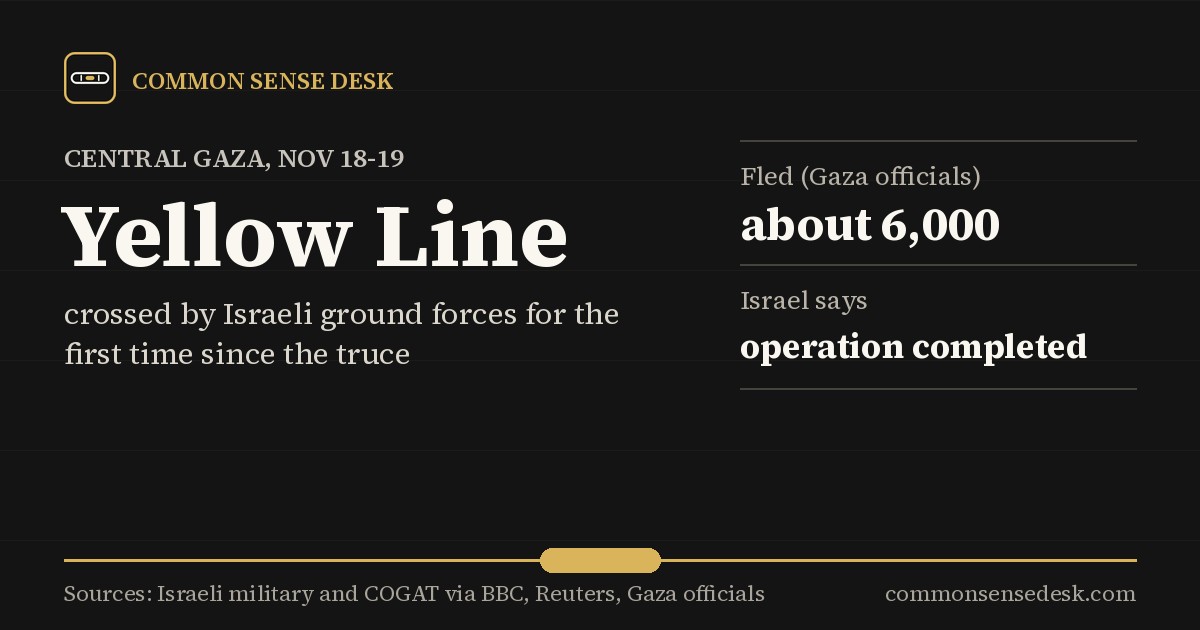
Israeli tanks and troops crossed the "Yellow Line" in central Gaza on Wednesday, November 18, in the first confirmed ground operation beyond the ceasefire boundary since the truce began in October 2025. Families near the Nuseirat and Bureij refugee camps fled. By Thursday morning, Israeli authorities said the operation had ended and the main road through the area had reopened.
The Israeli military said it went after a tunnel. Hamas called the move "a dangerous development and a flagrant violation of the ceasefire agreement."
What is the Yellow Line?
Under the ceasefire that took effect in October 2025, Israeli forces pulled back to a boundary inside Gaza that became known as the Yellow Line. Israel holds the land on one side, and most of Gaza's roughly two million people live on the other. Israel controls more than 60% of Gaza's territory, according to the BBC. The line isn't a fence, and in many places it's only loosely marked.
What Israel says it did
The Israeli military said the joint operation with the Shin Bet security service was meant "to dismantle a terror tunnel west of the Yellow Line that posed an immediate and direct threat to IDF troops," the BBC reported. It described the operation as "targeted."
COGAT, the Israeli military body that handles civilian affairs in Gaza, announced in Arabic in the early afternoon Wednesday that residents should leave and that a section of the Salah al-Din road, the main north-south road through Gaza, would be closed to traffic.
On Thursday morning, COGAT said "the activity has ended, and the Salah al-Din axis has been reopened," according to the BBC. The military said, "The operation is completed." Israel's military also said Washington had been briefed before troops crossed, according to India's The Week. There's no independent confirmation that the tunnel was destroyed.
How far the forces went is unclear. BBC Verify said videos it checked show tank tracks and destruction more than 1.2 kilometers, about three-quarters of a mile, beyond the line, which it said would be the deepest Israeli advance into central Gaza since the truce. Other reports put the advance at a few hundred meters.
What Palestinians say
Gaza's government media office, which is run by Hamas, said about 6,000 people fled their homes and tents, the BBC reported. Many had already been displaced several times during the war. The UN says more than 1.9 million people, about 90% of Gaza's population, remain displaced.
Gaza's civil defense agency, also Hamas-run, said three people were killed in three separate Israeli drone strikes on Wednesday in Nuseirat, Gaza City and Deir al-Balah. Gaza health officials told Reuters that two more people were killed by Israeli fire in eastern Gaza City on Thursday. The Israeli military said it struck armed men who threatened its soldiers. These figures come from each side and couldn't be independently checked.
Hamas appealed to the ceasefire mediators and said forcing residents out amounted to a war crime.
The ceasefire under strain
The truce has held only loosely. Gaza's Health Ministry, which is Hamas-run but whose figures the UN generally treats as reliable, says more than 1,600 Palestinians have been killed since the ceasefire began. Israel says several of its soldiers have been killed in the same period.
This week the Board of Peace, the international body set up to oversee the truce, told the UN Security Council the agreement could collapse, which we covered in our Board of Peace story. Israel has kept up airstrikes it says target militants, including one that killed a Hamas brigade commander in Rafah.
Israeli Defense Minister Israel Katz has said Israel is ready to take more of Gaza and keep newly seized areas as part of its security zones if fighting widens on other fronts, according to The Week.
As of Thursday, there was no public reaction from the United States or the Board of Peace to the operation itself.
What to watch
The main questions are whether this was a one-time raid, as Israel's quick withdrawal suggests, or the start of more operations beyond the line, and whether the mediators, Egypt, Qatar and the United States, step in. For the families who fled, the immediate question is simpler: whether it's safe to go back, and whether there's anything left to go back to.
Sources
- BBC Verify (via Yahoo): Israeli military completes ground operation in Gaza beyond Yellow Line (Nov. 19, 2026) yahoo.com
- HNGN: Israel ends tank raid in central Gaza beyond Yellow Line (Nov. 19, 2026) hngn.com
- The Week: Israeli forces cross Gaza Yellow Line, first major incursion since ceasefire (Nov. 19, 2026) theweek.in