

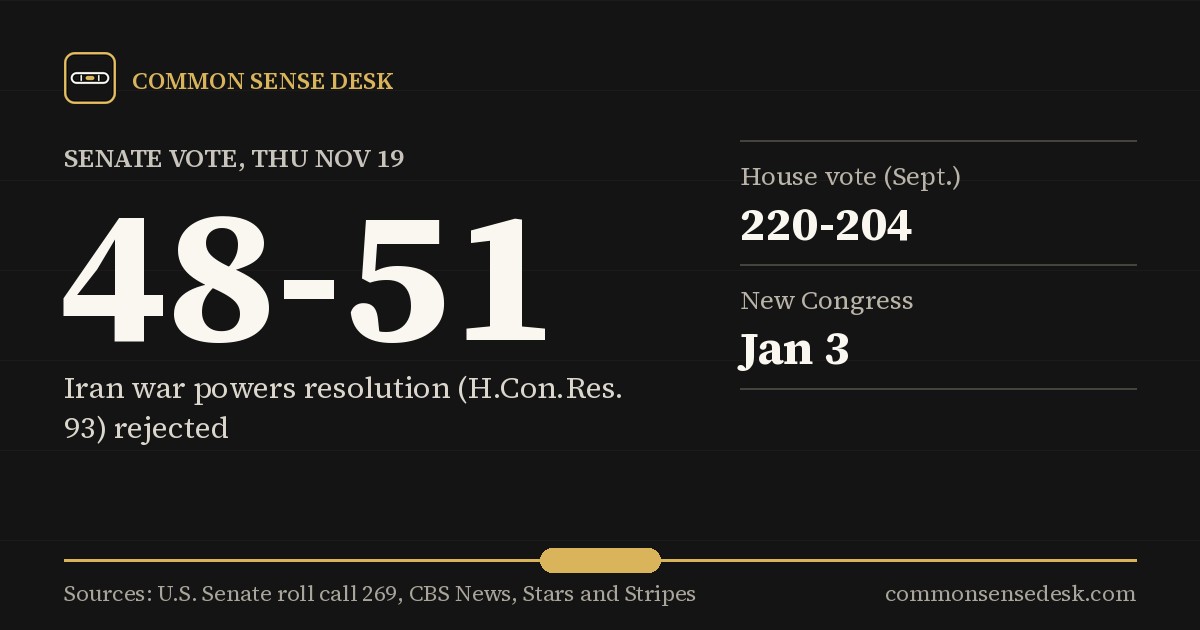
The Senate voted 48 to 51 on Thursday, November 19, against a measure that would have directed President Trump to pull U.S. forces out of hostilities with Iran. It was the first vote by either chamber on the war since the November 3 midterms, in which Republicans lost both the House and the Senate.
The measure, H.Con.Res. 93, had already passed the House 220 to 204 in September. Thursday's result means it dies in this Congress.
How the vote split
According to the official Senate roll call:
- Three Republicans voted yes: Susan Collins of Maine, Lisa Murkowski of Alaska and Rand Paul of Kentucky.
- One Democrat voted no: John Fetterman of Pennsylvania.
- One senator didn't vote: Democrat Chris Murphy of Connecticut.
- Every other Republican voted no and every other Democrat voted yes.
Sen. Thom Tillis, a North Carolina Republican, voted no this time after supporting an earlier attempt, Stars and Stripes reported. He said this measure "doesn't go to the president, so it's just a statement from Congress," according to CBS News.
The vote picked up no new Republican support after the election, even though many Democrats had argued the midterm results were partly a verdict on the war.
What it would have done
The resolution, introduced in April by Rep. Seth Moulton, a Massachusetts Democrat and Marine veteran, would have directed the president "to remove United States Armed Forces from hostilities with Iran" unless Congress declared war or specifically authorized the use of force.
It was written under the War Powers Resolution of 1973, a law passed after the Vietnam War. That law says the president has to pull forces out of hostilities if Congress tells him to by a concurrent resolution. A concurrent resolution is passed by both chambers but isn't sent to the president to sign or veto.
That's why even supporters admitted the effect would have been mostly symbolic. Administrations of both parties have argued that this part of the law is unconstitutional, because the Supreme Court ruled in 1983 that Congress can't override the president with a measure he never gets to sign or veto. The White House said in September that it "strongly opposes" H.Con.Res. 93 and called measures like it unconstitutional legislative vetoes.
What each side said
Democrats said voters had spoken. "We can and must take the message voters sent us and act now to end this war," Sen. Tammy Baldwin of Wisconsin said, according to Stars and Stripes. "Every day this war goes on, we are risking the lives of service members." Sen. Tim Kaine of Virginia, who has led Democrats' repeated war powers efforts, called it an "illegal, catastrophic war" and said its unpopularity "was made absolutely manifestly clear in the election results from Nov. 3," CBS reported.
Republicans who voted no said the U.S. should see the conflict through. "We should finish the job, protect this nation and protect our allies," said Sen. Tim Sheehy of Montana, according to Stars and Stripes. He called it "a war of necessity," not a war of choice.
A long string of votes
The war began in late February with U.S. and Israeli strikes on Iran. Since then, Democrats have forced more than a dozen war powers votes, CBS News reported. Most failed. In June, the Senate did adopt a House-passed resolution with the help of four Republicans, but it had no practical effect, and the fighting continued.
According to the Pentagon, 23 U.S. service members have died in operations connected to the conflict and more than 850 have been injured, Stars and Stripes reported.
Talks have stalled, attacks on shipping around the Strait of Hormuz continue, and Stars and Stripes reports that Trump is weighing whether to resume U.S. strikes.
What happens next
The real change comes in January. When the new Congress is sworn in on January 3, Democrats will control both chambers. Democrats say they plan to keep forcing war powers votes and to use the government's spending bills, including defense funding, to push for an end to the war, according to Stars and Stripes.
Spending is the stronger tool. Congress decides what the Pentagon can spend money on, and funding limits go to the president as part of must-pass bills. Trump could still veto them, and Democrats won't have the two-thirds majorities needed to override. That sets up a likely standoff next year over defense money and government funding deadlines.
House Democrats have already picked Hakeem Jeffries as their candidate for speaker, which we covered in our story on the caucus vote.
What it means for you
Thursday's vote doesn't change anything on the ground. The war's effect on most households has come through energy: fuel and freight costs rose as fighting threatened shipping in the Gulf. Any real move to end U.S. involvement is more likely to come through next year's budget fights than through votes like this one.
Sources
- U.S. Senate: Roll call vote 269, H.Con.Res. 93 (Nov. 19, 2026) senate.gov
- CBS News: Iran war powers measure again falls short in Senate (Nov. 19, 2026) cbsnews.com
- Stars and Stripes: Senate rejects first post-election attempt to end Iran war (Nov. 19, 2026) stripes.com
- White House: Statement of Administration Policy on H.Con.Res. 93 (Sept. 2026) whitehouse.gov
- Text of H.Con.Res. 93 (GovInfo) govinfo.gov