

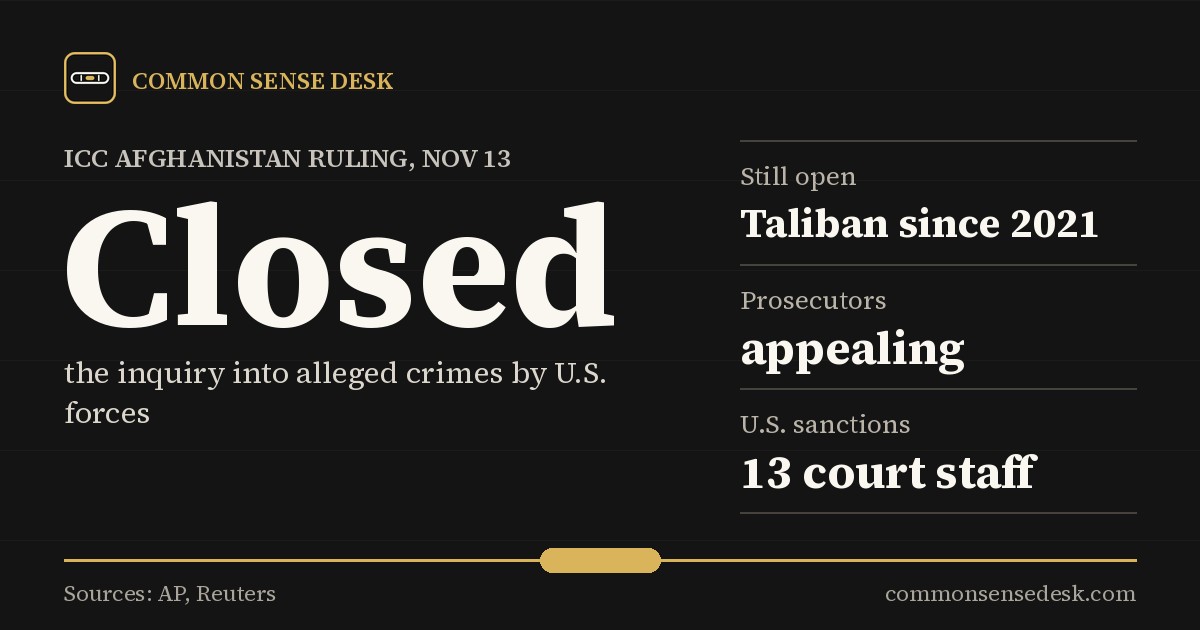
Judges at the International Criminal Court have shut down the part of the court's Afghanistan investigation that could have looked at American troops. The ruling, issued Thursday and made public Friday, November 13, closes that line of inquiry and narrows the case to alleged crimes by the Taliban since 2021, according to the Associated Press and Reuters. The court's prosecutors have already appealed.
For American soldiers and veterans who served in Afghanistan, it's a significant development. Here's what the judges decided, why, and what it does and doesn't change.
What the judges decided
The ICC's Afghanistan investigation has covered alleged crimes going back to 2002, by Afghan government forces, the Taliban, U.S. troops and U.S. intelligence officers. The judges' ruling closes two parts of it:
- The inquiry into alleged crimes by U.S. forces and intelligence personnel.
- The inquiry into the Islamic State affiliate in Afghanistan, known as ISIS-K or ISKP.
What continues is the investigation into alleged crimes by the Taliban since August 2021, when the group took back power after the U.S. withdrawal. The court issued arrest warrants for four Taliban leaders last year.
The judges pointed to "significant limitations to the Prosecution's ability to conduct its investigations and secure evidence." In plain words: the prosecutors hadn't shown they could realistically investigate those other allegations, so the judges ended them.
How it got here
The investigation formally opened in 2020 and included possible offences by American forces, which drew strong objections from Washington. In 2021, then-Prosecutor Karim Khan said he would "deprioritise" the part involving U.S. forces, citing the difficulty of getting evidence, and focus on the Taliban and ISIS-K. So the U.S. part had been sitting mostly dormant for about five years before this ruling closed it.
Khan himself is no longer at the court; he was removed earlier this year over sexual misconduct allegations, according to Al Jazeera.
What the ICC is
The International Criminal Court sits in The Hague, in the Netherlands, and tries individuals, not countries, for war crimes, crimes against humanity and genocide. About 125 countries have joined it; the U.S., China and Russia haven't. It's meant to step in only when a country can't or won't prosecute crimes itself. Afghanistan joined in 2003, which is why the court claims it can look at crimes committed on Afghan soil, even by people from countries that never joined.
Washington's position
The U.S. isn't a member of the ICC and doesn't recognize its authority over Americans. That position has held under presidents of both parties, though how hard Washington pushes back has varied.
Under President Trump, it has been firm. The U.S. has sanctioned 13 current and former court staff members over the Afghanistan investigation and over the court's arrest warrants for Israeli officials, according to AP and Reuters. Secretary of State Marco Rubio has said Trump "will never allow the International Criminal Court to prosecute Americans," and in October vowed to dismantle the court "brick by brick."
We didn't find a State Department response to Friday's ruling. It's not clear whether the decision will change Washington's approach to the court.
What both sides say
Supporters of the court argue that no country's soldiers should be beyond the reach of justice, and that closing the U.S. part of the case looks like giving in to pressure and sanctions.
The U.S. and the court's critics argue the opposite: that America has its own military justice system, which can and does prosecute misconduct, and that an international court Americans never agreed to has no business second-guessing U.S. troops. They also point out that the court's own judges concluded the evidence just wasn't there to be gathered.
Both are serious arguments. The judges' stated reason, though, wasn't politics. It was that the prosecutors couldn't do the work.
What it doesn't change
The ruling doesn't change the court's underlying claim of jurisdiction, and the prosecutors' appeal means it isn't final yet. The court's other cases, including the warrants for Israeli officials that Washington objects to, aren't affected.
What it means for you
If you or someone in your family served in Afghanistan, this removes, for now, the remote but real possibility of an international court investigating U.S. personnel over the war. For everyone else, it's a reminder that the war's legal story isn't over, and that the Taliban, now running the country, are the main focus of what remains.
What to watch next
- The ICC appeals judges' decision on the prosecutors' appeal.
- Whether the U.S. eases or keeps its sanctions on court staff.
- Progress on the warrants against Taliban leaders.
Sources
- Al Jazeera (with AP, Reuters): ICC stops probe into alleged crimes by US troops in Afghanistan aljazeera.com
- Reuters (via U.S. News): Judges close part of ICC Afghanistan investigations that could look at US troops usnews.com