

Here's a free show worth setting the alarm for. On Sunday and Monday mornings, November 15 and 16, the two planets Mars and Jupiter will sit right next to each other in the sky before sunrise. You don't need a telescope, an app or a dark field in the middle of nowhere. You need a clear sky, a view to the southeast and about five minutes.
And it's not the only thing up there this month. Here's what to look for, when and where, based on NASA's November skywatching guide.
Mars and Jupiter, side by side
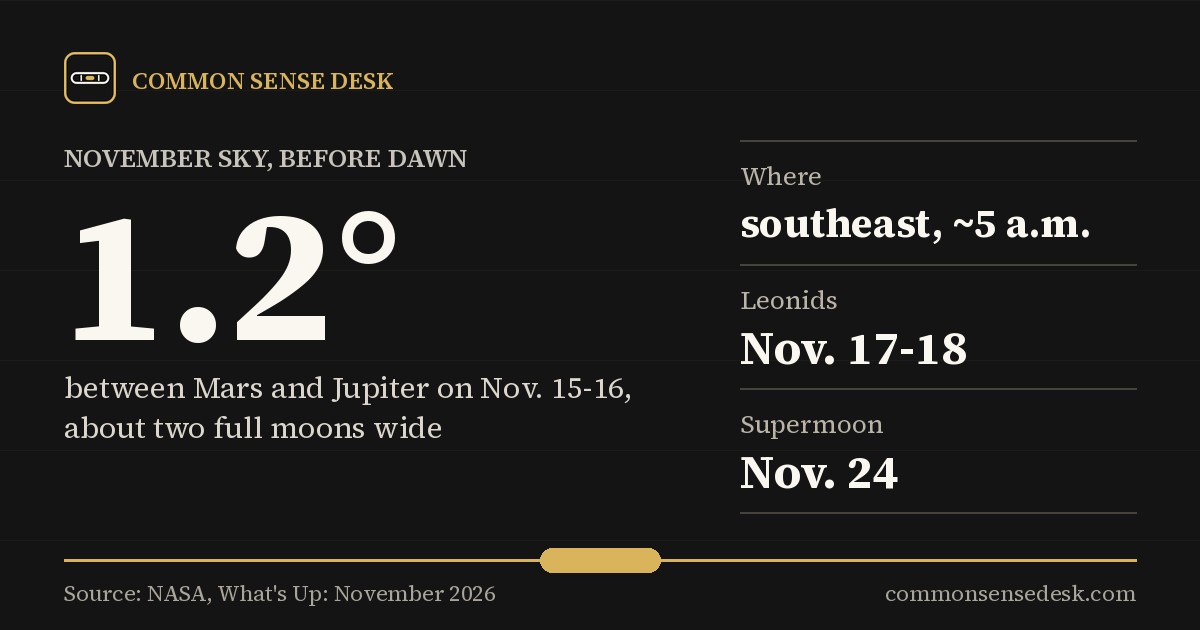
On the mornings of November 15 and 16, Mars and Jupiter will appear about 1.2 degrees apart, NASA says. That's roughly the width of two full moons placed side by side. Close enough that they'll look like a pair.
- When: before sunrise, around 5 a.m. local time works well.
- Where: look to the southeast.
- What you'll see: Jupiter is the brighter of the two, a steady, bright white point. Mars is right next to it and has a reddish or orange tint.
How to tell a planet from a star: stars twinkle, planets mostly don't. Planets shine with a steadier light. If you've got ordinary binoculars, hold them steady (lean on a car roof or a fence) and you may spot some of Jupiter's moons as tiny dots in a line next to it.
The two planets aren't actually close to each other. They just line up from where we stand. Mars and Jupiter are hundreds of millions of miles apart. It's a trick of perspective, the same way a far-off mountain can look like it's touching a nearby tree.
And Venus, low in the east
If your view to the east is clear, look low, near the horizon, for Venus. It's the brightest planet in the sky and hard to miss if it's not hidden behind trees or buildings. NASA's sky chart for the morning of November 15 shows it low between the east and southeast. Some astronomy sites are calling the group of morning planets a "planetary parade." Whatever you call it, it's worth a look.
Leonid meteors, November 17 and 18
The yearly Leonid meteor shower is next. NASA says the best viewing is in the early morning hours of November 17 and 18, after the moon has set. Under ideal dark skies you might see up to about 15 meteors an hour, though most people will see fewer, especially near city lights.
Tips for meteors are simple: get away from streetlights if you can, give your eyes 20 minutes to adjust to the dark, put your phone away (the screen ruins your night vision), and just lie back and look up. Meteors can show up anywhere in the sky.
A supermoon on November 24
The full moon on November 24 is a supermoon, which means the moon is near its closest point to Earth and looks a little bigger and brighter than usual. NASA says to watch it rise in the east around sunset. It's the first of three supermoons in a row, in November, December and January.
The best time to see a supermoon is right as it rises, low over the horizon. That's when the moon looks biggest to our eyes, especially with trees or buildings in front of it for scale.
November's moon phases
- New moon: November 8
- First quarter: November 17
- Full moon (supermoon): November 24
- Third quarter: November 30
The weather is the only catch
All of this depends on clear skies, and November doesn't always cooperate. Check the forecast the night before. If it's cloudy on the 15th, try the 16th; Mars and Jupiter will still be close for a few mornings after that, just a little farther apart each day. You can check conditions where you live on our weather page.
Dress warm. Early mornings this time of year are cold, and standing still is colder than walking. A thermos of coffee doesn't hurt either.
Why bother?
Because it's free, it takes five minutes, and it's one of those things kids remember for years. You don't need any gear or any knowledge. Step outside before sunrise on Sunday, look southeast, find the two bright dots close together, and you've seen two other worlds with your own eyes. In a month full of heavy news, that's not a bad way to start the day.
Sources
- NASA: What's Up: November 2026 Skywatching Tips from NASA science.nasa.gov
- NASA Jet Propulsion Laboratory: What's Up November 2026 (video) jpl.nasa.gov