

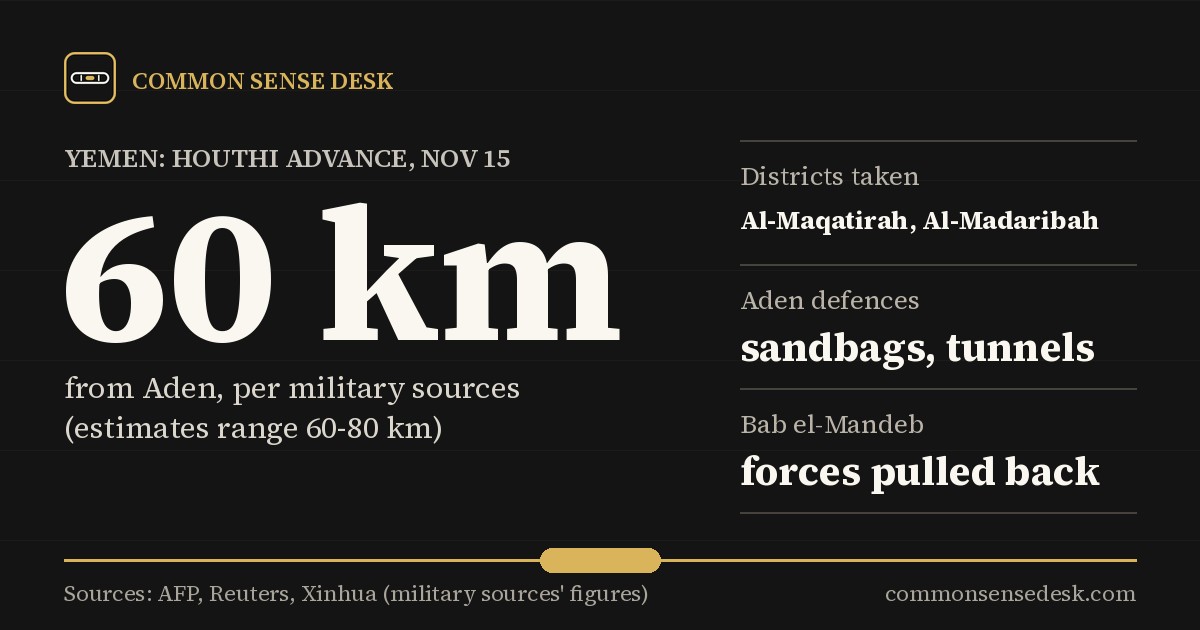
Yemen's Houthi rebels are pushing toward Aden, the southern port city that serves as the seat of Yemen's internationally recognized government. On Sunday, November 15, military and government sources told AFP the Houthis were about 60 kilometres (40 miles) from the city. Government forces are digging in to defend it.
It's the closest the Houthis have come to Aden since the early months of the war in 2015. Here's what's happening, and why a war in Yemen matters to the price of things here.
Where things stand
According to AFP, citing four military sources in the government forces and two government sources:
- The Houthis have taken the Al-Maqatirah and Al-Madaribah districts in Lahj province, north of Aden, and are advancing toward the city.
- Houthi forces are positioned at the Al-Kharaz camp in Al-Madaribah.
- Government forces began putting up sandbag defences and digging tunnels around Aden on Friday, military officials said.
Estimates of the distance vary. Reuters reported on November 2 that the Houthis were within 80 km of Aden; a government military source told China's Xinhua news agency on Monday they were about 70 km away. All of these figures come from military and government sources and can't be independently confirmed.
The government, which is backed by a Saudi-led military coalition, said it had finished pulling its forces back from areas near the Bab el-Mandeb Strait to reinforce Aden and nearby provinces, AFP reported.
A war more than a decade old
The Houthis, an armed movement from Yemen's north backed by Iran, took the capital, Sanaa, in 2014. A Saudi-led coalition intervened in 2015 to back the government, which moved its seat to Aden. The Houthis tried and failed to take Aden early in the war in 2015.
The fighting has been brutal for civilians. The Houthis have attacked Aden several times in recent weeks; an October 15 assault on the presidential palace killed four people, according to government military sources. Along the road between Aden and Lahj, dozens of buildings have been destroyed in fighting between the Houthis and local resistance groups, with air support from the Saudi-led coalition. Yemen was already one of the poorest countries in the world before the war, and millions of people depend on food aid.
Why it matters beyond Yemen: Bab el-Mandeb
Look at a map and you'll see why the world is watching. Yemen sits at the southern entrance to the Red Sea, on a narrow strait called Bab el-Mandeb. A huge share of the world's trade between Asia and Europe passes through it, along with oil and fuel shipments heading to and through the Suez Canal.
The Houthis have attacked ships in and near the Red Sea in recent years, forcing many shipping companies to take the long way around Africa, adding time and cost to every voyage. Government forces pulling back from the area near the strait leaves it more exposed.
That's the same pressure point as the Strait of Hormuz, on the other side of the Arabian Peninsula, where tension with Iran has already rattled oil markets this month. We've covered that in our Hormuz tanker story and our oil price coverage.
Who's who
It helps to keep the sides straight. The Houthis, officially called Ansar Allah, control Sanaa and most of Yemen's populated north and west, and they're armed and backed by Iran. The government they're fighting is internationally recognized and backed by Saudi Arabia and a coalition of Arab states. Southern Yemen also has its own groups that want more independence for the south, which has made the government side less united than the name suggests. That division is part of why the Houthis have been able to push so far.
What it means for your wallet
A war in Yemen can feel very far away, but shipping lanes connect it to your shopping cart. When ships have to avoid the Red Sea, freight costs rise and deliveries take longer, and some of that eventually shows up in prices for imported goods and fuel. If the Houthis take Aden or step up attacks on shipping, expect oil and shipping costs to be the first places it shows up.
There's no need to panic over one headline. But it's one more reason energy prices could stay jumpy this winter, on top of the Iran tension and the colder months ahead.
What to watch next
- Whether the Houthis reach Aden's outskirts or the front holds.
- Any new Houthi attacks on ships near Bab el-Mandeb.
- How Saudi Arabia, the U.S. and Iran respond.
Sources
- France 24 (with AFP): Yemen's Houthis advance on Aden as government forces retreat to defend their capital france24.com
- Reuters (via Al-Monitor): Yemen's Houthis advance to within 80 km of Aden, sources say al-monitor.com
- Xinhua: Houthis advance to positions 70 km from Yemen's Aden english.news.cn