

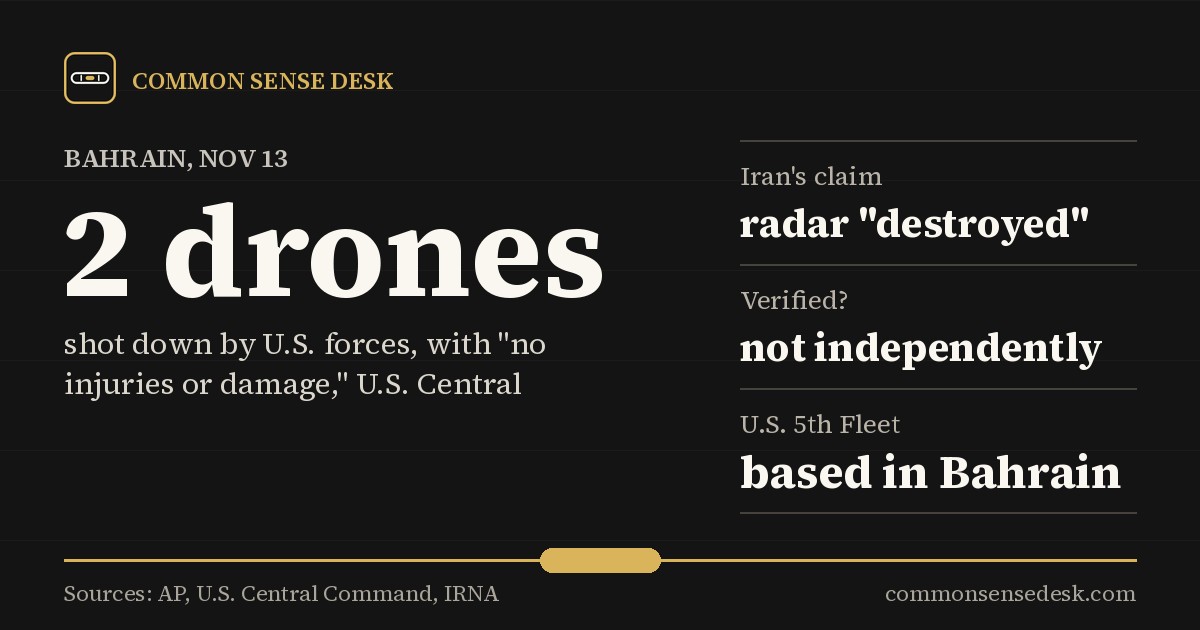
Iran's Revolutionary Guard says it destroyed an American early-warning radar in Bahrain on Friday, November 13. The U.S. military tells a very different story: it says it shot down two Iranian attack drones headed toward Bahrain, with "no injuries or damage."
It's the first time since September that Iran has claimed to target a facility in Bahrain, according to the Associated Press. And it comes one day after President Trump said "We don't need a deal with Iran" and pulled Vice President JD Vance off the talks. Here's what each side says, and what we can actually confirm.
Update, November 13 evening: Trump says Gulf allies asked him to hold off
President Trump said Gulf allies have asked him to hold off on further large-scale strikes on Iran for now. In an interview with Stephen A. Smith at the White House, he said Saudi Arabia asked him to let things stay as they are for a while, and that Qatar, Kuwait, the UAE and Bahrain prefer the same approach, according to the Jerusalem Post and Al Jazeera. He said he wasn't sure he agreed, and that without those requests he would have attacked. The naval blockade of Iranian ports stays in place. Trump also acknowledged that higher fuel prices from the war contributed to Republican losses in the midterms.
Meanwhile, the war is spilling over elsewhere in the Gulf. On Wednesday, Saudi air defenses intercepted three cruise missiles headed for the Riyadh region and two drones aimed at Mecca and southern areas, launched by Yemen's Iran-backed Houthi rebels, according to Reuters, citing the Saudi-led coalition. The Houthis denied targeting Mecca and claimed an attack on an oil pumping station in Yanbu, which Saudi Arabia didn't confirm. It was the second day in a row of intercepts toward Riyadh. A Houthi attack on Sunday damaged an Aramco office building in the Saudi capital, and an attack on Riyadh's main airport last month killed 13 people, Reuters reported.
Why it matters for energy prices: Saudi Arabia is one of the world's biggest oil exporters, and Yanbu is a key oil hub on its Red Sea coast. Attacks on Saudi oil sites, on top of tanker incidents near Hormuz, keep a risk premium on oil, and that reaches the pump. Gas has been falling, but this week's news makes a quick reversal possible.
What Iran claims
- The Revolutionary Guard said it "destroyed a U.S. early warning radar in Bahrain," according to AP.
- A Guard statement carried by Iran's IRNA news agency said the attack came in response to a U.S. strike on a telecommunications pole in Sirik, a port in southern Iran. That U.S. strike is known only from the Guard's account.
- The Guard called the attack "a serious warning to the U.S. to cease its strikes."
- Separately, the Guard said a tanker carrying liquefied petroleum gas hit a mine and exploded in the eastern part of the Strait of Hormuz after it "ignored repeated warnings."
What the U.S. says
U.S. Central Command said its forces intercepted two Iranian attack drones headed toward Bahrain, and that there were "no injuries or damage," according to AP. In other words, the U.S. account is that the attack happened but failed.
Bahrain's government didn't immediately respond to questions, AP reported.
What's confirmed, and what isn't
- Confirmed by the U.S. military: two Iranian attack drones flew toward Bahrain and were shot down. No one was hurt and nothing was damaged.
- Not confirmed: Iran's claim that a U.S. radar was destroyed. AP said the claims could not be independently verified, and the U.S. account directly contradicts it.
- Not confirmed: the U.S. strike on a telecom pole in Sirik that Iran says it was answering.
- Not confirmed: the tanker explosion. The UK Maritime Trade Operations center, which tracks shipping incidents, had no immediate report of it, according to AP.
When the two sides disagree this sharply, the honest answer is to wait for evidence, such as satellite images, statements from Bahrain, or reports from shipping trackers, before taking either version as fact.
Why Bahrain matters
Bahrain is a small island kingdom in the Persian Gulf, and it's home to the U.S. Navy's 5th Fleet, the force that patrols the Gulf, the Strait of Hormuz and nearby waters. It has also been one of Iran's strongest critics, AP notes. During the air war that began in February, Iran targeted U.S. bases in several Gulf countries, including Bahrain. Things had been quieter on that front since September.
Where things stand
The timing is what makes this worth watching. Earlier this week, talk of a deal had pushed oil prices down sharply. Then on Thursday, the president said the U.S. doesn't need a deal and is keeping the naval blockade in place. We covered that here: Trump says "we don't need a deal with Iran" and pulls Vance off the talks. Iran's security chief had already said there are no negotiations and that Iran won't let its enriched uranium leave the country.
Iran also told the UN nuclear watchdog that talks about inspections can't go forward while it faces military threats, according to a confidential IAEA report described by AP. Inspectors still haven't been allowed into sites hit in the June 2025 strikes.
And in a sign that Gulf neighbors are bracing, Turkey and Qatar signed a mutual defense agreement in Istanbul on Friday. Turkey's president said the two countries would work to prevent the war in the Gulf from flaring up again.
What it means for your wallet
Every flare-up near the Strait of Hormuz adds risk to oil prices, and oil prices reach the pump within a week or two. Brent crude, the world benchmark, had fallen below $90 a barrel on Tuesday, then jumped back near $96 on Thursday after the president's comments, according to Bloomberg. A failed drone attack with no damage is less of a shock than a successful one would be, but another tanker incident, if confirmed, would add to the worry.
For now, the U.S. average for regular gas is still falling. It was $3.91 on Thursday, according to AAA. Whether that continues depends a lot on how the next few days go in the Gulf. You can follow gas and diesel every week on our Wallet Watch page, and read our earlier coverage of the tanker attacks here: Iran says two more tankers are burning near Hormuz.
What to watch next
- Any statement from Bahrain, or more detail from U.S. Central Command.
- Whether the U.S. responds to the drone launches.
- Shipping reports from the strait, and oil prices when markets open Monday.
Sources
- Reuters via GMA News: Saudi Arabia intercepts Houthi missiles, drones; group denies targeting Mecca gmanetwork.com
- Jerusalem Post: Trump says Gulf allies urged Iran restraint, war hurt GOP in midterms jpost.com
- Dawn (citing Al Jazeera): Trump says Gulf allies asked him to hold off on further Iran strikes dawn.com
- AP via The Daily Gazette: US military downs 2 Iranian attack drones as Iran claims a strike on a US radar in Bahrain dailygazette.com
- AP via ABC News: Iran's Revolutionary Guard says it destroyed a US radar in Bahrain abcnews.com
- Bloomberg: Oil prices rise after Trump says US doesn't need Iran deal bloomberg.com
- AAA Gas Prices gasprices.aaa.com