

Iran's Revolutionary Guards say two more tankers, one of them a supertanker, are on fire near the Strait of Hormuz. The claim came on Tuesday, November 10, one day after President Trump said the war with Iran is "effectively over." Tehran, for its part, denies that any peace talks are planned.
So which is it? Here's what we actually know, what is only claimed, and what it could mean for the price you pay at the pump.
What Iran says happened
The navy of Iran's Islamic Revolutionary Guard Corps (IRGC) put out a statement on its own channels, which was carried by Iranian news agencies and reported by Xinhua, TASS and Anadolu. According to the IRGC:
- Two oil tankers tried to cross the strait on what Iran calls an "unauthorized" route, with their navigation and tracking systems switched off.
- One of them, a supertanker, hit a naval mine and exploded.
- The second had an "incident" while, the IRGC says, it was trying to sneak through with support from U.S. fighter jets. It's now stopped and burning.
- Both ships, the IRGC says, were left burning off the strait's southern coast.
The IRGC called the route "unsafe" and warned that any ship using it in cooperation with the U.S. military would "suffer the same fate."
What's confirmed, and what isn't
This is the important part. As of Tuesday evening:
- Not confirmed: the IRGC did not name the ships, their flags, their owners or their crews. No independent source has confirmed the fires or the explosions yet.
- Not confirmed: the claim that U.S. fighter jets were escorting one of the tankers. There was no immediate U.S. military comment on it, according to Anadolu.
- Not confirmed: Iranian state media have also reported that the IRGC navy has hit 11 tankers in the past 10 days. We could not find that figure in an official IRGC statement, and nobody has independently confirmed it. Treat it as Iran's claim.
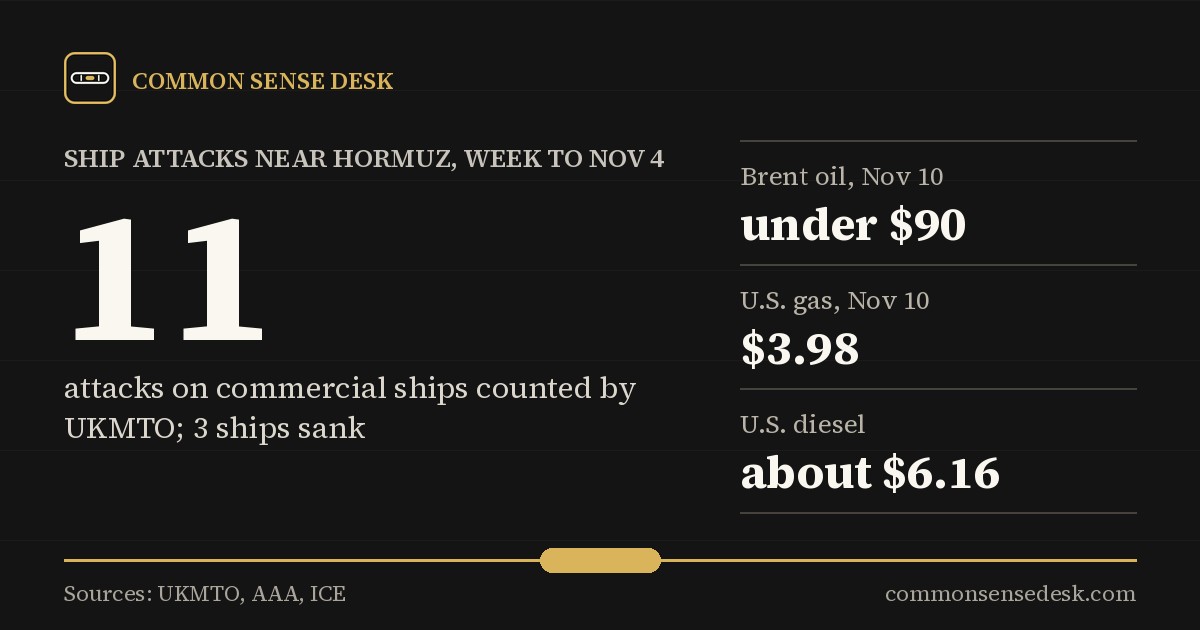
- Confirmed earlier: ships really are being hit. The UK Maritime Trade Operations center (UKMTO), which tracks shipping security for the British military, counted 11 attacks on commercial ships in the strait and the Gulf in the seven days to November 4. Three ships sank. One crew member was killed when a small boat was hit on November 2.
- Confirmed earlier: UKMTO confirmed two tanker incidents on November 8, with no crew casualties. Iran had claimed three that day.
So the pattern is real, even if each new Iranian claim needs checking. We covered the November 8 and 9 tanker fires in our earlier story: Oil falls below $90 for the first time since August.
Trump: "effectively over." Iran: no talks.
On Monday, after meeting Qatar's prime minister, who has been carrying messages between the two sides, Trump said Iran "militarily, is effectively over. We're just keeping it the status quo." He called new strikes "quite unlikely," but added: "If we do have to go back in, we are locked and loaded, and ready to go." On Truth Social he said he was "seeing positive momentum toward an end to this conflict." More on that meeting here: Trump meets Qatar's leader on Iran talks, but no deal yet.
Tehran tells a very different story. Mohsen Rezaei, secretary of Iran's Supreme National Security Council, called the talks "imaginary" and told Washington to "fold your hand." Foreign Minister Abbas Araghchi denied reports that a meeting between Vice President JD Vance and Rezaei was being planned. Iran's Tasnim news agency, citing a senior security official, said Iran won't talk until the U.S. takes concrete steps on its list of seven conditions.
The U.S. naval blockade of Iranian ports stays in place. Trump called it "the largest naval blockade in history."
What this means for your wallet
Here's the plain version. About a fifth of the world's oil normally moves through this one narrow strait. When ships burn there, oil traders get nervous, and oil prices go up. When there's talk of peace, prices come down.
Right now, peace talk is winning. Brent crude, the world benchmark, fell below $90 a barrel on Tuesday for the first time since August. It was above $117 in late October. And the U.S. average for regular gas dropped to $3.98 a gallon on Tuesday, the first time under $4 since July. We covered that here: U.S. gas falls to $3.98, the lowest since July.
But today's news is a reminder of how fragile that is. If more tankers are hit, or the talks fall apart, oil could jump back quickly, and gas prices usually follow within one to two weeks. Diesel, which is already over $6 a gallon, is even more sensitive. That's what trucks run on, and higher diesel shows up in grocery prices.
The common-sense takeaway: enjoy cheaper gas while it lasts, but don't plan your budget around it falling much further. Until there's a signed deal and ships move safely through Hormuz, prices can swing either way.
What to watch next
- Whether UKMTO or shipping companies confirm today's two tanker fires, and name the ships.
- Any U.S. military response to the claim about fighter jets.
- Whether a Vance-Rezaei meeting happens, as Turkey's intelligence chief said media had reported, or Iran's denial holds.
- Oil prices over the next few days, and gas prices over the next two weeks.
Sources
- Anadolu Agency: Iran says 2 oil tankers explode, catch fire in Strait of Hormuz aa.com.tr
- TASS: Two tankers caught fire in Hormuz on Tuesday, IRGC Navy tass.com
- Xinhua: Iran's IRGC says 2 tankers exploded on Hormuz Strait's unauthorized route english.news.cn
- Euronews: Trump says Iran war 'effectively over' as Tehran denies planned talks euronews.com
- Middle East Eye: UKMTO says 11 ships attacked in week to 4 Nov middleeasteye.net
- House of Saud: IRGC says 3 tankers hit in Hormuz, 11 ships in 10 days houseofsaud.com
- U.S. Energy Information Administration: The Strait of Hormuz is the world's most important oil transit chokepoint eia.gov