

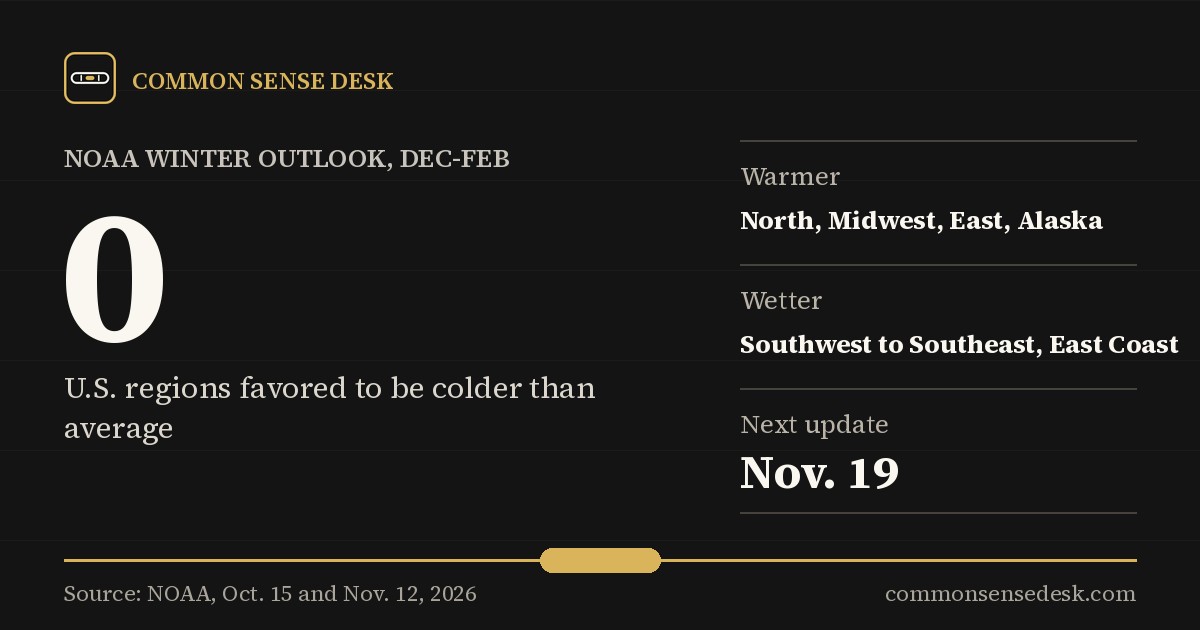
If you're bracing for a brutal winter, NOAA has some news that may help: for a big part of the country, the government's forecasters lean toward a milder winter than usual. The reason is El Niño, and this year it's a strong one. Here's what NOAA's official winter outlook says, region by region, and what it could mean for your heating bill.
What El Niño is, in plain words
El Niño is when the surface of the Pacific Ocean near the equator runs warmer than normal. That warm water changes where the big storms go. In winter it tends to push the jet stream, the river of fast wind high up that steers storms, farther south and east across the U.S.
"A very strong El Niño will likely bring a southward and eastward shift to the jet stream for the contiguous U.S.," National Weather Service Director Ken Graham said when NOAA released the outlook on October 15.
And it's still going strong. NOAA's Climate Prediction Center has an El Niño Advisory in place, and its November 12 update says a strong to very strong El Niño is likely to last through January to March 2027.
Who gets a warmer winter
For December through February, NOAA's outlook favors warmer-than-average temperatures in:
- Northern California and the Pacific Northwest
- The Midwest and the Mississippi Valley
- Much of the East
- Alaska, plus Puerto Rico and the U.S. Virgin Islands
Parts of the Southeast, including Florida, lean toward near-normal temperatures. Much of the Southwest and Hawaii have "equal chances," which means forecasters can't tilt the odds either way. Notably, no part of the country is favored to be colder than average.
Who gets more rain and snow
The wet signal is in the south. NOAA favors wetter-than-average conditions across the southern tier, from the Southwest to the Southeast, and along the East Coast.
Drier-than-average odds are higher in parts of the northern Mountain West, parts of the Great Lakes, much of Alaska and Hawaii. The Intermountain West, northern Plains and Ohio Valley are equal chances.
The rain should help with drought. NOAA expects drought to improve or end by late January across the Southwest, the southern Great Plains, the Southeast and parts of the East Coast. It could develop or get worse in parts of the northern Rockies, northeastern Oregon and eastern Washington.
There's a flip side to the rain. "Too much precipitation on dry soil can fuel destructive flash floods and mudslides," Graham warned. That's worth remembering in places that burned in recent wildfires.
What about snow?
NOAA doesn't forecast seasonal snow totals. Snow depends on the exact track and temperature of each storm, which can't be predicted more than about a week ahead. A warmer winter doesn't mean no snow. It can still bring big storms, especially in the East, where a southern storm track pulls in plenty of moisture.
Read this as odds, not a promise
This is the part people miss. NOAA's seasonal outlook doesn't say it will be warm in Chicago on any given day. It says the odds of the whole season averaging warmer than normal are higher than usual. You can still get a hard cold snap in a "warm" winter. NOAA updates the outlook every month; the next update is due November 19.
What it means for your wallet
Heating is the biggest winter cost for most homes, and the weather is the one part of the bill nobody controls. A milder winter in the Midwest and East is good news for gas and oil heating bills there. The U.S. Energy Information Administration already expects natural gas heating bills to fall about 9% this winter, partly because of milder weather in the Northeast, Midwest and South. We broke down those numbers, and when a heat pump makes sense, in our heating costs story.
The West is the exception in the EIA's numbers: it expects a colder winter there than last year, so heating bills are forecast to rise. And in the wet South, the cost to watch is water, not heat: clean gutters and drains, check your sump pump, and know whether your home insurance covers flooding. Most standard policies don't.
Common sense for everyone: get the furnace checked now, keep a winter kit in the car, and don't let a "mild" forecast talk you out of being ready.
For current conditions and any big weather alerts, check our weather page.
Sources
- NOAA: El Nino looms large over U.S. Winter Outlook (Oct. 15, 2026) noaa.gov
- NOAA Climate Prediction Center: ENSO Diagnostic Discussion (Nov. 12, 2026) cpc.ncep.noaa.gov
- U.S. Energy Information Administration: Winter Fuels Outlook 2026-27 eia.gov