

We may earn a commission from Amazon links on this page, at no extra cost to you. As an Amazon Associate, Common Sense Desk earns from qualifying purchases.
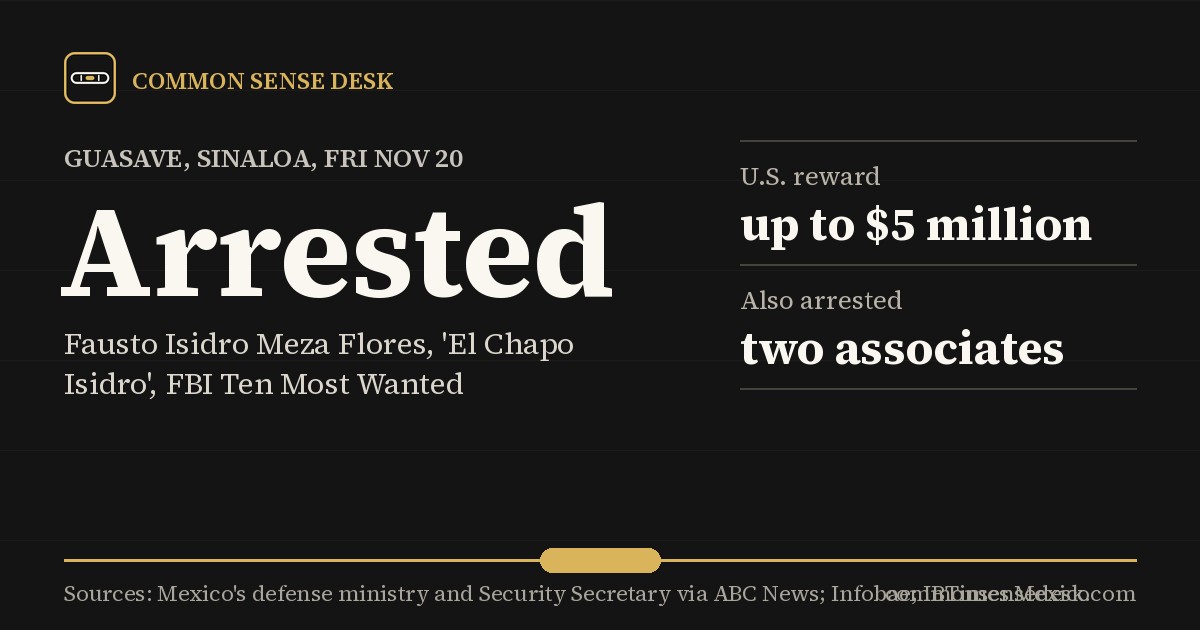
Mexican special forces arrested Fausto Isidro Meza Flores, known as "El Chapo Isidro," on Friday night, November 20, in Guasave, in the northern part of Sinaloa state. He was on the FBI's Ten Most Wanted list. Mexico's defense ministry said the operation was carried out in coordination with U.S. intelligence agencies.
The arrest set off a night of violence in the area. Trucks were set on fire, roads were blocked, and residents were told to stay inside.
What happened
According to Mexico's defense ministry (SEDENA), special forces were met with gunfire and explosive attacks when they moved in. They arrested Meza Flores and two other men: a man identified only as Germán, nicknamed "Serafín," described as his second-in-command, and a man identified only as José, described as a financial operator, ABC News reported. Mexican authorities usually give only first names of suspects at this stage.
The three were flown to Mexico City and handed over to federal prosecutors. No deaths or injuries from the raid have been reported so far.
On Saturday morning, Security Secretary Omar García Harfuch confirmed the arrest on X and thanked the defense ministry, the army's special forces and the National Guard. He called the arrests an important step toward restoring peace in Sinaloa and said security forces "remain deployed in the state to protect the population," according to ABC's translation.
A rough night in northern Sinaloa
Within hours, videos showed semi-trucks burning on major roads. Blockades went up on the Mexico 15 coastal highway and in several towns, including Guasave, Ahome (Los Mochis), Navolato and the Guamúchil area, according to local reports.
In Guasave, city buses stayed off the streets until authorities gave the all-clear, and the local water utility suspended operations for the day. A professional baseball game between Guasave and Mazatlán was called off. Residents took shelter in homes and businesses, and some were told after 1:30 a.m. that it was safe to go home.
This kind of reaction is common in Sinaloa after a major arrest. Burning vehicles and blocking roads is a way for armed groups to slow down security forces and show strength. It also puts ordinary people in the middle.
Who he is
Meza Flores, 44, comes out of the Beltrán Leyva organization, a group that split from the Sinaloa Cartel in 2008. Mexican authorities say he leads a group based around Guasave and Los Mochis, sometimes called the Meza Flores organization or the Guasave Cartel, which is aligned with the "Mayos" faction of the Sinaloa Cartel.
That alliance matters. Sinaloa has been torn by fighting between the two main Sinaloa Cartel factions, the Mayos and the Chapitos, since 2024. That fighting has left many people dead or missing across the state.
The U.S. State Department has described his group as "a heavily armed and violent" organization. It offered a reward of up to $5 million in 2017 for information leading to his arrest or conviction. The FBI added him to its Ten Most Wanted list in February 2025.
In the U.S., he was first indicted in federal court in Washington, D.C., in 2012, and a grand jury returned a superseding indictment in 2019. The charges involve conspiracy to traffic cocaine, heroin, methamphetamine and marijuana into the United States, plus firearms charges.
Mexico's defense ministry said he is subject to a U.S. extradition warrant. No date or decision on extradition has been announced, and Mexican courts would have to approve it.
The U.S. role
Mexico says U.S. intelligence helped find him, while Mexican forces carried out the raid and the arrests. That fits a pattern over the past year: Mexico has stepped up arrests and, in 2025, sent dozens of cartel suspects to the U.S. under pressure from Washington, which has tied cooperation on drugs to tariffs and border policy.
No senior U.S. official had commented publicly on the arrest by Saturday afternoon, as far as we could confirm.
What it means
For people in Sinaloa, the short-term risk is more violence. Arrests of big leaders often lead to fights inside the group over who takes over, or attacks by rivals who see a chance. García Harfuch's message that forces will stay deployed is aimed at that.
For Americans, the question is whether arrests like this actually reduce the drugs crossing the border. Experts have long pointed out that cartels replace leaders quickly. Still, taking out the person at the top of a well-armed network can disrupt shipments and money for a while, and it sends a message that being on the FBI's list eventually catches up with people.
For the U.S.-Mexico relationship, it's a visible win both governments can point to at a time when drugs, tariffs and border security are tightly linked in talks between the two countries.
For readers who want the bigger picture, Ioan Grillo's El Narco is a clear history of how Mexico's cartels grew, and his later book Blood Gun Money looks at how guns from the U.S. end up fueling the violence.
What to watch
- Whether Mexico moves to extradite him to the U.S., and how quickly.
- Any statement from the FBI, DEA or Justice Department.
- Whether the violence in northern Sinaloa continues into next week.
Sources
- ABC News: Mexican cartel leader on FBI's 10 most wanted fugitive list arrested (Nov. 21, 2026) abcnews.com
- Infobae (Spanish): Detención de 'El Chapo Isidro' en Sinaloa (Nov. 21, 2026) infobae.com
- IBTimes Mexico: 'El Chapo Isidro' arrest triggers night of violence, halts services in Guasave (Nov. 21, 2026) mx.ibtimes.com