

We may earn a commission from Amazon links on this page, at no extra cost to you. As an Amazon Associate, Common Sense Desk earns from qualifying purchases.
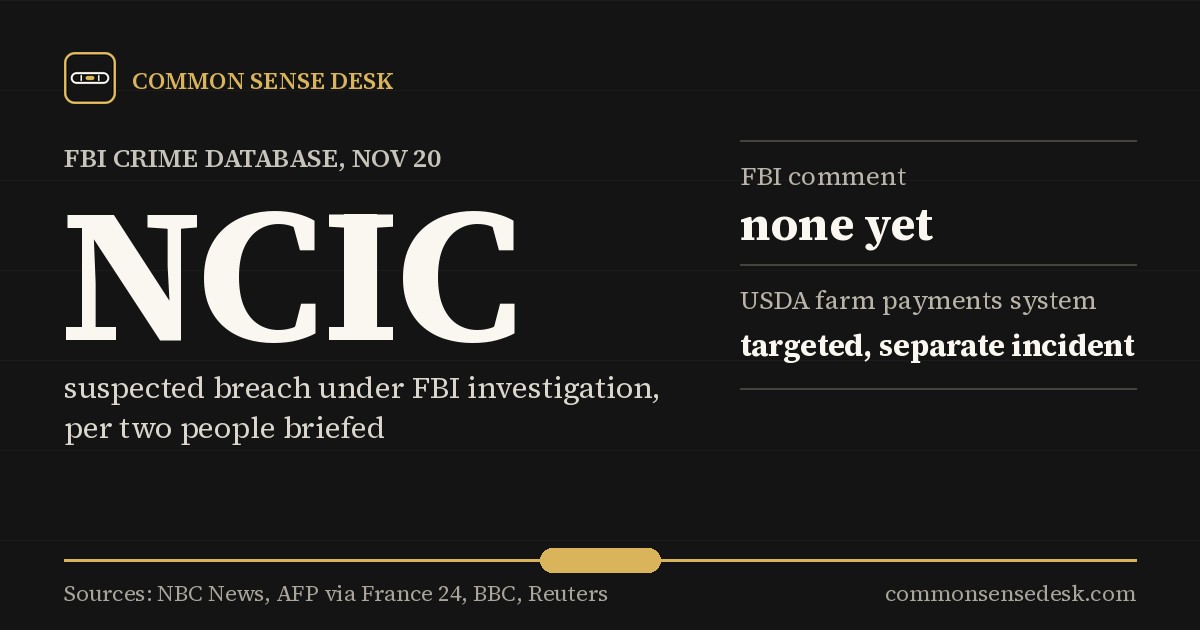
The FBI is investigating a suspected breach of the National Crime Information Center, the national database police use every day to check for warrants, stolen cars and criminal records. The news came out on Friday evening, November 20. It was first reported by CNN, and NBC News confirmed it with two people briefed on the matter.
The FBI hasn't confirmed anything publicly. It had no comment as of Friday night, NBC News reported. So right now there's no official word on what was accessed, who did it, or whether the system is still working normally.
What the NCIC is
If you've ever been pulled over, there's a good chance the officer ran your name or plate through the NCIC before walking up to your car. It's run by the FBI and links federal, state and local agencies, so a warrant issued in one state shows up for an officer in another.
Police use it to check for outstanding warrants, wanted and missing people, stolen vehicles and guns, and background information. It's one of the most-used law enforcement systems in the country, which is why even a suspected breach gets attention fast.
What we know and what we don't
So far, the reported facts are few:
- The FBI is looking into an apparent breach of the NCIC, according to two people briefed on it who spoke to NBC News.
- The FBI has not said who may be responsible.
- There's no public information yet on whether data was copied, changed, or just viewed.
- No one has said whether police access to the system has been affected.
The main worry from security experts isn't only that someone could read the records. It's whether they could change them. Officers make fast decisions based on what the database tells them, like whether a driver has a warrant or whether a car is stolen. AFP, in a report citing a former FBI official, said one concern is that hackers could affect the accuracy of the information officers rely on. There's no report that anything was changed.
Not the first FBI incident this fall
This would be the second reported breach involving the FBI in recent months. In September, the hacking group ShinyHunters said it had stolen data on "almost ALL FBI Agents" and people who had applied for FBI jobs, Reuters reported at the time. The BBC reported the group claimed about 38,000 people were affected; that number is the group's claim and hasn't been confirmed.
Reuters was able to partly check some of the data the group released. In at least nine cases, names, addresses and Social Security numbers appeared to match real people. But Reuters couldn't establish where the data came from or whether it was taken from the FBI's own systems. The FBI said in September it was investigating.
Nobody has said whether the NCIC breach is connected to that earlier one.
A separate hit at the USDA
On the same day, NBC News reported that the U.S. Department of Agriculture told employees on Thursday that one of its systems had been targeted. People with knowledge of the matter said it was a system used to pay farmers, and that no other systems had been hit as of Friday. Officials worried the attackers could use it to reach more sensitive information, NBC reported.
The USDA hasn't commented publicly. There's no sign so far that the USDA incident and the FBI incident are linked, and AFP noted it was unclear whether they were related or who was behind either one.
How this fits with this month's outages
A lot of Americans have had a rough month with technology. Banks, airlines, a worldwide Microsoft outage and an FAA ground stop all made news. Officials have said those outages weren't caused by cyberattacks. NBC reported that a classified National Security Agency network also went down for several days this week because of a technical problem during maintenance, with no sign of an attack.
The FBI and USDA cases are different. These are described as suspected hacks, not glitches. It's worth keeping the two apart, because lumping everything together makes it sound like one big attack, and nobody has said that.
The White House also confirmed this week that the national cyber director, Sean Cairncross, is leaving his post, NBC News reported.
What it means for you
For most people, nothing changes today. You can't do anything about the NCIC itself, and there's no report that personal records of ordinary citizens were taken.
But a few simple habits help whenever government or company systems are in the news for breaches:
- Freeze your credit with Equifax, Experian and TransUnion. It's free and stops anyone from opening new accounts in your name.
- Watch for scams that use the news. Criminals often send fake "FBI" or "USDA" emails and calls after a story like this. The FBI won't call you asking for money or gift cards.
- Farmers who get USDA payments should keep an eye on their bank accounts and any messages about payment changes, and confirm directly with their local USDA office before changing banking details.
- If you were stopped by police and something looked wrong with your record, ask for it in writing. Errors in databases do happen, breach or not.
If you want a plain guide to protecting yourself, Frank Abagnale's Scam Me If You Can covers the common tricks, and Kevin Mitnick's The Art of Invisibility explains how to keep your data private online.
What to watch
- Any FBI statement confirming the breach and what was affected.
- Whether police departments report problems using the NCIC.
- A USDA statement on the farm payment system.
- Whether anyone claims responsibility.
We'll add a dated update when officials say more.
Sources
- NBC News: FBI investigating potential breach of its crime database (Nov. 20, 2026; first reported by CNN) nbcnews.com
- France 24 (AFP): US Agriculture Department and FBI hit by cyberattacks, media report (Nov. 21, 2026) france24.com
- BBC (via Yahoo): FBI reportedly investigating apparent hack of its criminal database (Nov. 21, 2026) yahoo.com
- Reuters (via CNBC): ShinyHunters hackers say they breached FBI, stole data on bureau employees (Sept. 22, 2026) cnbc.com