

We may earn a commission from Amazon links on this page, at no extra cost to you. As an Amazon Associate, Common Sense Desk earns from qualifying purchases.
Updated Tuesday, November 17, about 5:45 p.m. ET: The board says no to Huang's return. Board chair Harvey Jones opened the earnings call by saying the board "does not intend to reinstate" Huang as CEO, according to CNBC and NBC News, hours after Huang said he'd be "honored" to return. Jones declined to answer questions about Huang's resignation or the board's ongoing investigation. Nvidia's shares were up about 3% after hours, according to CNBC.
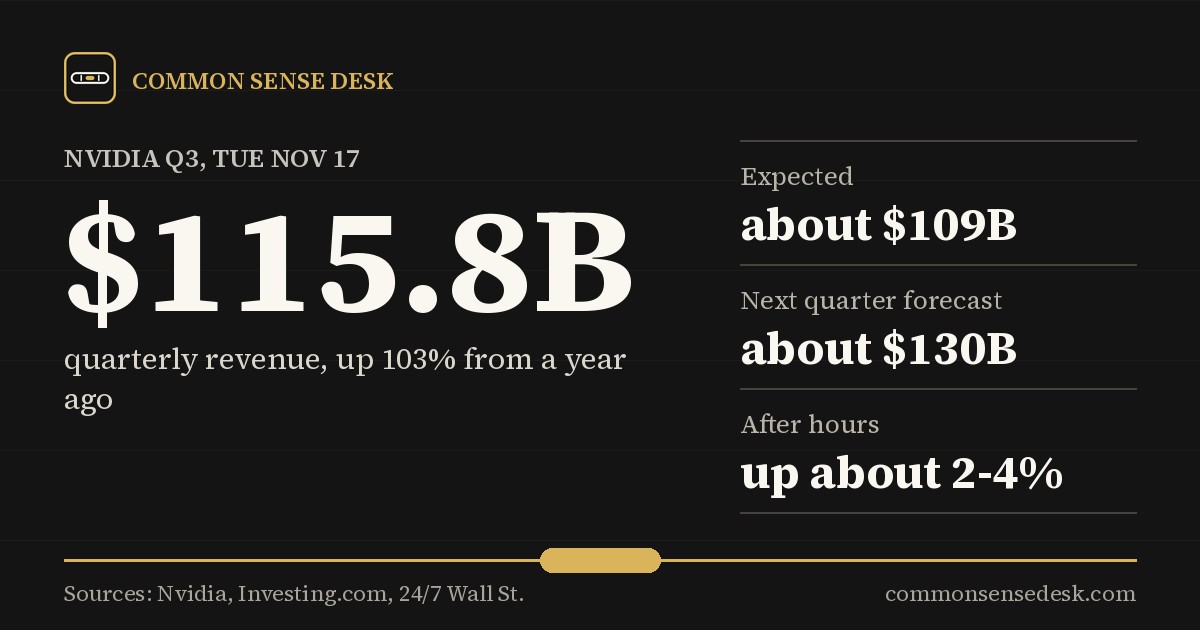
Nvidia's first earnings report without Jensen Huang in charge came in well ahead of what Wall Street expected. The chipmaker said Tuesday, November 17, that revenue more than doubled from a year ago to $115.8 billion, and it forecast even more next quarter. The shares rose in after-hours trading.
Nvidia is one of the biggest companies in the stock market, so this report matters to most people with a 401(k). Here's what it said and what it means for your money.
The numbers
For the quarter that ended October 25, according to Nvidia's release:
- Revenue: $115.8 billion, up 103% from a year ago and 20% from the quarter before. Analysts expected about $109 billion, according to Investing.com and other data providers. Nvidia's own forecast had been $108 billion.
- Data centers (the AI chips that power services like chatbots): $107.6 billion, up 110%.
- Adjusted earnings: $2.68 a share, compared with about $2.47 to $2.48 expected.
- Profit margin: about 75 cents of gross profit on every dollar of sales.
Where the money came from
Almost all of the growth came from AI data centers. Within that business, sales to the giant cloud companies, like the ones that run big online services, came to $60.1 billion, up 71%. Sales to newer AI cloud providers, factories and other businesses came to $47.5 billion, nearly triple a year ago, according to the release.
Nvidia's smaller business, which it calls edge computing and which includes chips for gaming PCs, cars and robots, brought in $8.2 billion, up 42%. Customers based in China, including Hong Kong, accounted for about $11.1 billion of sales. The company also generated $48.3 billion in cash from its operations during the quarter.
The outlook
Nvidia expects about $130 billion in revenue next quarter, give or take 3%. Analysts had expected about $125 billion. The quarter includes an extra week, and the forecast assumes no data center chip sales to China.
Interim CEO Colette Kress sounded confident. "Our momentum is real," she said in the release, adding that Nvidia's new Vera Rubin chips are "off to an explosive start."
The company also added $150 billion to its stock buyback plan. It returned $28.1 billion to shareholders last quarter through buybacks and dividends. The quarterly dividend stays at a small 25 cents a share, paid December 23.
How the stock reacted
Nvidia's shares rose about 2% to 4% in after-hours trading, according to several reports. 24/7 Wall St. put them at $159.08 shortly after the release, up 2.3% from Tuesday's close of $155.46. That's a calm reaction compared with the bigger swing options traders had been bracing for.
After-hours prices can change a lot by the next morning, so Wednesday's open will tell more.
The Huang question
This was Nvidia's first report since Huang resigned on November 12, as we covered in our story on his resignation. Earlier Tuesday, he said he'd be "honored" to come back if the board asks, which we covered here.
Nvidia's release doesn't mention Huang by name. It refers to the CEO transition and the board's search for a new chief executive, with Kress serving as interim CEO and finance chief. On the earnings call, board chair Harvey Jones said the board does not intend to reinstate Huang (see the update at the top).
What it means for your 401(k)
- Most 401(k)s own Nvidia. It's one of the largest companies in the S&P 500, and the index is weighted by size, so a strong report helps most stock funds a bit.
- The AI boom isn't over, at least not yet. AI stocks have slid this month on worries about a bubble. Nvidia's numbers show companies are still spending heavily on AI chips. That's good news for tech-heavy funds in the short run.
- Don't chase it. One good night doesn't change long-term risk. Nvidia has swung hard this month, losing about $450 billion in market value after the Huang news before Tuesday's report. If Nvidia or tech funds are a big part of your savings, a diversified mix is still the safer path. The Little Book of Common Sense Investing explains why in plain words.
- China is a wild card. Nvidia's forecast assumes no data center chip sales to China. Any change in U.S. export rules could move the stock either way.
What to watch next
- Comments on the earnings call about Huang and the CEO search.
- How the stock and the wider market open on Wednesday.
- The board's decision on a permanent CEO, and Huang's House interview on December 1.
Sources
- CNBC: Nvidia chair Harvey Jones says board doesn't intend to reinstate Huang as CEO (live updates, Nov. 17, 2026) cnbc.com
- NBC News: Live updates on Nvidia's first earnings call after Huang's exit nbcnews.com
- NVIDIA: Financial results for third quarter fiscal 2027 (Nov. 17, 2026) nvidianews.nvidia.com
- NVIDIA SEC Form 8-K, Q3 fiscal 2027 press release sec.gov
- Investing.com: Nvidia stock rises after hours as quarterly results, guidance beat estimates investing.com
- 24/7 Wall St.: Nvidia's first report without Jensen Huang 247wallst.com