

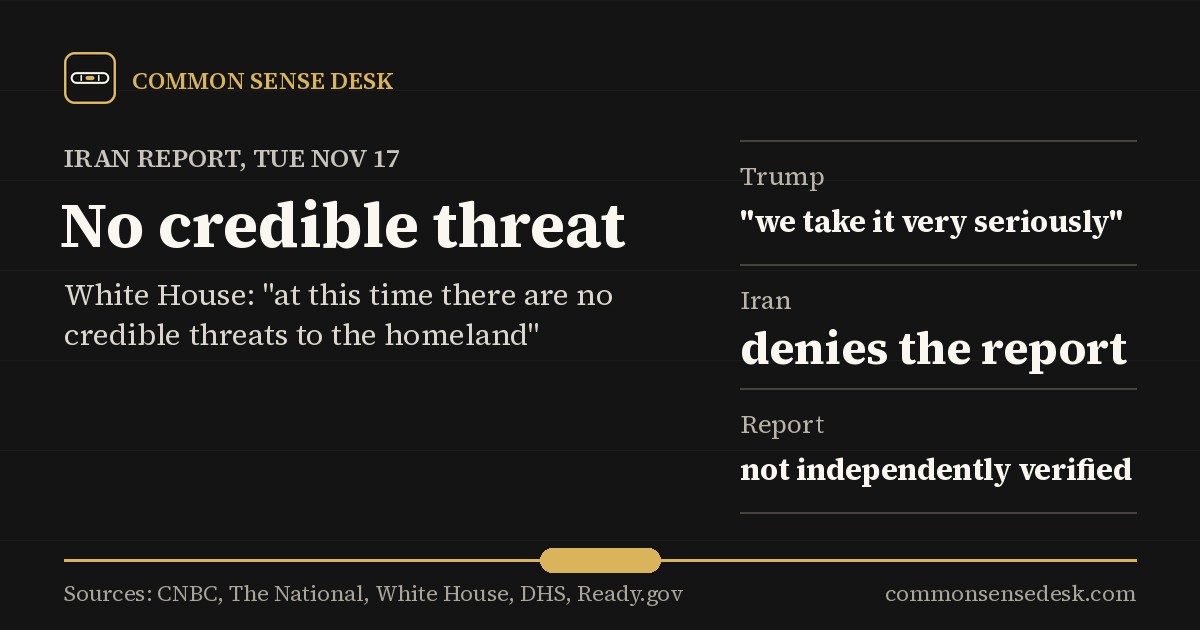
President Trump says the United States is taking seriously a reported Iranian plan to set off a "dirty bomb" in Washington, and warned that Iran would "pay a price the likes of which no country has ever paid before" if it tried. The White House also says there are no credible threats to the homeland right now. Iran denies the report.
That's a lot of mixed signals. Here's what's actually on the record, what's only reported, and what people in Washington should know.
What Trump said
Trump was asked about the report on Tuesday, November 17, at the Southeast Asian leaders' summit in Manila, in the Philippines, according to CNBC. Asked whether there's an imminent threat to Washington, he said:
- "Well, if there is, they will pay a price the likes of which no country has ever paid before."
- "I hope it's not, but we take it very seriously, because they happen to be crazy."
- "This is why they can't have a nuclear weapon, by the way, in case people had any questions."
He also said he'd press Russian President Vladimir Putin and Chinese President Xi Jinping to help end the Iran war when he meets them in Shenzhen on Thursday, and said the war is "very close to getting it done," according to The National.
What's reported, and what isn't confirmed
The report came from a U.S. news outlet late Monday, citing U.S. officials who described new intelligence about Iranian plans for a possible dirty bomb in Washington. A dirty bomb is a regular explosive packed with radioactive material. It's not a nuclear bomb: the main danger is the blast itself, plus radioactive dust spread over a small area.
Several things are not confirmed:
- CNBC said it has not independently verified the report.
- Officials have debated whether Iran would actually try such an attack in the U.S., and whether it could, according to CNBC's account of the reporting.
- Coverage describes the intelligence as giving Iran options, not as an attack that's about to happen.
What officials say
The White House: Spokeswoman Lauren Bis said the U.S. is "monitoring any and all potential threats, but at this time there are no credible threats to the homeland."
Homeland Security: Secretary Markwayne Mullin told CNBC the plot was not new and called Iran's threats "aspirational." He said "the homeland is secure," while noting his department deals with new threats every day. He warned any Iranian attack would "cause an all-out war."
Iran: A Foreign Ministry spokesman denied the report and called it part of a U.S. campaign to prepare the media for Washington's own plans, according to The National. Foreign Minister Abbas Araghchi was in Oman for talks on Tuesday, and Iran said it remains committed to diplomacy to end the conflict.
We found no new public security alerts for Washington as of Tuesday afternoon.
The backdrop
The U.S. and Iran have been at war since late February, and the U.S. has reimposed a naval blockade. Tension has been rising again in the Gulf. Iran has claimed strikes on a U.S. radar in Bahrain; U.S. Central Command says the drones were intercepted and nothing was damaged, as we covered in our Bahrain story. A third U.S. aircraft carrier has also arrived in the region, which we covered in our carrier story. On Tuesday, a tanker was hit twice off Oman in the Strait of Hormuz; its crew was rescued.
What it means for you
If you live in or are visiting Washington, officials have not asked anyone to change their plans. The White House says there's no credible threat right now. It's still worth knowing the official advice for any radiation emergency, from the government's Ready.gov site. It's simple: get inside, stay inside, stay tuned.
- Get inside the nearest building, away from windows. Basements and the middle of large brick or concrete buildings are best.
- Stay inside for at least 24 hours unless officials say otherwise, or there's a fire or other immediate danger. Turn off fans and air systems that pull in outside air.
- Stay tuned to local officials on TV, radio or your phone, and follow their instructions.
- If you were outside, carefully take off your outer layer of clothing, which removes most of the dust, then wash with soap and water. Hand sanitizer doesn't remove radioactive material.
For everyone else, the bigger day-to-day effect of the Iran war is still at the gas pump and in shipping costs. Gas has come down from its September peak but remains high for November.
What to watch next
- Any official update from Homeland Security or the FBI.
- Trump's meeting with Xi and Putin in Shenzhen on Thursday.
- Talks in Oman, and whether the fighting in the Gulf calms down or picks up.
Sources
- CNBC: Trump says Iran would pay a price over reported dirty bomb plot (Nov. 17, 2026) cnbc.com
- The National: Iran will 'pay a price' if dirty bomb is detonated in US (Nov. 17, 2026) thenationalnews.com
- Ready.gov: Radiation emergencies ready.gov