

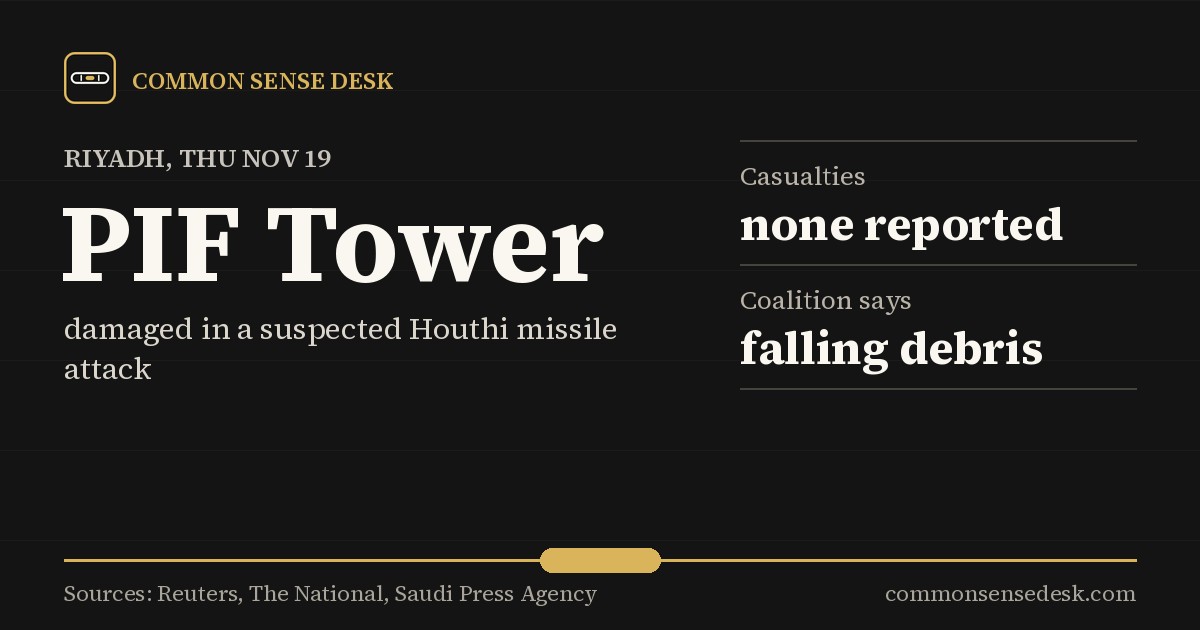
The headquarters tower of Saudi Arabia's sovereign wealth fund, the Public Investment Fund, was damaged before dawn on Thursday, November 19, in what appears to have been a missile attack from Yemen. Reuters reported the damage, citing three sources, and said it was a suspected missile launched by the Iran-backed Houthi movement. The Houthis later claimed cruise missile strikes on Riyadh's airport and financial district, though their statement didn't name the tower.
No casualties had been reported.
What happened
Saudi Civil Defence sent a mobile alert about a possible aerial threat over Riyadh before dawn. A loud explosion followed shortly after, and then an all-clear, according to The National, a newspaper based in Abu Dhabi. One resident told the paper they were woken by the blast at about 4:45 a.m. local time and called it "the loudest explosion I have heard since arriving in Riyadh in September."
The PIF Tower stands in the King Abdullah Financial District and is one of the tallest buildings in the city. Reuters' sources said the outside of the building and its windows were damaged across seven or eight floors.
The Saudi-led coalition fighting the Houthis in Yemen said it "dealt with" a missile threat launched toward Riyadh. Its first assessment was that falling debris caused material damage. Coalition spokesman Maj. Gen. Turki al-Malki said on X that the damage was still being assessed. He didn't say whether the missile was shot down, so it isn't clear yet whether the tower was hit directly or by pieces of an intercepted missile.
The coalition also said it intercepted a cruise missile aimed at southern Saudi Arabia, destroyed four ballistic missiles fired toward the south, and destroyed a missile launch platform in Yemen's Saada province.
What the Houthis say
Houthi military spokesman Yahya Saree said on X that the group fired "a large number" of cruise missiles at Riyadh's King Khalid International Airport and the financial district, according to China's Xinhua news agency and Middle East Eye. He called it retaliation for Saudi strikes in Yemen, and Russia's TASS quoted him as claiming "accurate and direct hits." Saree's statement didn't name the PIF Tower, and its timing doesn't line up neatly with the pre-dawn blast, so it isn't clear whether he was describing this attack or an earlier wave. These are the group's claims and haven't been independently confirmed. Saudi officials hadn't responded to them directly.
Saudi response
Saudi aircraft carried out airstrikes on Sanaa, the Houthi-held capital of Yemen, according to the Houthi-run Saba news agency, which gave no details.
On the same day, Crown Prince Mohammed bin Salman met the head of U.S. Central Command, Adm. Brad Cooper, in Riyadh, the official Saudi Press Agency reported. Defense Minister Prince Khalid bin Salman also held talks with Cooper. Neither side released details on the attack.
Part of a pattern this month
This is the second attack on a major business building in Riyadh this month. On November 8, a building belonging to the state oil company Aramco was damaged in what Saudi officials called an attempted attack.
On Wednesday, the Houthis said they attacked pumping stations on Saudi Arabia's East-West oil pipeline with drones, which we covered in our story on the pipeline claim. That pipeline matters because it lets Saudi oil reach the Red Sea without passing through the Strait of Hormuz.
The Houthis have also stepped up attacks on Saudi airports, ports and oil sites in recent weeks. Riyadh's King Khalid International Airport was hit earlier in the fall and is still not fully back to normal, according to The National. In Yemen itself, government-aligned forces said on Sunday they were pulling back from an area overlooking the Bab el-Mandeb strait at the southern end of the Red Sea.
Iran's claim in Hormuz
Also on Thursday, the naval arm of Iran's Islamic Revolutionary Guard Corps said two supertankers carrying a combined 4 million barrels of crude hit naval mines and exploded while using what it called a "restricted route" through the Strait of Hormuz. That is Iran's claim. As of Thursday morning, no shipowner, flag country, the UK Maritime Trade Operations center (UKMTO) or U.S. Central Command had confirmed that any ship hit a mine, and the tankers weren't named. Iran made similar claims on Monday and Wednesday. UKMTO has confirmed several tankers struck by projectiles in and around the strait this month but hasn't linked them to mines. Our earlier Hormuz story has the background.
Why it matters
The PIF is the engine of Saudi Arabia's plan to build an economy beyond oil. It manages hundreds of billions of dollars and has stakes in companies around the world, including in the United States. A hit on its headquarters, even one that caused no casualties, is a sign of how far the conflict now reaches into Saudi cities.
For the rest of us, the concern is energy. Saudi Arabia is one of the world's largest oil exporters. Attacks on its pipelines and cities, together with trouble in the Strait of Hormuz, are the kind of news that can push oil prices up quickly. As of Thursday morning there was no sign of damage to Saudi oil production from this attack.
What to watch
The key things now are whether the Houthis say specifically that they targeted the tower, what the Saudi damage assessment finds, and whether Saudi Arabia expands its strikes in Yemen. Any independent confirmation of Iran's mine claims in Hormuz would matter for shipping and fuel prices.
Sources
- Reuters (via The National): Saudi PIF tower in Riyadh damaged by Houthi strike (Nov. 19, 2026) thenationalnews.com
- Middle East Eye: Houthis say they targeted King Khalid Airport and financial centre in Riyadh (Nov. 2026) middleeasteye.net
- Xinhua (via China Daily): Yemen's Houthis claim strikes on Riyadh airport, financial center (Nov. 19, 2026) chinadaily.com.cn
- Iran International: Iran's Guards say two supertankers hit mines in Strait of Hormuz (Nov. 19, 2026) iranintl.com